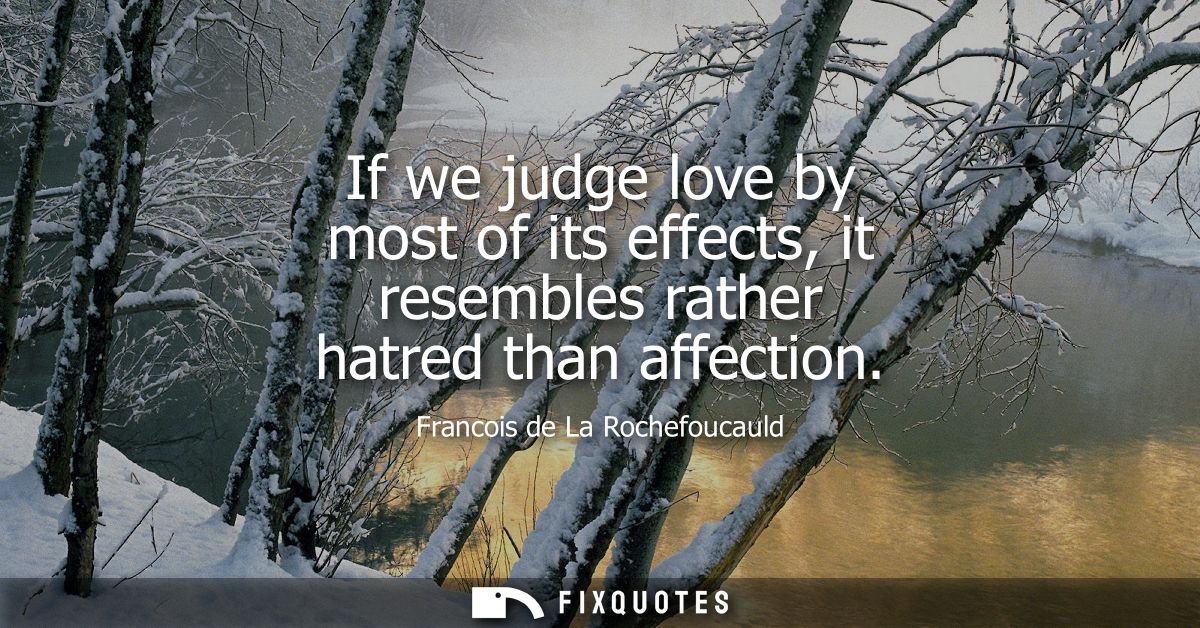
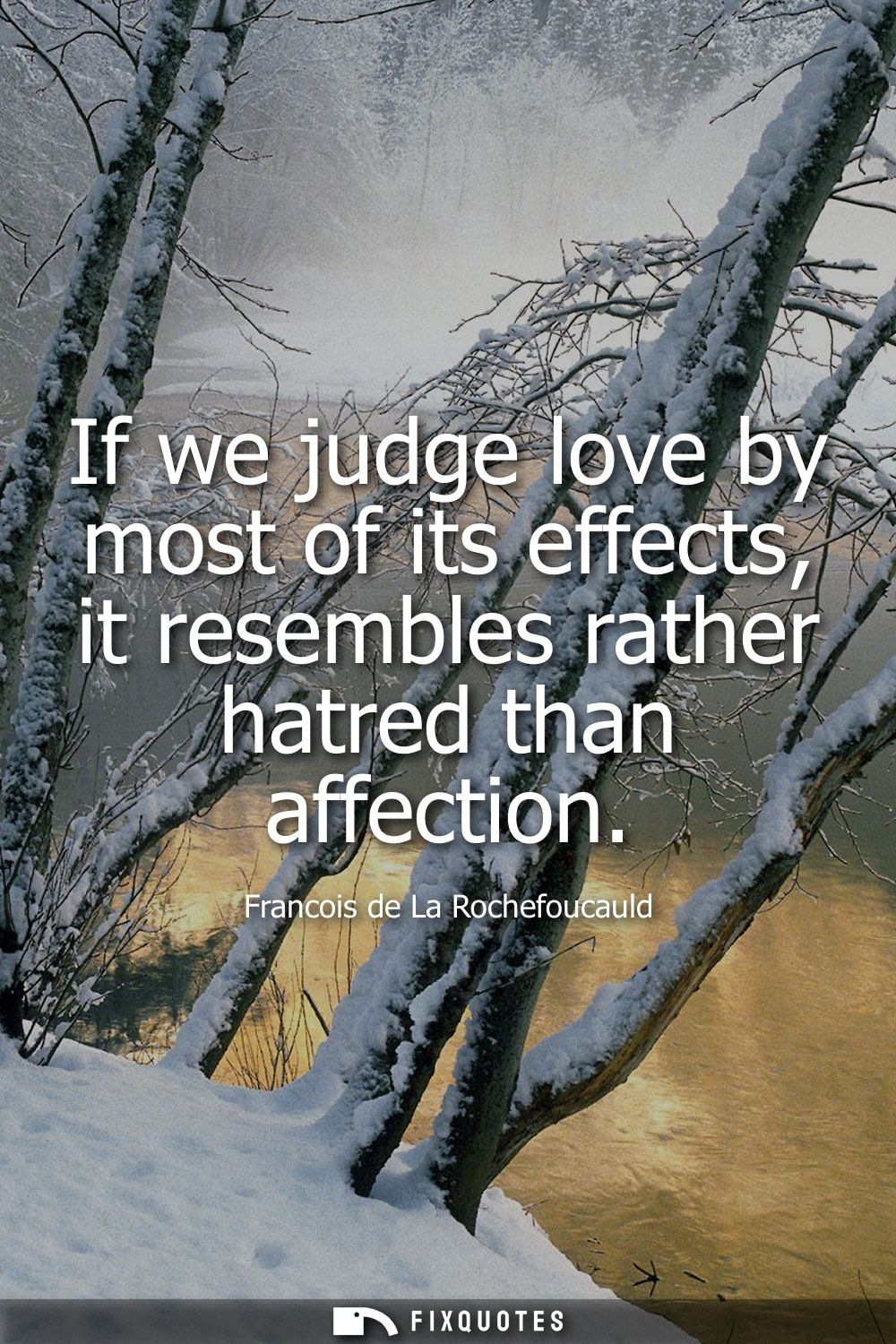
"If we judge love by most of its effects, it resembles rather hatred than affection"
About this Quote
La Rochefoucauld, the 17th-century French moralist whose Maxims pierce illusions of virtue, turns the lens from intentions to consequences. When love is measured by what it provokes rather than by the ideals we attach to it, the pattern that emerges is unsettling: jealousy, possessiveness, rivalry, suspicion, and a willingness to wound the very person one professes to cherish. The portrait is not a denial of tenderness but a critique of the way passion, fueled by self-love, slides into hostility.
At the heart of his psychology lies amour-propre, the self-regard that bends even noble feelings toward our own advantage. We love what reflects us well; the beloved becomes a mirror for our vanity and security. When that mirror cracks through rejection, indifference, or competition, the same energy that drew us near becomes aggression. The boundary-making force of attachment also sharpens animosity toward rivals, creating a logic of exclusion that mimics hatred’s effects. In courts and salons where reputation was currency and desire a strategic game, La Rochefoucauld watched affection erupt into feuds, betrayals, and cold calculations disguised as devotion.
The aphorism’s force lies in its empirical thrust. He asks us to look at the trail love leaves: sleeplessness, surveillance, tests, petty cruelties, and dramatic ruptures that resemble warfare more than mutual care. Modern psychology echoes his suspicion: the neurobiology of attachment couples reward with threat detection; heartbreak registers like pain; jealousy readily ignites anger. The difference between loving and hating, he suggests, is often a thin membrane stretched over wounded pride.
Yet the provocation invites discernment, not despair. If the effects of love veer toward hatred when self-love dominates, then the task is to disentangle devotion from vanity, care from control. By exposing how easily passion becomes predation, he urges a humbler, more vigilant affection that judges itself by what it makes us do.
At the heart of his psychology lies amour-propre, the self-regard that bends even noble feelings toward our own advantage. We love what reflects us well; the beloved becomes a mirror for our vanity and security. When that mirror cracks through rejection, indifference, or competition, the same energy that drew us near becomes aggression. The boundary-making force of attachment also sharpens animosity toward rivals, creating a logic of exclusion that mimics hatred’s effects. In courts and salons where reputation was currency and desire a strategic game, La Rochefoucauld watched affection erupt into feuds, betrayals, and cold calculations disguised as devotion.
The aphorism’s force lies in its empirical thrust. He asks us to look at the trail love leaves: sleeplessness, surveillance, tests, petty cruelties, and dramatic ruptures that resemble warfare more than mutual care. Modern psychology echoes his suspicion: the neurobiology of attachment couples reward with threat detection; heartbreak registers like pain; jealousy readily ignites anger. The difference between loving and hating, he suggests, is often a thin membrane stretched over wounded pride.
Yet the provocation invites discernment, not despair. If the effects of love veer toward hatred when self-love dominates, then the task is to disentangle devotion from vanity, care from control. By exposing how easily passion becomes predation, he urges a humbler, more vigilant affection that judges itself by what it makes us do.
Quote Details
| Topic | Love |
|---|
More Quotes by Francois
Add to List