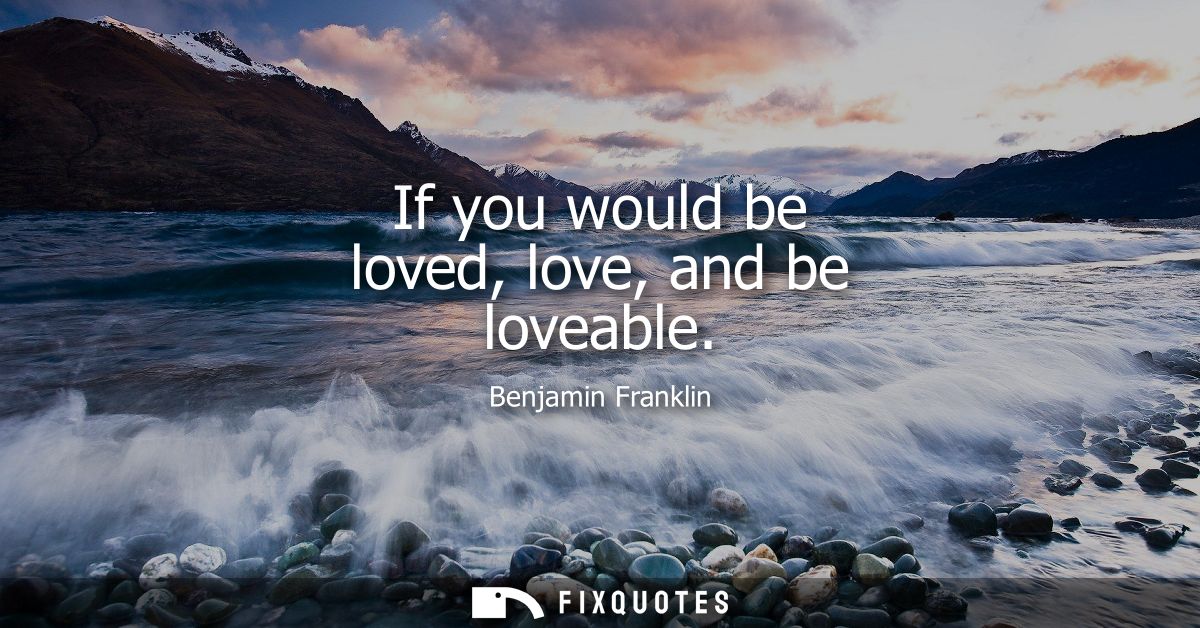
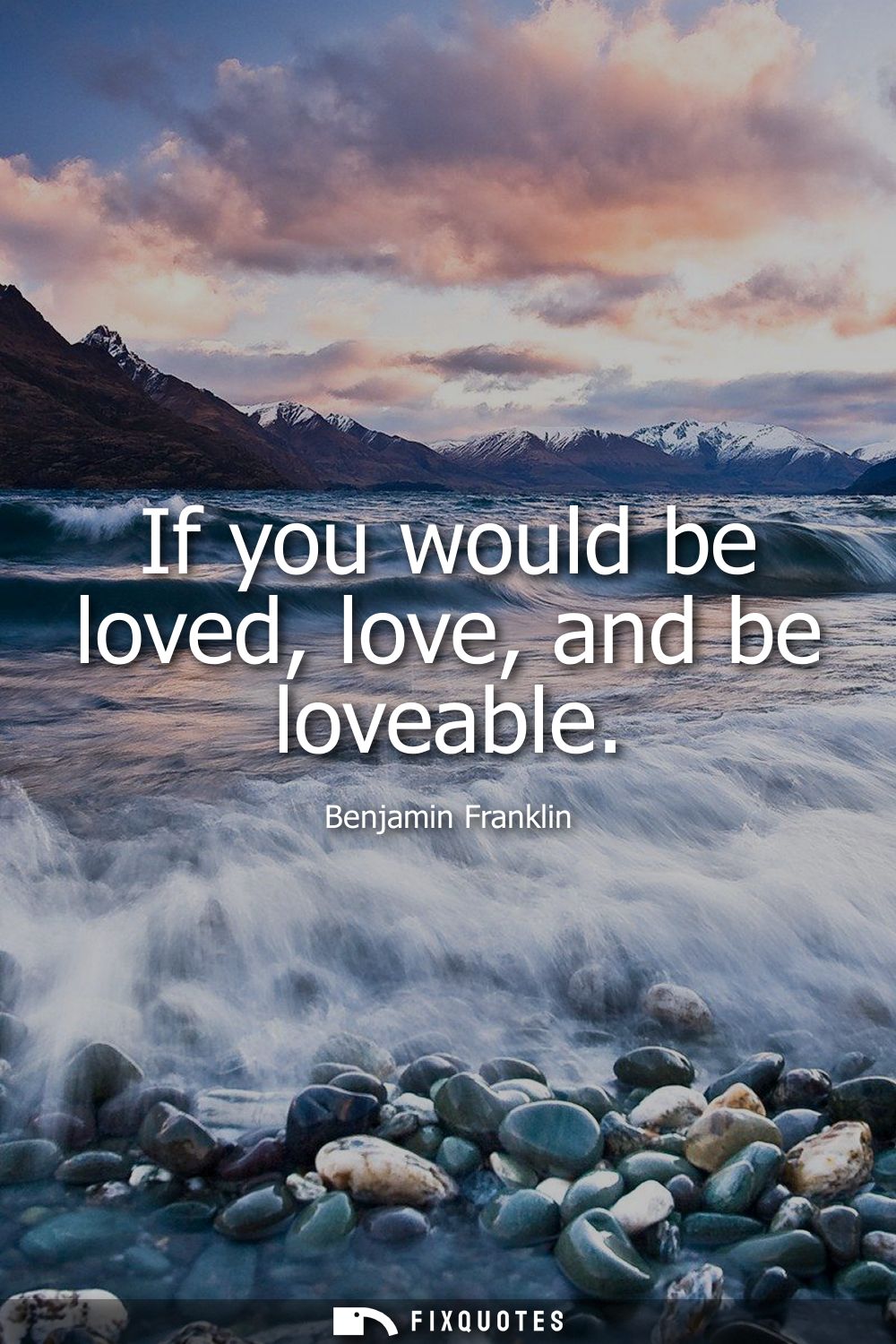
"If you would be loved, love, and be loveable"
About this Quote
Franklin offers affection not as fate but as engineering: a three-part recipe that turns “being loved” from a wish into a civic project. The line’s brilliance is its brisk conditional. “If you would” sounds politely old-fashioned, but it’s also a contract. Love isn’t owed to you; it’s something you can invite by changing your inputs.
The first move, “love,” is action-oriented, almost entrepreneurial. Franklin’s world rewarded initiative and distrusted entitlement, and he smuggles that ethic into the emotional realm. The subtext is mildly corrective: people who complain about being unloved often haven’t done the relational labor. He’s not romanticizing love; he’s reclassifying it as a practice.
Then he tightens the screw with “be loveable,” which can read like self-help before self-help existed. Underneath the charm is Franklin’s moral accounting: character is social currency. “Loveable” doesn’t mean performative niceness; in an 18th-century public sphere of salons, pamphlets, and fragile alliances, it means reliability, restraint, humor, generosity - the traits that make cooperation possible. As a politician and diplomat, Franklin understood that people “love” what makes their lives easier, safer, brighter.
The line also contains a quiet democratic sting. You can’t control others’ feelings, but you can control your conduct. Franklin reframes love as a feedback loop between self-improvement and community approval, a small Enlightenment manifesto disguised as dating advice.
The first move, “love,” is action-oriented, almost entrepreneurial. Franklin’s world rewarded initiative and distrusted entitlement, and he smuggles that ethic into the emotional realm. The subtext is mildly corrective: people who complain about being unloved often haven’t done the relational labor. He’s not romanticizing love; he’s reclassifying it as a practice.
Then he tightens the screw with “be loveable,” which can read like self-help before self-help existed. Underneath the charm is Franklin’s moral accounting: character is social currency. “Loveable” doesn’t mean performative niceness; in an 18th-century public sphere of salons, pamphlets, and fragile alliances, it means reliability, restraint, humor, generosity - the traits that make cooperation possible. As a politician and diplomat, Franklin understood that people “love” what makes their lives easier, safer, brighter.
The line also contains a quiet democratic sting. You can’t control others’ feelings, but you can control your conduct. Franklin reframes love as a feedback loop between self-improvement and community approval, a small Enlightenment manifesto disguised as dating advice.
Quote Details
| Topic | Love |
|---|---|
| Source | Help us find the source |
| Cite |
Citation Formats
APA Style (7th ed.)
Franklin, Benjamin. (2026, January 14). If you would be loved, love, and be loveable. FixQuotes. https://fixquotes.com/quotes/if-you-would-be-loved-love-and-be-loveable-25507/
Chicago Style
Franklin, Benjamin. "If you would be loved, love, and be loveable." FixQuotes. January 14, 2026. https://fixquotes.com/quotes/if-you-would-be-loved-love-and-be-loveable-25507/.
MLA Style (9th ed.)
"If you would be loved, love, and be loveable." FixQuotes, 14 Jan. 2026, https://fixquotes.com/quotes/if-you-would-be-loved-love-and-be-loveable-25507/. Accessed 12 Feb. 2026.
More Quotes by Benjamin
Add to List