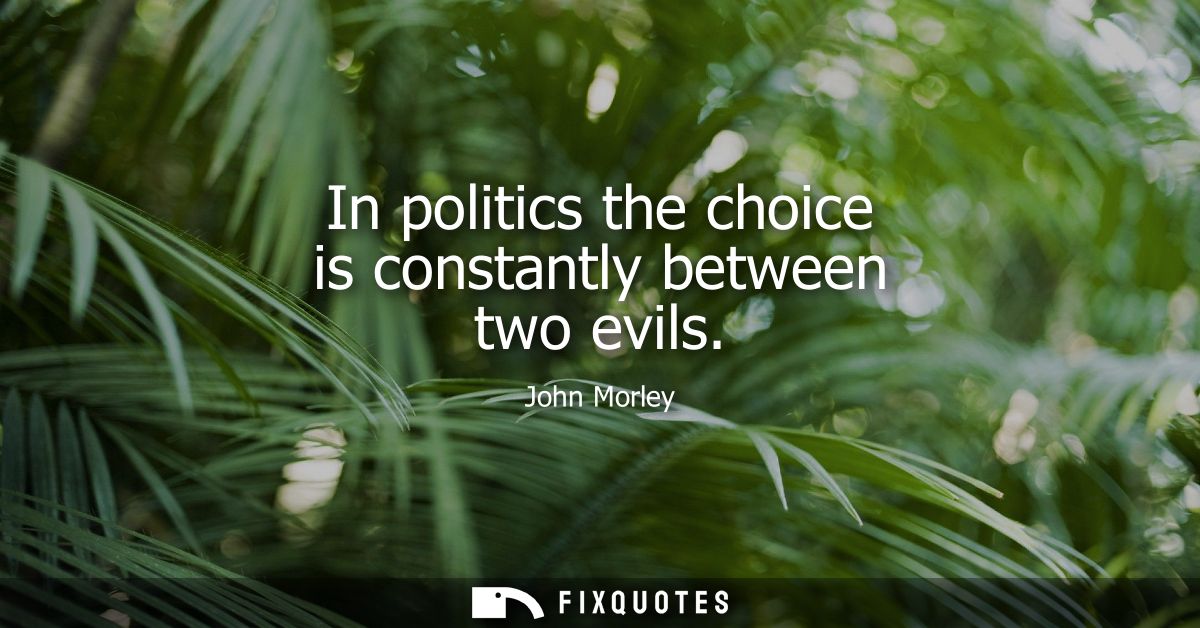
"In politics the choice is constantly between two evils"
About this Quote
Morley’s line lands like a sigh that’s been sharpened into doctrine: politics isn’t a march toward the good, it’s a series of constrained bargains where “purity” is mostly a luxury. As a statesman and liberal thinker watching late-19th-century Britain grind through empire, Ireland, class conflict, and party discipline, Morley is stripping away the comforting fiction that elections deliver moral clarity. The rhetorical power comes from the word “constantly.” This isn’t a momentary crisis or a cynical hot take about one bad ballot; it’s an operating condition. Government, in Morley’s view, is a machine built from trade-offs, and every lever you pull pinches someone’s fingers.
The phrase “two evils” also quietly implies a limited menu. Politics offers binaries not because reality is binary, but because institutions compress complexity into choices you can count: yes/no votes, two-party contests, cabinet solidarity, whip systems. Morley is diagnosing structural coercion, not just voter pessimism. You may see more than two options; the system will still funnel you into a decision that feels like complicity.
The subtext is a warning against moral maximalism. If you demand an untainted option, you don’t exit the game; you cede it to people comfortable with worse. Yet Morley isn’t celebrating compromise as virtue. He’s insisting on adult ethics: choose the lesser harm, then own the responsibility for what you endorsed. It’s a sober liberalism that treats power as dangerous even when it’s necessary, and treats politics as the art of minimizing damage without pretending that damage can be eliminated.
The phrase “two evils” also quietly implies a limited menu. Politics offers binaries not because reality is binary, but because institutions compress complexity into choices you can count: yes/no votes, two-party contests, cabinet solidarity, whip systems. Morley is diagnosing structural coercion, not just voter pessimism. You may see more than two options; the system will still funnel you into a decision that feels like complicity.
The subtext is a warning against moral maximalism. If you demand an untainted option, you don’t exit the game; you cede it to people comfortable with worse. Yet Morley isn’t celebrating compromise as virtue. He’s insisting on adult ethics: choose the lesser harm, then own the responsibility for what you endorsed. It’s a sober liberalism that treats power as dangerous even when it’s necessary, and treats politics as the art of minimizing damage without pretending that damage can be eliminated.
Quote Details
| Topic | Decision-Making |
|---|
More Quotes by John
Add to List