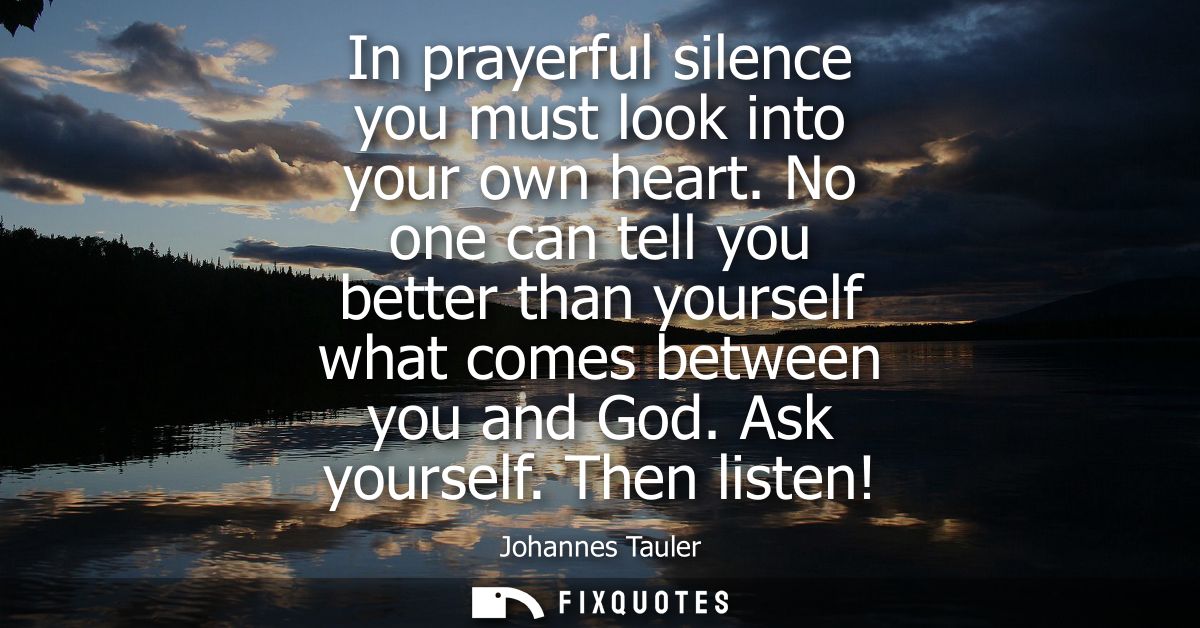
"In prayerful silence you must look into your own heart. No one can tell you better than yourself what comes between you and God. Ask yourself. Then listen!"
About this Quote
Tauler doesn’t offer comfort so much as a method: stop outsourcing your conscience. The line is structured like a spiritual drill-sergeant’s cadence - look, ask, listen - and each verb tightens the circle until the only authority left is the self under God’s gaze. “Prayerful silence” is doing double duty here. It isn’t mere calm; it’s a technology of attention, a way to strip away the noise of excuses, social performance, even theological chatter. Tauler is telling you that the obstacle isn’t primarily intellectual error but interference: whatever “comes between” you and God is already lodged in your habits, resentments, attachments, self-deceptions.
The subtext is quietly radical for a medieval theologian. In an age of elaborate religious systems, clerical mediation, and public piety, he makes the decisive battleground interior. “No one can tell you better than yourself” doesn’t deny teachers or tradition; it reorders them. External guidance can point, but it can’t substitute for the moment of honest self-recognition - the kind that feels less like being informed and more like being exposed.
Context matters: Tauler, a 14th-century Dominican linked to the Rhineland mystical tradition, wrote amid social upheaval and spiritual anxiety (plague-era Europe, institutional distrust, reformist currents). His emphasis on inward listening reads like a response to both the church’s verbosity and the world’s instability: when everything external is compromised or chaotic, the most reliable diagnostic tool is the uncomfortable clarity that arrives when you finally shut up long enough to hear yourself.
The subtext is quietly radical for a medieval theologian. In an age of elaborate religious systems, clerical mediation, and public piety, he makes the decisive battleground interior. “No one can tell you better than yourself” doesn’t deny teachers or tradition; it reorders them. External guidance can point, but it can’t substitute for the moment of honest self-recognition - the kind that feels less like being informed and more like being exposed.
Context matters: Tauler, a 14th-century Dominican linked to the Rhineland mystical tradition, wrote amid social upheaval and spiritual anxiety (plague-era Europe, institutional distrust, reformist currents). His emphasis on inward listening reads like a response to both the church’s verbosity and the world’s instability: when everything external is compromised or chaotic, the most reliable diagnostic tool is the uncomfortable clarity that arrives when you finally shut up long enough to hear yourself.
Quote Details
| Topic | Prayer |
|---|
More Quotes by Johannes
Add to List