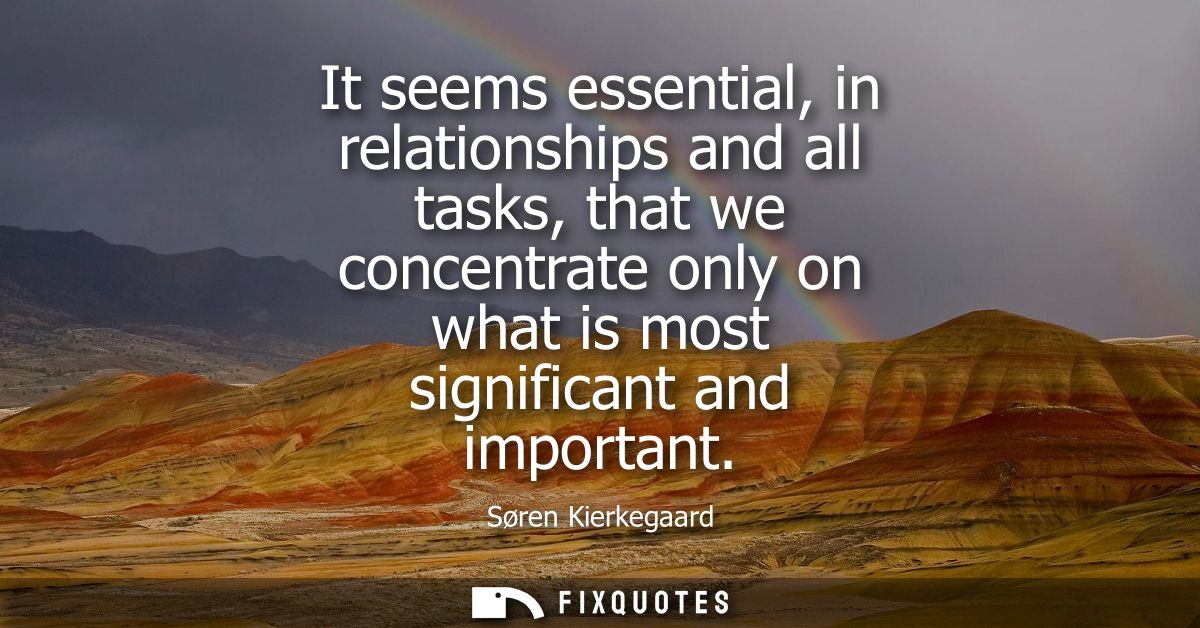
"It seems essential, in relationships and all tasks, that we concentrate only on what is most significant and important"
About this Quote
Kierkegaard’s line has the clipped severity of someone who thinks most of what we call “living” is sophisticated evasion. “It seems essential” is a polite throat-clear before a demand: stop dispersing yourself. The phrasing matters. He pairs “relationships” with “all tasks,” refusing the modern split between the tender private self and the productive public one. For Kierkegaard, the same disease infects both: distraction masquerading as breadth, busyness as virtue, social performance as intimacy.
The subtext is less self-help than spiritual triage. Kierkegaard wrote against a 19th-century Danish culture he saw as comfortably Christian in name, anesthetized by respectability, and addicted to “the public” as a way to avoid personal accountability. “Concentrate only” is not efficiency talk; it’s an existential injunction. The important thing is not whatever your calendar screams loudest, but the commitment that requires you to choose and, crucially, to forgo. His ethics run on sacrifice: to love is to will one thing for another; to act authentically is to accept the narrowing of options that choice entails.
What makes the sentence work is its quiet pressure. It doesn’t romanticize focus; it frames it as necessary, almost medical. In Kierkegaard’s universe, scattering attention isn’t just unproductive, it’s a way of dodging the self and, by extension, dodging God. The line sounds calm because it’s aimed at panic: the panic of infinite possibilities, infinite opinions, infinite little duties. “Most significant and important” is his antidote to a life spent skimming.
The subtext is less self-help than spiritual triage. Kierkegaard wrote against a 19th-century Danish culture he saw as comfortably Christian in name, anesthetized by respectability, and addicted to “the public” as a way to avoid personal accountability. “Concentrate only” is not efficiency talk; it’s an existential injunction. The important thing is not whatever your calendar screams loudest, but the commitment that requires you to choose and, crucially, to forgo. His ethics run on sacrifice: to love is to will one thing for another; to act authentically is to accept the narrowing of options that choice entails.
What makes the sentence work is its quiet pressure. It doesn’t romanticize focus; it frames it as necessary, almost medical. In Kierkegaard’s universe, scattering attention isn’t just unproductive, it’s a way of dodging the self and, by extension, dodging God. The line sounds calm because it’s aimed at panic: the panic of infinite possibilities, infinite opinions, infinite little duties. “Most significant and important” is his antidote to a life spent skimming.
Quote Details
| Topic | Wisdom |
|---|
More Quotes by Søren
Add to List