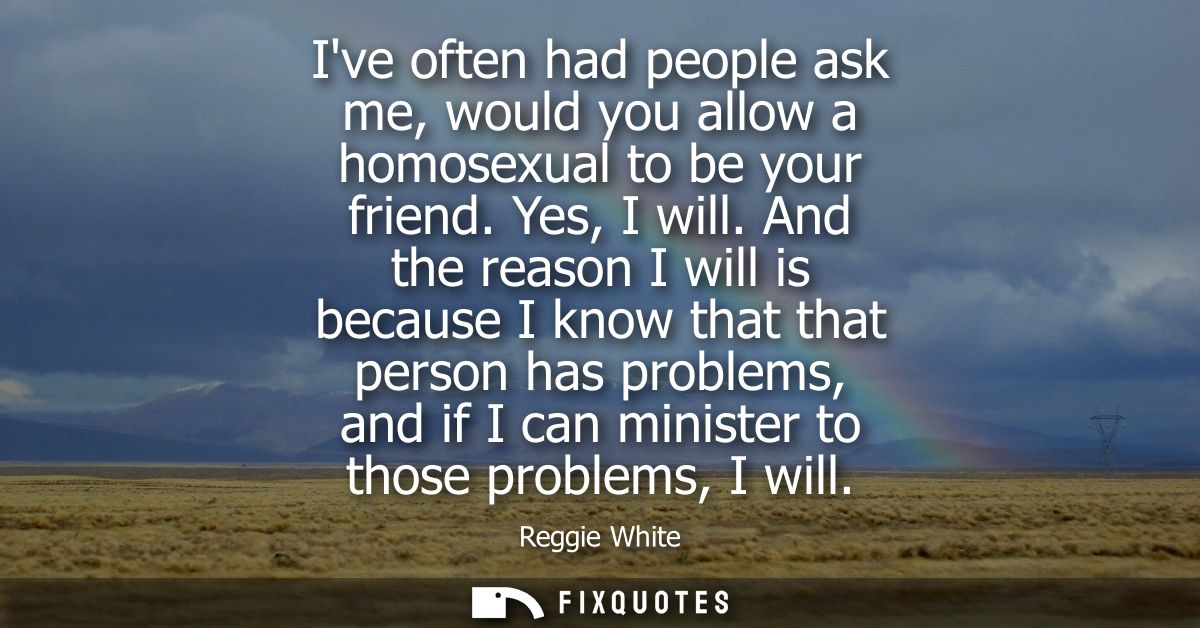
"I've often had people ask me, would you allow a homosexual to be your friend. Yes, I will. And the reason I will is because I know that that person has problems, and if I can minister to those problems, I will"
About this Quote
The line reveals a posture of conditional friendship: acceptance offered not as mutual regard but as a chance to fix what he sees as broken. The cadence moves from a surface yes to a because that reframes the relationship as ministry. Homosexuality becomes a problem to be addressed rather than an identity to be respected, and friendship is cast as a tool for cure rather than a space for equality.
As a Hall of Fame defensive end nicknamed the Minister of Defense and an ordained evangelical pastor, Reggie White often merged public faith with public stature. In the late 1990s, during heated national debates over sexuality, he spoke frequently about sin, redemption, and social order. His language here echoes the widely used Christian mantra of the era, hate the sin, love the sinner, which aimed to express compassion while maintaining theological boundaries. Yet the compassion is paternalistic: it presumes diagnosis and hierarchy. One person stands as healer, the other as patient.
That asymmetry matters. By defining LGBTQ people as inherently problem-laden, the statement narrows the possibilities of friendship to evangelism and denies the other person full moral agency. It also conflates intimacy with conversion, implying that proximity exists to produce change. For LGBTQ listeners, the frame is othering, even when couched in kindness; it transforms a plea for dignity into a subject for treatment.
The cultural context amplifies the impact. Professional sports then had no openly gay players, and locker room culture often relied on rigid norms of masculinity. When a figure as admired as White spoke this way, it carried the force of authority, shaping norms and signaling who belonged. The controversy that followed reflected a broader shift: many Americans were beginning to challenge pathologizing language and demand that friendship and civic life be built on equal regard, not on the promise of correction.
As a Hall of Fame defensive end nicknamed the Minister of Defense and an ordained evangelical pastor, Reggie White often merged public faith with public stature. In the late 1990s, during heated national debates over sexuality, he spoke frequently about sin, redemption, and social order. His language here echoes the widely used Christian mantra of the era, hate the sin, love the sinner, which aimed to express compassion while maintaining theological boundaries. Yet the compassion is paternalistic: it presumes diagnosis and hierarchy. One person stands as healer, the other as patient.
That asymmetry matters. By defining LGBTQ people as inherently problem-laden, the statement narrows the possibilities of friendship to evangelism and denies the other person full moral agency. It also conflates intimacy with conversion, implying that proximity exists to produce change. For LGBTQ listeners, the frame is othering, even when couched in kindness; it transforms a plea for dignity into a subject for treatment.
The cultural context amplifies the impact. Professional sports then had no openly gay players, and locker room culture often relied on rigid norms of masculinity. When a figure as admired as White spoke this way, it carried the force of authority, shaping norms and signaling who belonged. The controversy that followed reflected a broader shift: many Americans were beginning to challenge pathologizing language and demand that friendship and civic life be built on equal regard, not on the promise of correction.
Quote Details
| Topic | Friendship |
|---|
More Quotes by Reggie
Add to List