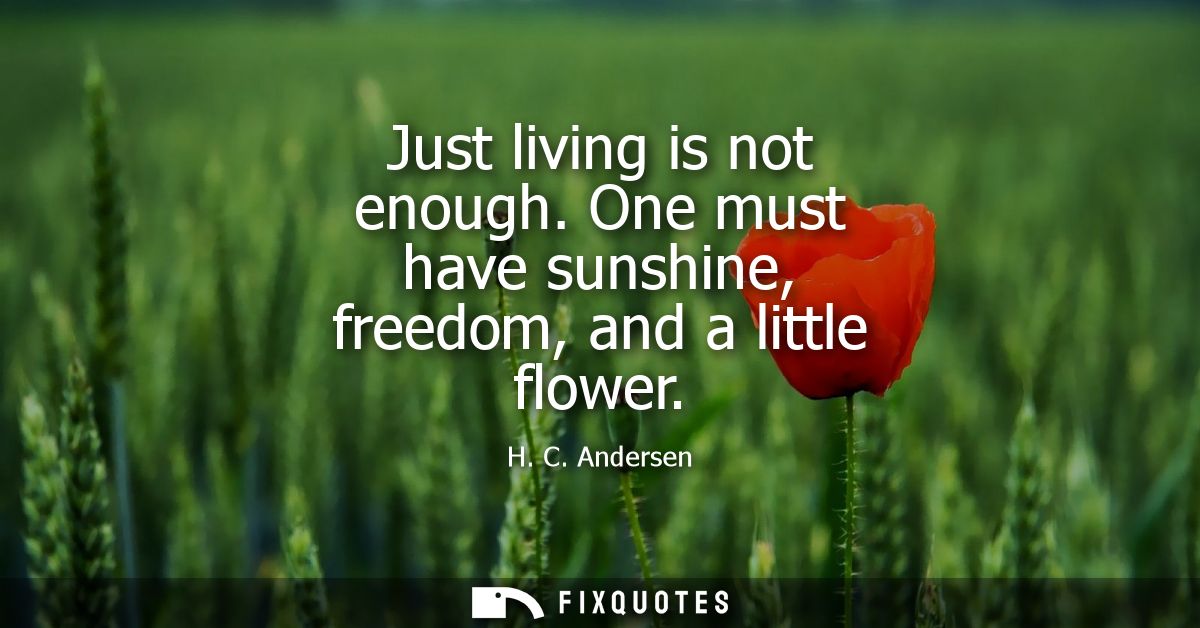
"Just living is not enough. One must have sunshine, freedom, and a little flower"
About this Quote
The subtext is a rebuke to any culture that treats people as machines for endurance. “Just living” evokes subsistence: bread, shelter, the baseline pulse of existence. Against that, “sunshine” signals warmth and visibility, a life lived in the open rather than under the lid of fear or drudgery. “Freedom” lands as the moral hinge: without agency, all the sunlight in the world becomes a spotlight in a prison yard. Then the line swerves tenderly to “a little flower,” a deliberately unheroic symbol of play, softness, and attention. Not the bouquet, not the garden, just enough beauty to prove you’re more than a body being kept alive.
Context matters: Andersen wrote from a 19th-century Europe where class constraint, nationalism, and social conformity pressed hard, and his tales often place fragile figures under harsh systems. This quote reads like a miniature manifesto for his fiction: the insistence that the most vulnerable desires - warmth, choice, a scrap of wonder - are not luxuries. They are the evidence of a life worth calling human.
Quote Details
| Topic | Meaning of Life |
|---|---|
| Source | Verified source: Sommerfuglen ("The Butterfly") (H. C. Andersen, 1860)
Evidence:
"But just to keep alive isn't enough," he said. "To live you must have sunshine and freedom and a little flower to love!" (pp. 95–97 (Folkekalender for Danmark 1861, 10. Aargang; issued Dec 1860)). PRIMARY SOURCE: This line is from Hans Christian Andersen’s fairy tale "Sommerfuglen" (English: "The Butterfly"). The Hans Christian Andersen Centre (University of Southern Denmark) register states the tale was first published in Folkekalender for Danmark, 1861 (10th year), pp. 95–97, and that this issue was released in December 1860. Later book-publication: included in "Nye Eventyr og Historier. Anden Række. Anden Samling. 1862" (published 25 Nov 1861) per the same register entry. IMPORTANT: The popular quotation is usually a shortened/paraphrased version (often: "Just living is not enough. One must have sunshine, freedom, and a little flower"), but the verified English wording in a faithful translation is as quoted above (Jean Hersholt translation hosted by the Andersen Centre). |
| Featured | This quote was our Quote of the Day on April 2, 2023 |
| Cite |
Citation Formats
APA Style (7th ed.)
Andersen, H. C. (2026, February 7). Just living is not enough. One must have sunshine, freedom, and a little flower. FixQuotes. https://fixquotes.com/quotes/just-living-is-not-enough-one-must-have-sunshine-171978/
Chicago Style
Andersen, H. C. "Just living is not enough. One must have sunshine, freedom, and a little flower." FixQuotes. February 7, 2026. https://fixquotes.com/quotes/just-living-is-not-enough-one-must-have-sunshine-171978/.
MLA Style (9th ed.)
"Just living is not enough. One must have sunshine, freedom, and a little flower." FixQuotes, 7 Feb. 2026, https://fixquotes.com/quotes/just-living-is-not-enough-one-must-have-sunshine-171978/. Accessed 1 Apr. 2026.