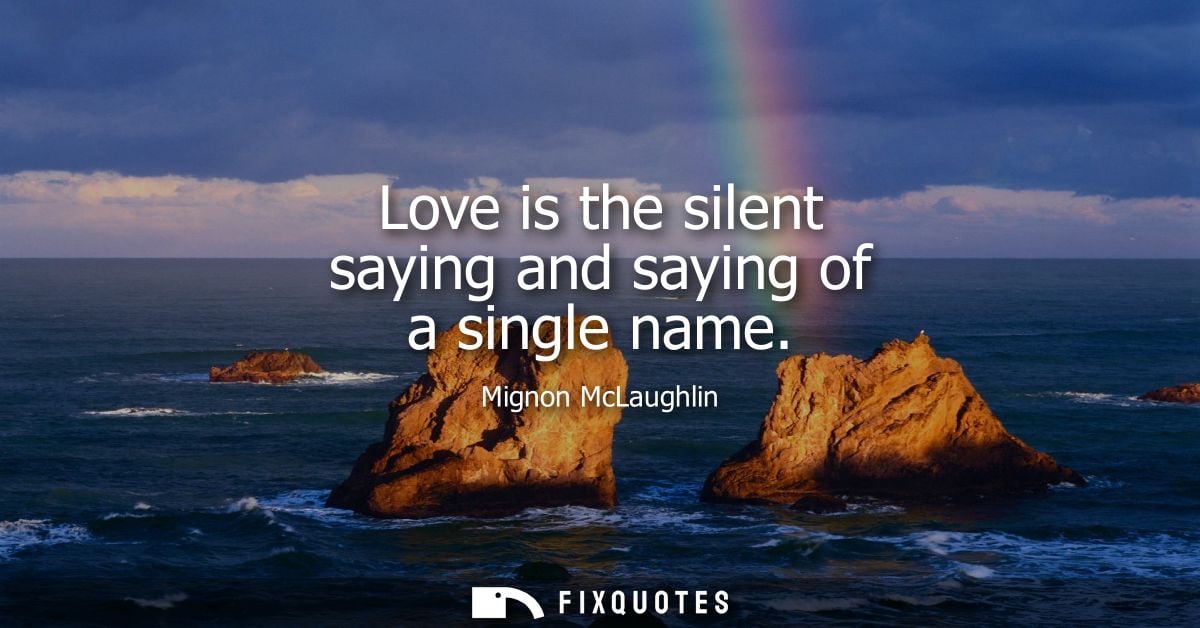
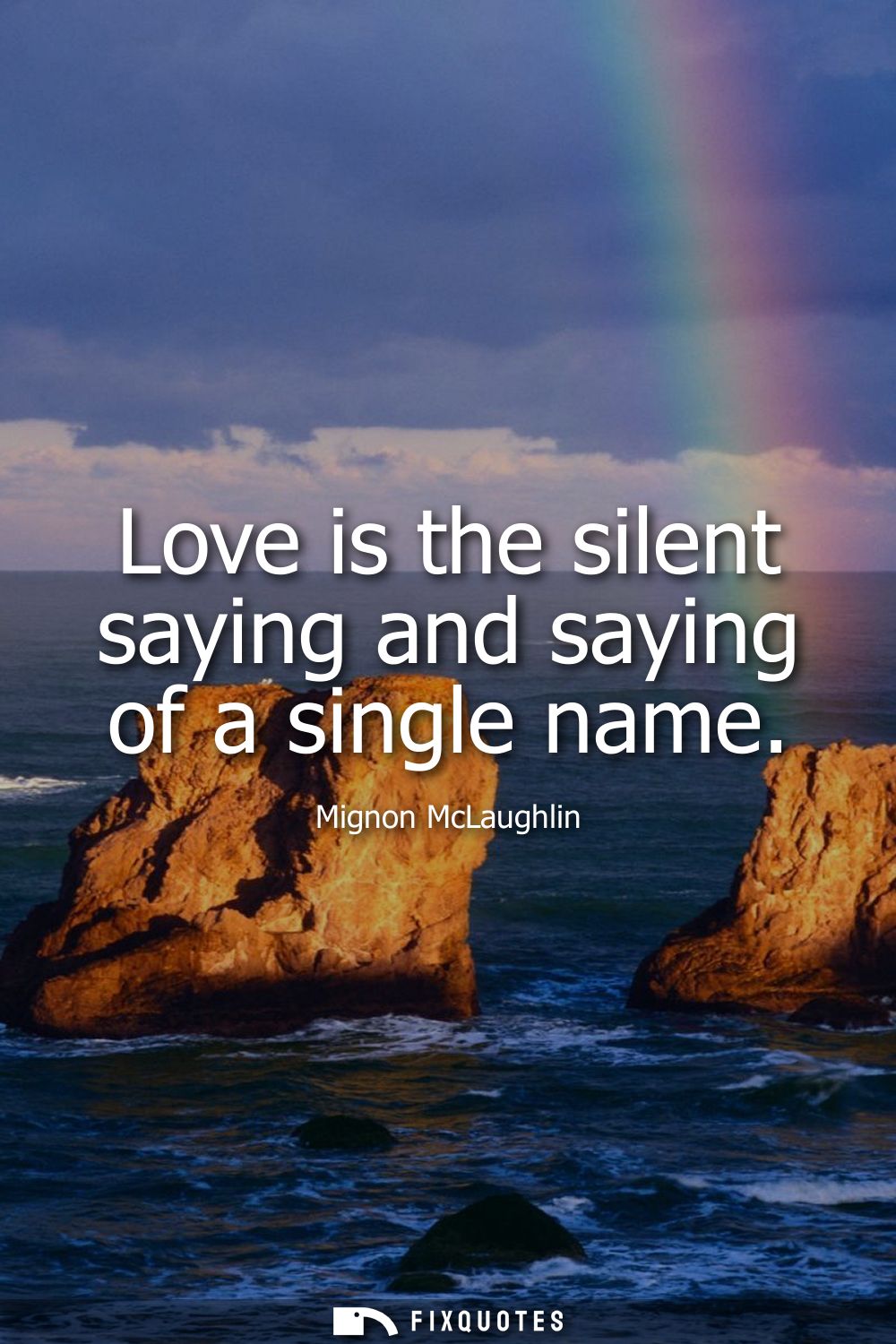
"Love is the silent saying and saying of a single name"
About this Quote
Love, in McLaughlin's hands, isn't a grand speech; it's a private habit of attention. "The silent saying and saying" turns the feeling into a loop: love repeats itself, out loud and under the breath, until it becomes less an emotion than a reflex. The phrase does a neat trick with contradiction. "Silent saying" suggests what can't be declared without cheapening it, while "saying" insists that love still needs expression. McLaughlin bridges that tension with "a single name" - not a soulmate-as-destiny flourish, but the practical fact that intimacy often narrows the world's noise down to one person you keep returning to, mentally and verbally.
There's also a quiet journalistic precision here. A name is a concrete unit of language; it anchors love in something you can utter in the kitchen, on a phone message, in a prayer you don't believe in anymore. McLaughlin, known for sharp aphorisms, avoids romantic inflation. She doesn't describe love as an idea, a covenant, or a fire. She reduces it to the smallest verbal token that carries maximum charge. Subtext: devotion shows up less in declarations than in repetition - the way you keep re-centering that person in your mind, the way their name becomes shorthand for safety, irritation, longing, responsibility.
Context matters, too: a mid-20th-century American journalist writing in an era that sold romance as spectacle. McLaughlin counters the sales pitch with something more intimate and, in its own way, more exacting: love as the continual return to one name, even when nobody's listening.
There's also a quiet journalistic precision here. A name is a concrete unit of language; it anchors love in something you can utter in the kitchen, on a phone message, in a prayer you don't believe in anymore. McLaughlin, known for sharp aphorisms, avoids romantic inflation. She doesn't describe love as an idea, a covenant, or a fire. She reduces it to the smallest verbal token that carries maximum charge. Subtext: devotion shows up less in declarations than in repetition - the way you keep re-centering that person in your mind, the way their name becomes shorthand for safety, irritation, longing, responsibility.
Context matters, too: a mid-20th-century American journalist writing in an era that sold romance as spectacle. McLaughlin counters the sales pitch with something more intimate and, in its own way, more exacting: love as the continual return to one name, even when nobody's listening.
Quote Details
| Topic | Love |
|---|---|
| Source | Help us find the source |
| Cite |
Citation Formats
APA Style (7th ed.)
McLaughlin, Mignon. (2026, January 14). Love is the silent saying and saying of a single name. FixQuotes. https://fixquotes.com/quotes/love-is-the-silent-saying-and-saying-of-a-single-82788/
Chicago Style
McLaughlin, Mignon. "Love is the silent saying and saying of a single name." FixQuotes. January 14, 2026. https://fixquotes.com/quotes/love-is-the-silent-saying-and-saying-of-a-single-82788/.
MLA Style (9th ed.)
"Love is the silent saying and saying of a single name." FixQuotes, 14 Jan. 2026, https://fixquotes.com/quotes/love-is-the-silent-saying-and-saying-of-a-single-82788/. Accessed 10 Feb. 2026.
More Quotes by Mignon
Add to List