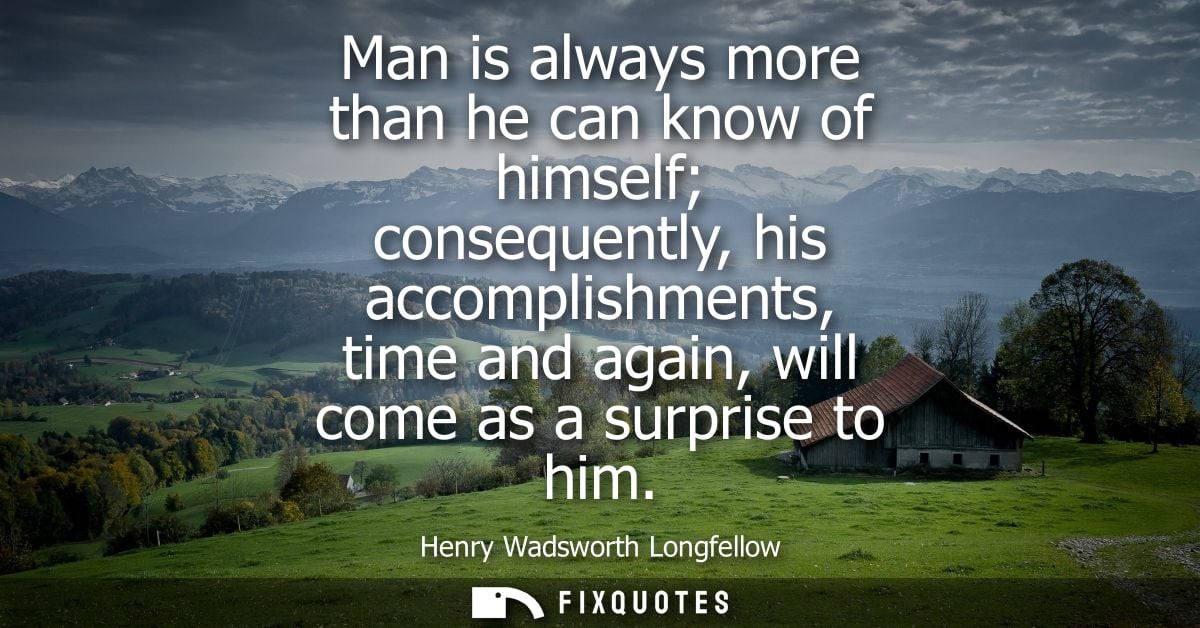
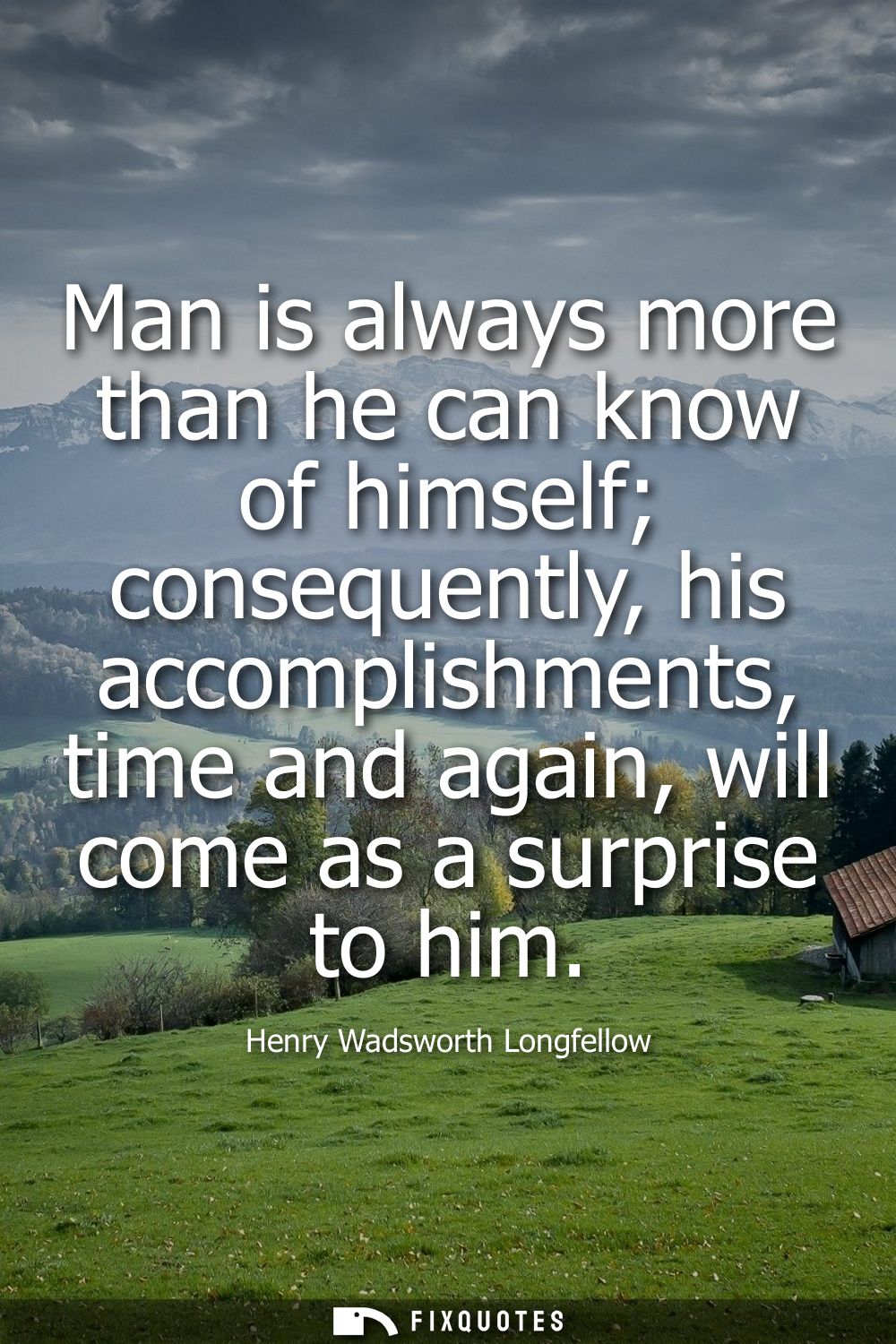
"Man is always more than he can know of himself; consequently, his accomplishments, time and again, will come as a surprise to him"
About this Quote
Longfellow points to a paradox at the heart of selfhood: we live inside our minds yet cannot take full inventory of who we are. Introspection sketches a map, but the territory is larger, full of latent capacities, motives, and strengths that only appear under pressure or in the act of creation. Because the self exceeds self-knowledge, achievement often feels like discovery rather than execution. We surprise ourselves not because we were pretending to be small, but because potential is dynamic, relational, and revealed in motion.
The line carries the optimism of 19th-century American Romanticism, which trusted the hidden reserves of the individual and the generative power of imagination. Longfellow moved in the orbit of Emerson and other writers who believed that the soul contains more than reason can catalog. Yet his claim is not triumphant so much as humble. If we are more than we can know, then certainty about our limits is premature. The proper stance is willingness to try and readiness to be surprised.
Life and art bear this out. Writers find themselves producing lines they did not know they could write; inventors stumble onto solutions they did not plan; ordinary people discover endurance only when grief or responsibility demands it. Longfellow himself endured profound losses and still produced work that resonated across a nation, translating Dante and composing poems that outlived him. Accomplishment, in this view, is less a proof of what we already knew and more an unveiling of what we could not see beforehand.
There is also a quiet comfort here. If identity is larger than self-concept, failure is not final and success is not a fluke. The self is a frontier, and effort is exploration. Start before you feel fully ready, because readiness often arrives in the doing. What astonishes us in our own work is not foreign to us; it is the part of us that could not be measured until it was called forth.
The line carries the optimism of 19th-century American Romanticism, which trusted the hidden reserves of the individual and the generative power of imagination. Longfellow moved in the orbit of Emerson and other writers who believed that the soul contains more than reason can catalog. Yet his claim is not triumphant so much as humble. If we are more than we can know, then certainty about our limits is premature. The proper stance is willingness to try and readiness to be surprised.
Life and art bear this out. Writers find themselves producing lines they did not know they could write; inventors stumble onto solutions they did not plan; ordinary people discover endurance only when grief or responsibility demands it. Longfellow himself endured profound losses and still produced work that resonated across a nation, translating Dante and composing poems that outlived him. Accomplishment, in this view, is less a proof of what we already knew and more an unveiling of what we could not see beforehand.
There is also a quiet comfort here. If identity is larger than self-concept, failure is not final and success is not a fluke. The self is a frontier, and effort is exploration. Start before you feel fully ready, because readiness often arrives in the doing. What astonishes us in our own work is not foreign to us; it is the part of us that could not be measured until it was called forth.
Quote Details
| Topic | Wisdom |
|---|
More Quotes by Henry
Add to List