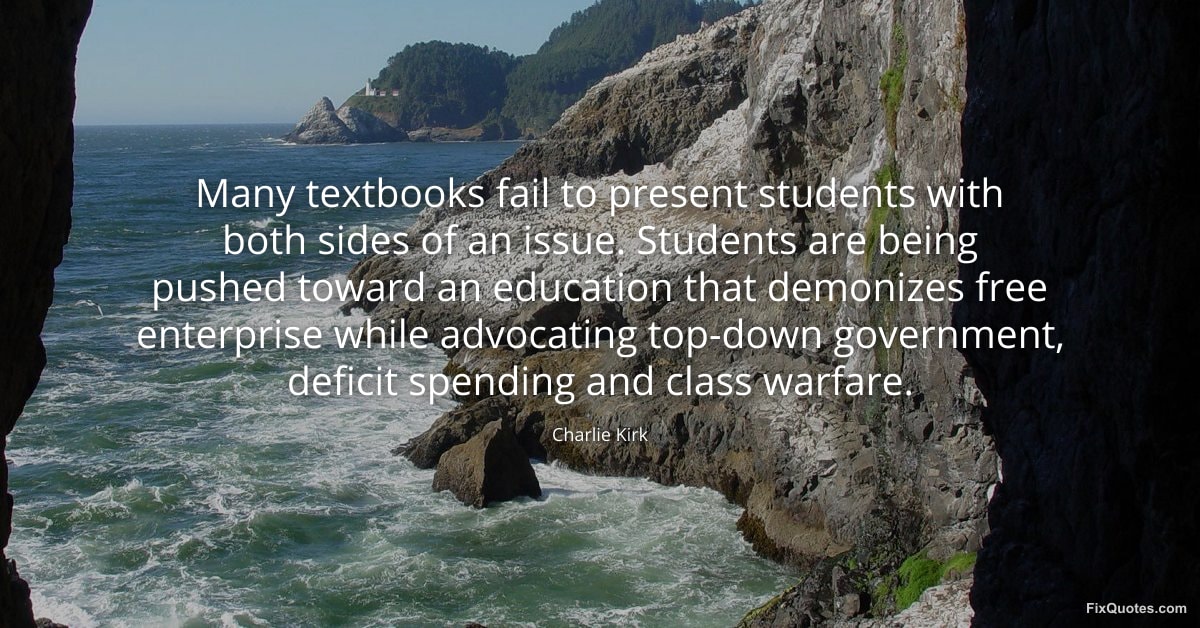
"Many textbooks fail to present students with both sides of an issue. Students are being pushed toward an education that demonizes free enterprise while advocating top-down government, deficit spending and class warfare"
About this Quote
Kirk’s line works less as a complaint about pedagogy than as a recruitment pitch: it takes a mundane worry (textbooks are biased) and escalates it into an existential threat (students are being “pushed” into a worldview). That verb choice is doing heavy lifting. “Fail to present” implies negligence, but “being pushed” implies an organized project - faceless authorities steering children. The sentence is built to convert suspicion into urgency.
The phrase “both sides of an issue” frames politics as a neutral debate with symmetrical options, a common move in culture-war rhetoric because it casts the speaker as the reasonable referee while pre-labeling opponents as extremists. Then the ideological payload arrives in a fast, stacked list: “demonizes free enterprise” versus “advocating top-down government, deficit spending and class warfare.” The cadence is courtroom-like, a charge sheet. “Free enterprise” is made moral, almost civic-religious; the alternatives are rendered as coercive, reckless, and resentful. “Class warfare” is especially telling: it doesn’t rebut any particular policy so much as it delegitimizes the motive behind redistribution, suggesting envy or agitation rather than material grievances.
The subtext is a familiar conservative story about institutions - schools, publishers, bureaucracies - as captured by left-leaning elites, shaping the next generation through selective framing rather than open argument. Culturally, it fits the post-2010s conservative campus narrative and the broader right-populist strategy of treating education as the frontline of politics: win the curriculum, win the country. In that sense, it’s less about textbooks than about authority - who gets to define “neutral,” and whose values get smuggled in as common sense.
The phrase “both sides of an issue” frames politics as a neutral debate with symmetrical options, a common move in culture-war rhetoric because it casts the speaker as the reasonable referee while pre-labeling opponents as extremists. Then the ideological payload arrives in a fast, stacked list: “demonizes free enterprise” versus “advocating top-down government, deficit spending and class warfare.” The cadence is courtroom-like, a charge sheet. “Free enterprise” is made moral, almost civic-religious; the alternatives are rendered as coercive, reckless, and resentful. “Class warfare” is especially telling: it doesn’t rebut any particular policy so much as it delegitimizes the motive behind redistribution, suggesting envy or agitation rather than material grievances.
The subtext is a familiar conservative story about institutions - schools, publishers, bureaucracies - as captured by left-leaning elites, shaping the next generation through selective framing rather than open argument. Culturally, it fits the post-2010s conservative campus narrative and the broader right-populist strategy of treating education as the frontline of politics: win the curriculum, win the country. In that sense, it’s less about textbooks than about authority - who gets to define “neutral,” and whose values get smuggled in as common sense.
Quote Details
| Topic | Teaching |
|---|
More Quotes by Charlie
Add to List