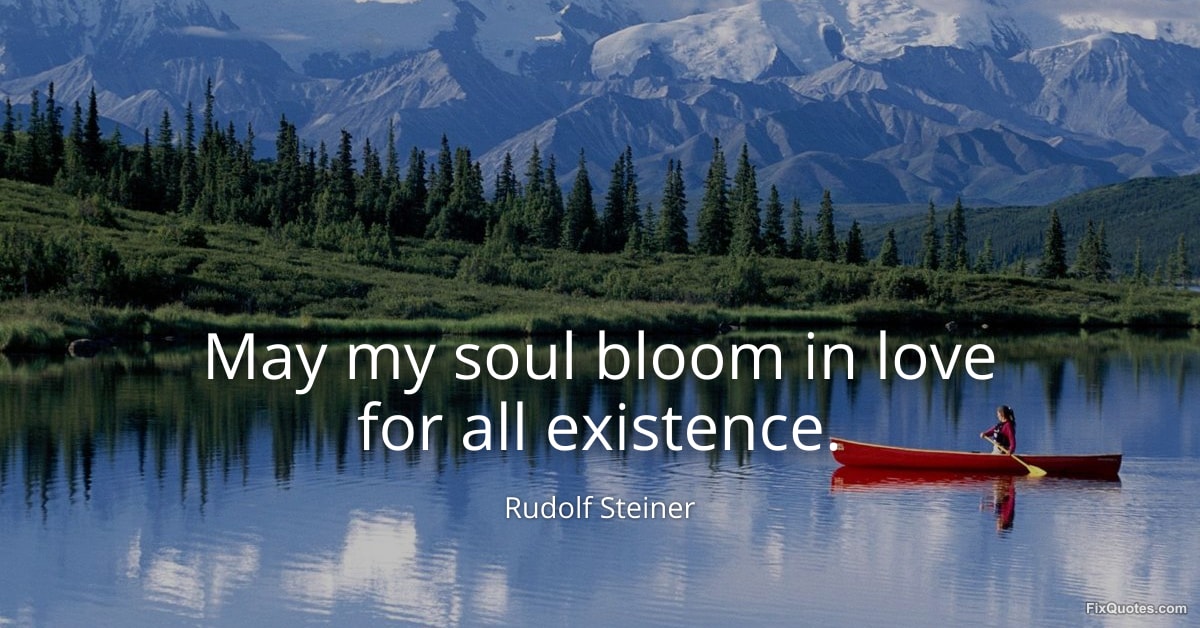
"May my soul bloom in love for all existence"
About this Quote
A prayer disguised as a cultivation manual: "May my soul bloom in love for all existence" treats love less like a feeling and more like a disciplined, almost botanical practice. The verb "bloom" does heavy lifting. It implies seasonality, patience, and inner labor; you cannot command a flower to open, but you can tend the conditions. Steiner sidesteps the modern fantasy of instantaneous enlightenment and replaces it with growth that is slow, embodied, and earned.
The line also telegraphs his broader project. As the founder of anthroposophy, Steiner argued that consciousness could be trained to perceive spiritual dimensions within the everyday world. Read in that context, "love for all existence" is not sentimental charity; it is an epistemology. Love becomes a way of knowing, a posture that dissolves the subject-object divide. You don't simply observe the world; you meet it with a kind of participatory attention.
The phrasing "May my..". frames this as aspiration rather than achievement, which matters. It smuggles humility into a grand claim: the self is not already large enough to hold "all existence", but it can be widened. There's also a quiet ethical ambition here. If the soul can bloom into expansive regard, cruelty becomes not merely immoral but perceptually distorted, a failure to register the aliveness of what surrounds you.
Steiner wrote in a Europe rattled by industrial modernity and spiritual dislocation; this line reads like a counter-spell. Against mechanization and abstraction, he offers a vow to re-enchant the real by loving it whole.
The line also telegraphs his broader project. As the founder of anthroposophy, Steiner argued that consciousness could be trained to perceive spiritual dimensions within the everyday world. Read in that context, "love for all existence" is not sentimental charity; it is an epistemology. Love becomes a way of knowing, a posture that dissolves the subject-object divide. You don't simply observe the world; you meet it with a kind of participatory attention.
The phrasing "May my..". frames this as aspiration rather than achievement, which matters. It smuggles humility into a grand claim: the self is not already large enough to hold "all existence", but it can be widened. There's also a quiet ethical ambition here. If the soul can bloom into expansive regard, cruelty becomes not merely immoral but perceptually distorted, a failure to register the aliveness of what surrounds you.
Steiner wrote in a Europe rattled by industrial modernity and spiritual dislocation; this line reads like a counter-spell. Against mechanization and abstraction, he offers a vow to re-enchant the real by loving it whole.
Quote Details
| Topic | Kindness |
|---|
More Quotes by Rudolf
Add to List