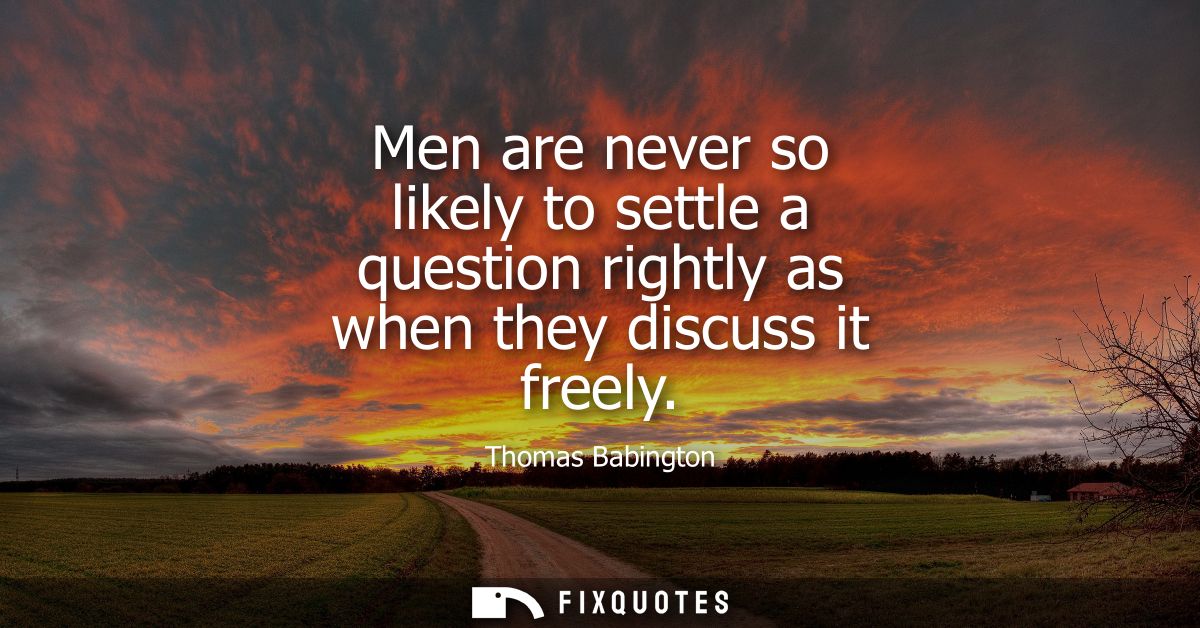
"Men are never so likely to settle a question rightly as when they discuss it freely"
About this Quote
Freedom, in Babington's formulation, isn't a noble ornament on debate; it's the mechanism that makes truth more likely. The line wagers that correctness is not chiefly the product of genius or authority, but of process: people circling an idea in public, testing it, bruising it, refining it. "Never so likely" is doing quiet work here. It's not utopian. Free discussion doesn't guarantee the right answer; it just raises the odds compared to every rival method - decree, tradition, intimidation, polite silence.
The subtext is a rebuke to any culture that treats disagreement as disorder. Babington implies that a "settled" question reached without open argument is less settled than it looks, a verdict achieved by social pressure rather than intellectual contact. "Discuss it freely" also carries a moral condition: participants must be able to speak without fear of punishment, reputational exile, or enforced conformity. In that sense, the quote defends not just speech but the messy pluralism around it: dissenters, unpopular claims, arguments that land badly before they land well.
Context matters. Babington wrote in a 19th-century Britain wrestling with reform, expanding literacy, and the rise of mass politics - a society renegotiating who gets to speak and whose reasons count. The sentence reads like a liberal confidence statement, but also like an anxiety: when institutions throttle conversation, they don't just silence people; they warp outcomes. It's a compact case for open discourse as epistemology, not etiquette.
The subtext is a rebuke to any culture that treats disagreement as disorder. Babington implies that a "settled" question reached without open argument is less settled than it looks, a verdict achieved by social pressure rather than intellectual contact. "Discuss it freely" also carries a moral condition: participants must be able to speak without fear of punishment, reputational exile, or enforced conformity. In that sense, the quote defends not just speech but the messy pluralism around it: dissenters, unpopular claims, arguments that land badly before they land well.
Context matters. Babington wrote in a 19th-century Britain wrestling with reform, expanding literacy, and the rise of mass politics - a society renegotiating who gets to speak and whose reasons count. The sentence reads like a liberal confidence statement, but also like an anxiety: when institutions throttle conversation, they don't just silence people; they warp outcomes. It's a compact case for open discourse as epistemology, not etiquette.
Quote Details
| Topic | Decision-Making |
|---|
More Quotes by Thomas
Add to List