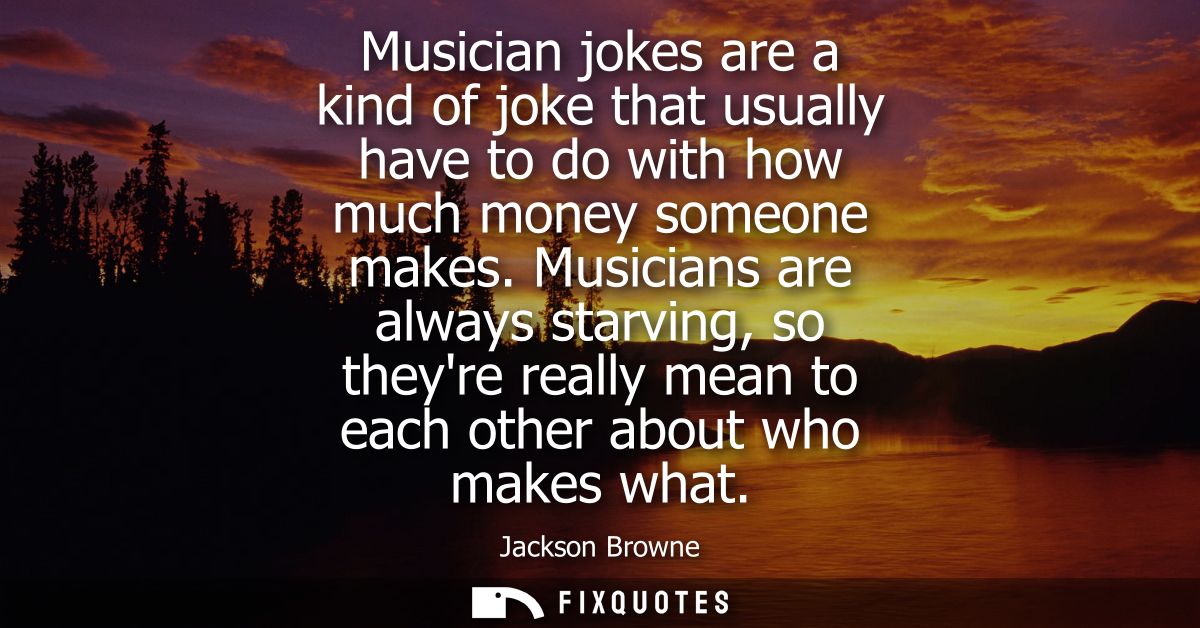
"Musician jokes are a kind of joke that usually have to do with how much money someone makes. Musicians are always starving, so they're really mean to each other about who makes what"
About this Quote
Jackson Browne points to the economics behind musicians humor: when livelihoods are precarious, jokes gravitate toward money. The starving artist stereotype is not only a cliche but a lived condition for many players navigating bar gigs, session work, and patchwork income streams. Under those pressures, humor becomes both shield and blade. It softens anxiety about rent and bills, and at the same time it polices status, ranking people by the kinds of rooms they play, the instruments they haul, and the paychecks they bring home.
Money jokes among musicians are a form of gallows humor. They let insiders laugh at a system where a few stars capture outsized rewards while most scrape by. The punchline often turns on who is a sideman and who is a bandleader, who is playing weddings and who is on a marquee, who is on per diem and who gets royalties. That focus can be mean because the underlying competition is real. Scarcity sharpens envy; the joke becomes a way to process it without admitting it outright.
Brownes observation also hints at the paradox of creative work. Musicians enter the field for art, not for spreadsheets, yet the industry continually forces them to quantify their worth. Fees, advances, splits, fees for gear and travel, the cut everyone else takes before the artist gets paid: all of it turns art into arithmetic. Joking about money is a way to reclaim agency and to puncture the seriousness of those calculations. It is also a way to cope with the shame that can come with underpayment, using self-deprecation to stay in the game.
At bottom, the humor reveals a community that bonds through shared struggle while replicating the hierarchies that produce that struggle. The laughter is real, but so is the hunger it covers.
Money jokes among musicians are a form of gallows humor. They let insiders laugh at a system where a few stars capture outsized rewards while most scrape by. The punchline often turns on who is a sideman and who is a bandleader, who is playing weddings and who is on a marquee, who is on per diem and who gets royalties. That focus can be mean because the underlying competition is real. Scarcity sharpens envy; the joke becomes a way to process it without admitting it outright.
Brownes observation also hints at the paradox of creative work. Musicians enter the field for art, not for spreadsheets, yet the industry continually forces them to quantify their worth. Fees, advances, splits, fees for gear and travel, the cut everyone else takes before the artist gets paid: all of it turns art into arithmetic. Joking about money is a way to reclaim agency and to puncture the seriousness of those calculations. It is also a way to cope with the shame that can come with underpayment, using self-deprecation to stay in the game.
At bottom, the humor reveals a community that bonds through shared struggle while replicating the hierarchies that produce that struggle. The laughter is real, but so is the hunger it covers.
Quote Details
| Topic | Music |
|---|
More Quotes by Jackson
Add to List