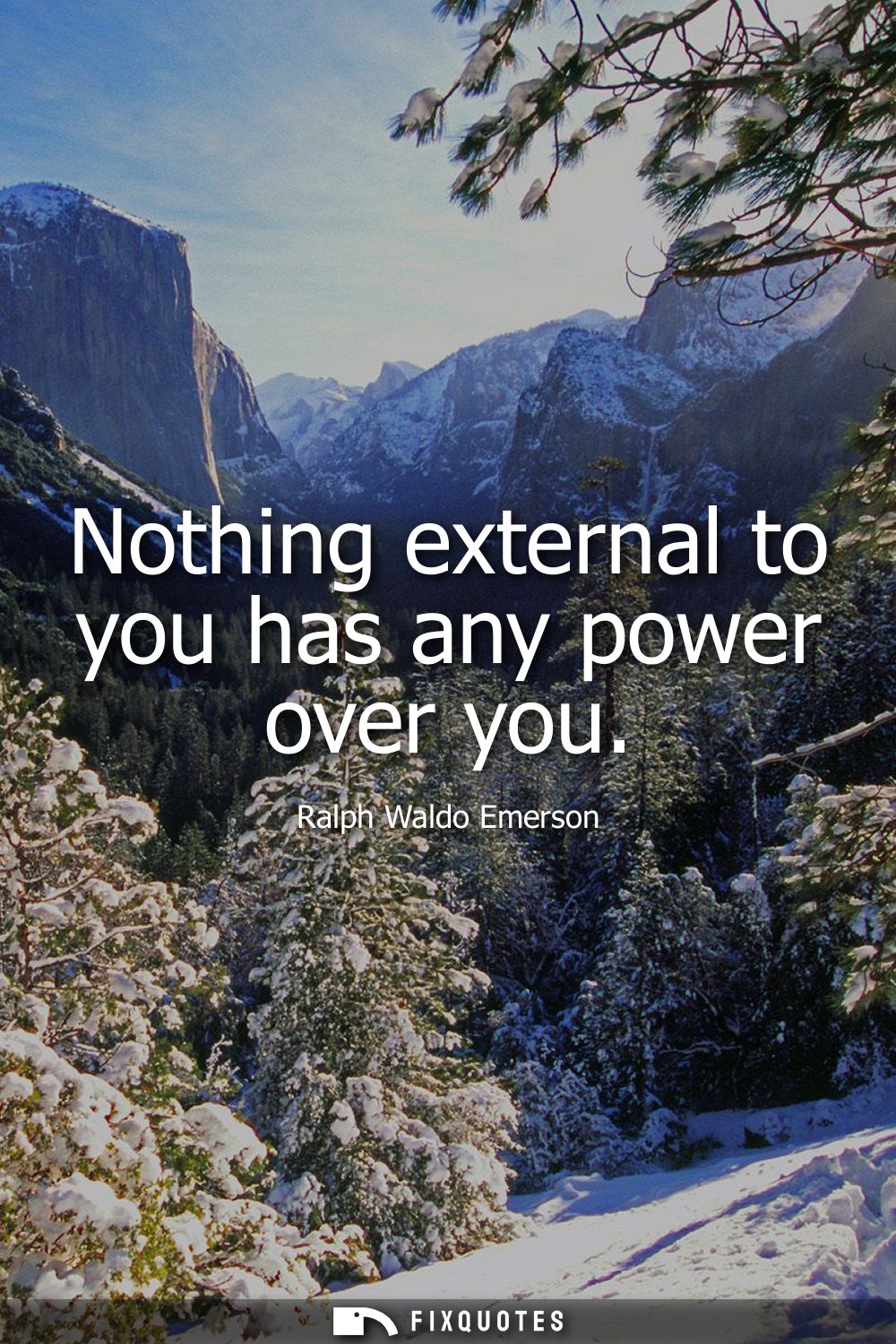
"Nothing external to you has any power over you"
About this Quote
Emerson’s line is a small verbal hand grenade: it detonates the comforting idea that the world is in charge of us. “Nothing external” isn’t naive denial of poverty, illness, prejudice, or bad luck; it’s a wager on where authority actually lives. The sentence works because it shifts the terrain from events to interpretation. Power, Emerson implies, is not merely the force exerted on you but the consent you grant it inside your own mind.
That’s the subtext of American Transcendentalism in one hard-edged claim. Writing in a young republic intoxicated with expansion and anxious about conformity, Emerson was pushing back against inherited institutions: church doctrine, European cultural prestige, the social pressure to live as a copy. His broader project in “Self-Reliance” is to treat the self not as a private indulgence but as a civic engine. If people stop outsourcing moral judgment, the culture has to renegotiate who gets to define truth.
The rhetoric is spare on purpose. No qualifiers, no loopholes, no soothing “most of the time.” That absolutism is strategic: it forces readers to confront how often they mistake reflex for fate. At the same time, the line has a productive blind spot. Emerson’s faith in inward sovereignty can read, in a modern key, like a recipe for ignoring structural power. Yet that tension is part of its durability. It’s both an antidote to victimhood and a challenge to complacency: if the external world can’t rule you without your permission, then your inner life is not just personal therapy. It’s a political stance.
That’s the subtext of American Transcendentalism in one hard-edged claim. Writing in a young republic intoxicated with expansion and anxious about conformity, Emerson was pushing back against inherited institutions: church doctrine, European cultural prestige, the social pressure to live as a copy. His broader project in “Self-Reliance” is to treat the self not as a private indulgence but as a civic engine. If people stop outsourcing moral judgment, the culture has to renegotiate who gets to define truth.
The rhetoric is spare on purpose. No qualifiers, no loopholes, no soothing “most of the time.” That absolutism is strategic: it forces readers to confront how often they mistake reflex for fate. At the same time, the line has a productive blind spot. Emerson’s faith in inward sovereignty can read, in a modern key, like a recipe for ignoring structural power. Yet that tension is part of its durability. It’s both an antidote to victimhood and a challenge to complacency: if the external world can’t rule you without your permission, then your inner life is not just personal therapy. It’s a political stance.
Quote Details
| Topic | Self-Improvement |
|---|
More Quotes by Ralph
Add to List