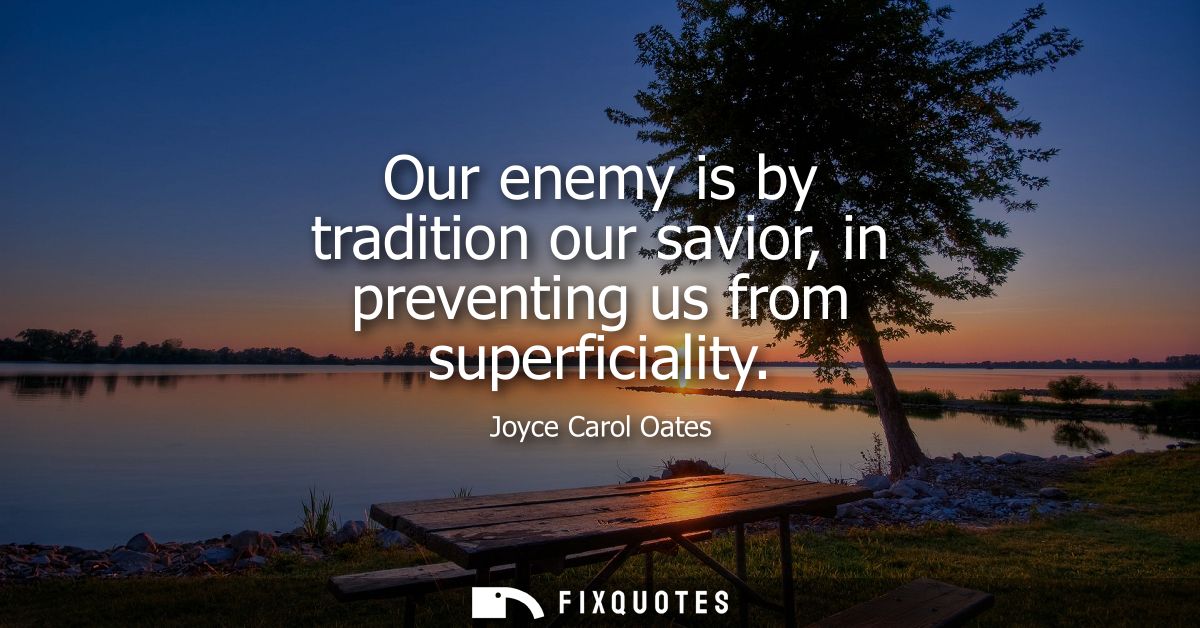
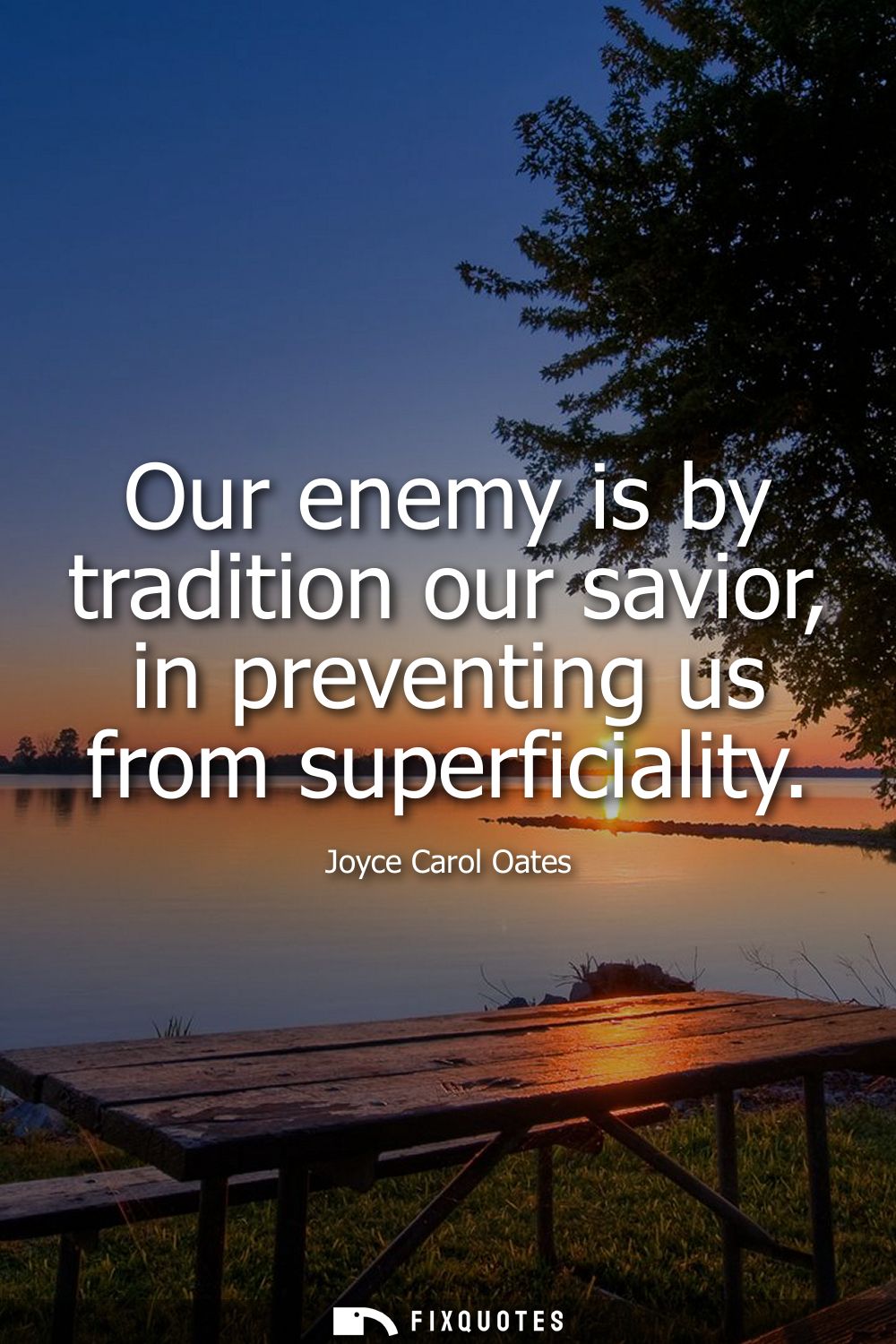
"Our enemy is by tradition our savior, in preventing us from superficiality"
About this Quote
Oates flips the moral furniture with a single sly pivot: the enemy, that stock figure of threat and grievance, becomes an unlikely agent of depth. The line works because it refuses the comfort of clean categories. “By tradition” is doing quiet, corrosive work here, hinting that we inherit our antagonisms the way we inherit family stories: half true, half convenient, stubbornly repeated. Enemies aren’t just encountered; they’re curated, maintained, and mythologized.
The “savior” claim isn’t sentimental. It’s almost grudging. Oates suggests that conflict is one of the few forces strong enough to puncture the glossy narratives we tell ourselves when life is going well. Superficiality thrives on ease: the untested opinion, the identity worn like a brand, the morality that’s never had to pay rent in reality. An enemy introduces friction. They force the self to sharpen its arguments, examine its motives, and confront the possibility that its coherence depends on what it opposes.
The subtext is uncomfortable: we may need antagonists to feel real. That’s a psychological insight and a cultural critique. In a media ecosystem that rewards outrage and rival camps, “enemy” can become a productivity hack for meaning, a shortcut to intensity. Oates, as a novelist steeped in violence, obsession, and American psychic turbulence, is also warning about the seductive utility of opposition. The enemy “prevents us” from superficiality, yes, but at a price: when salvation comes from hostility, we risk confusing depth with perpetual combat.
The “savior” claim isn’t sentimental. It’s almost grudging. Oates suggests that conflict is one of the few forces strong enough to puncture the glossy narratives we tell ourselves when life is going well. Superficiality thrives on ease: the untested opinion, the identity worn like a brand, the morality that’s never had to pay rent in reality. An enemy introduces friction. They force the self to sharpen its arguments, examine its motives, and confront the possibility that its coherence depends on what it opposes.
The subtext is uncomfortable: we may need antagonists to feel real. That’s a psychological insight and a cultural critique. In a media ecosystem that rewards outrage and rival camps, “enemy” can become a productivity hack for meaning, a shortcut to intensity. Oates, as a novelist steeped in violence, obsession, and American psychic turbulence, is also warning about the seductive utility of opposition. The enemy “prevents us” from superficiality, yes, but at a price: when salvation comes from hostility, we risk confusing depth with perpetual combat.
Quote Details
| Topic | Wisdom |
|---|---|
| Source | Verified source: Partisan Review: "Master Race" (Joyce Carol Oates, 1984)
Evidence: Our enemy is by tradition our savior, in preventing us from superficiality. (Vol. 51, No. 4, p. 566 (story begins); exact quote page not verified in available scan). The strongest primary-source lead is Joyce Carol Oates's short story "Master Race," published in Partisan Review, Vol. 51, No. 4 (1984), not 1985. Boston University's Partisan Review archive shows the story beginning on page 566 in the 1984 issue. Multiple quotation reference works and quote databases attribute this specific line to "Master Race"; one secondary reference further describes it as Oates 'quoting an aphorism' in that story. I could verify the story's publication in the 1984 Partisan Review archive, but I could not directly locate the sentence itself in the searchable web-exposed pages of the scan, so the exact page within the story remains unconfirmed. Some later quote sites incorrectly give 1985 because they are citing the Partisan Review 50th Anniversary Edition edited by William Phillips, which appears to have reprinted or anthologized the piece. Based on the evidence available, the earliest verified publication is the original Partisan Review appearance in 1984, in Oates's own work. Other candidates (1) The New Penguin Dictionary of Modern Quotations (Robert Andrews, 2003) compilation95.0% ... Joyce Carol Oates ( b . 1938 ) US AUTHOR Using a range of genres from Gothic horror fiction to social ... Our ene... |
| Cite |
Citation Formats
APA Style (7th ed.)
Oates, Joyce Carol. (2026, March 7). Our enemy is by tradition our savior, in preventing us from superficiality. FixQuotes. https://fixquotes.com/quotes/our-enemy-is-by-tradition-our-savior-in-160398/
Chicago Style
Oates, Joyce Carol. "Our enemy is by tradition our savior, in preventing us from superficiality." FixQuotes. March 7, 2026. https://fixquotes.com/quotes/our-enemy-is-by-tradition-our-savior-in-160398/.
MLA Style (9th ed.)
"Our enemy is by tradition our savior, in preventing us from superficiality." FixQuotes, 7 Mar. 2026, https://fixquotes.com/quotes/our-enemy-is-by-tradition-our-savior-in-160398/. Accessed 1 Apr. 2026.
More Quotes by Joyce
Add to List