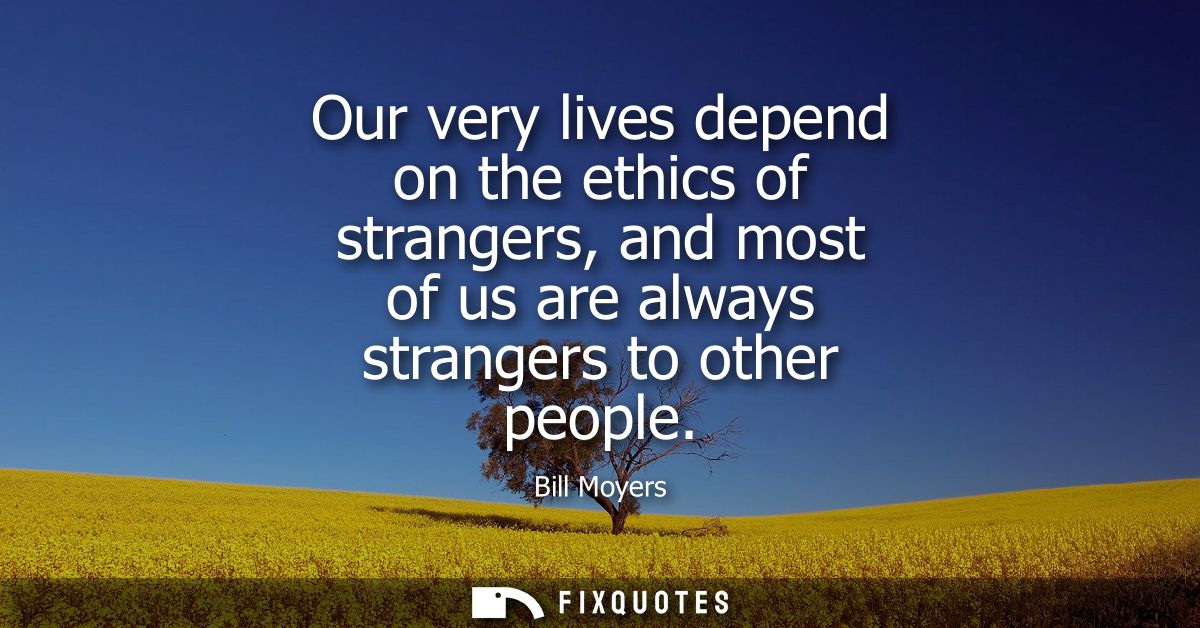
"Our very lives depend on the ethics of strangers, and most of us are always strangers to other people"
About this Quote
Each day, our existence is shaped in crucial ways by people we may never meet or even notice: the truck driver who safely delivers food across the country, the engineer who designs safe bridges, the pharmacist who precisely prepares our medicines. At every turn, our welfare relies on the choices and integrity of countless individuals outside our social circles. We entrust strangers with our safety, our health, even the orderly function of our society, often without a second thought. The doctor performing an operation, the pilot guiding a plane, the sanitation worker collecting our trash, all act as stewards of our well-being, bound together by a shared responsibility that extends far beyond the boundaries of acquaintance or kinship.
Yet, we seldom consider that to those same individuals, we are strangers as well. Our stories, values, and faces are unknown to them. Despite this distance, an unspoken moral fabric connects us, asking each person, even in anonymity, to act with decency and consideration. Ethics, in this sense, is not merely about legal rules or social contracts, but about the daily, often invisible decisions people make to treat others fairly, even when those others are faceless and, perhaps, forgotten.
Civilization’s foundation is built on this mutual trust among strangers. When we buy produce, ride elevators, or take medication, we do so with confidence that unseen hands have acted uprightly. If that web of ethical behavior erodes, chaos and fear replace trust, making community impossible. The reality that we are essentially strangers to most people reinforces the importance of shared ethical norms, guiding actions not out of obligation to friends or family, but from recognition of our common vulnerability and interdependence. By honoring the ethical expectations of society, even in small acts, we contribute to the invisible scaffolding that supports not just our own lives, but the very possibility of peaceful coexistence.
More details
About the Author