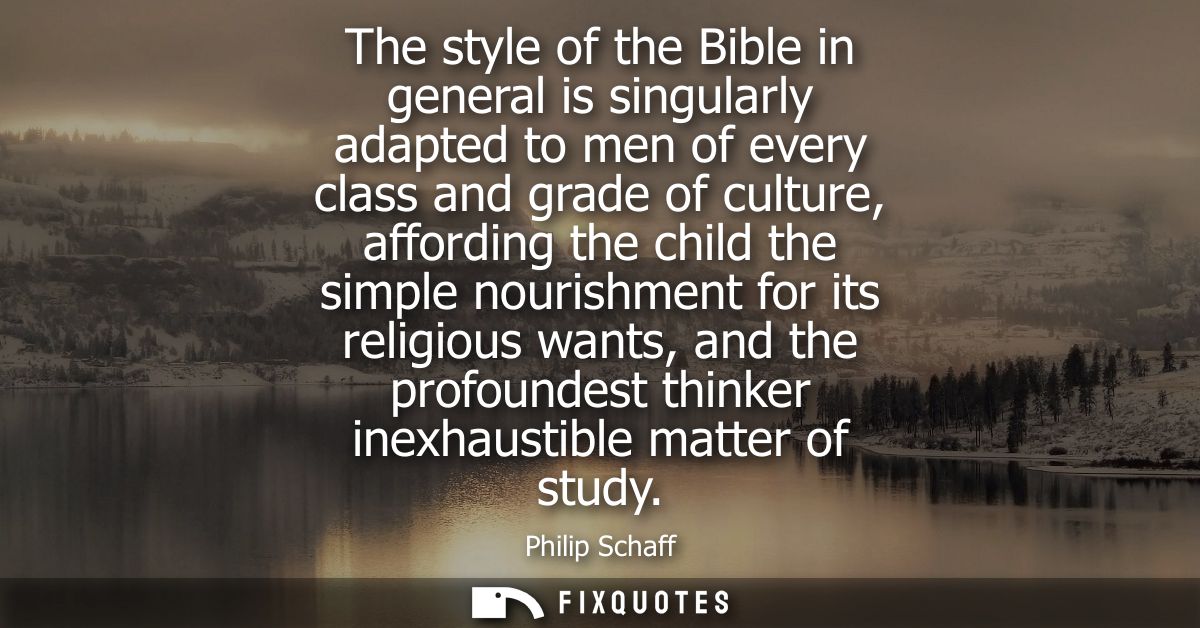
"The style of the Bible in general is singularly adapted to men of every class and grade of culture, affording the child the simple nourishment for its religious wants, and the profoundest thinker inexhaustible matter of study"
About this Quote
Philip Schaff, the 19th-century church historian and champion of ecumenical learning, praises the Bible as a work whose language meets readers where they are and then draws them deeper. His claim rests on a keen sense of style rather than merely doctrine. The Scriptures speak in narratives, songs, proverbs, and letters, with rhythms of parallelism, vivid imagery, and concrete storytelling. Children grasp the moral contours of a parable or the comfort of a psalm because the diction is elemental and the scenes tangible. At the same time, the same passages yield layers of metaphor, typology, and theological architecture that can occupy scholars for a lifetime.
Schaff wrote amid the rise of Sunday schools, the spread of popular literacy, and the influx of German higher criticism into American seminaries. He sought a middle path that honored historical scholarship without losing the devotional center. Calling the Bible singularly adapted to every class belongs to this mediating vision. The style is public and portable; it thrives in oral recitation and communal worship, yet it also invites careful exegesis, philology, and philosophical reflection. A child can love the Good Samaritan as a story of neighborly mercy; a philosopher can wrestle with the Prologue of John and its language of Word and light; a jurist can read Deuteronomy for covenantal jurisprudence; a poet finds an inexhaustible lexicon in the Psalms.
The effect of this style is to democratize wisdom without diluting it. Plain speech does not preclude mystery; it makes mystery enter through the ear. Because the Bible’s rhetoric blends accessibility with symbolic depth, it generates a living tradition of interpretation, from homily to commentary to modern criticism. Schaff’s observation is thus both descriptive and prescriptive: the Scriptures are meant to be bread for beginners and a sea for explorers, sustaining devotion and demanding thought, common enough to carry, inexhaustible enough to pursue.
Schaff wrote amid the rise of Sunday schools, the spread of popular literacy, and the influx of German higher criticism into American seminaries. He sought a middle path that honored historical scholarship without losing the devotional center. Calling the Bible singularly adapted to every class belongs to this mediating vision. The style is public and portable; it thrives in oral recitation and communal worship, yet it also invites careful exegesis, philology, and philosophical reflection. A child can love the Good Samaritan as a story of neighborly mercy; a philosopher can wrestle with the Prologue of John and its language of Word and light; a jurist can read Deuteronomy for covenantal jurisprudence; a poet finds an inexhaustible lexicon in the Psalms.
The effect of this style is to democratize wisdom without diluting it. Plain speech does not preclude mystery; it makes mystery enter through the ear. Because the Bible’s rhetoric blends accessibility with symbolic depth, it generates a living tradition of interpretation, from homily to commentary to modern criticism. Schaff’s observation is thus both descriptive and prescriptive: the Scriptures are meant to be bread for beginners and a sea for explorers, sustaining devotion and demanding thought, common enough to carry, inexhaustible enough to pursue.
Quote Details
| Topic | Bible |
|---|
More Quotes by Philip
Add to List