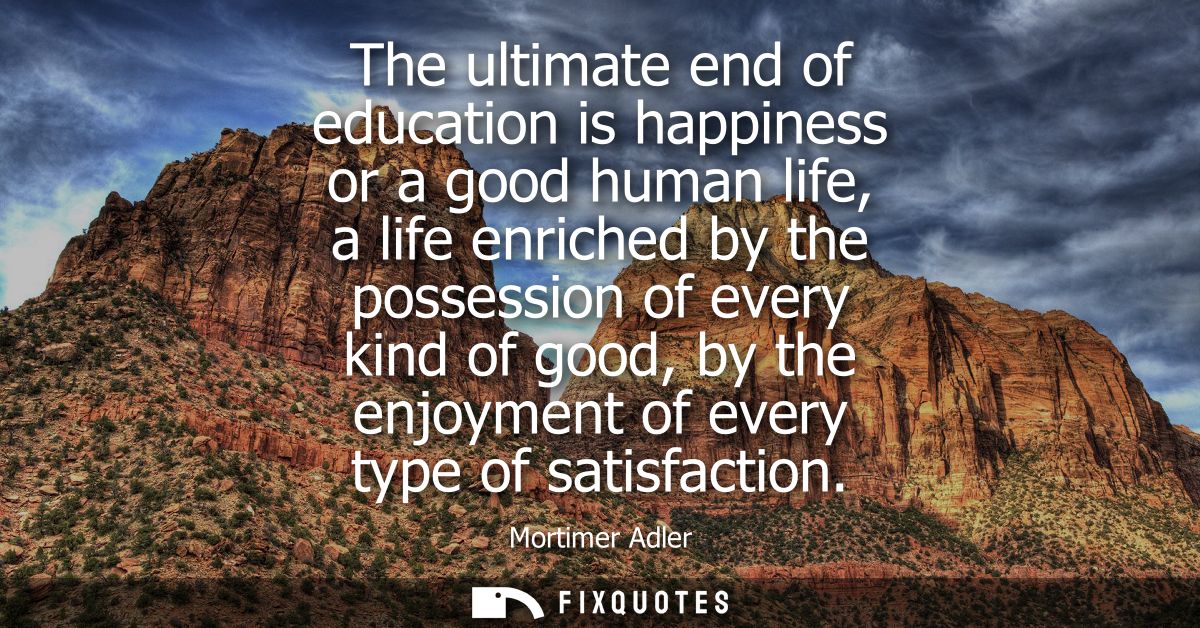
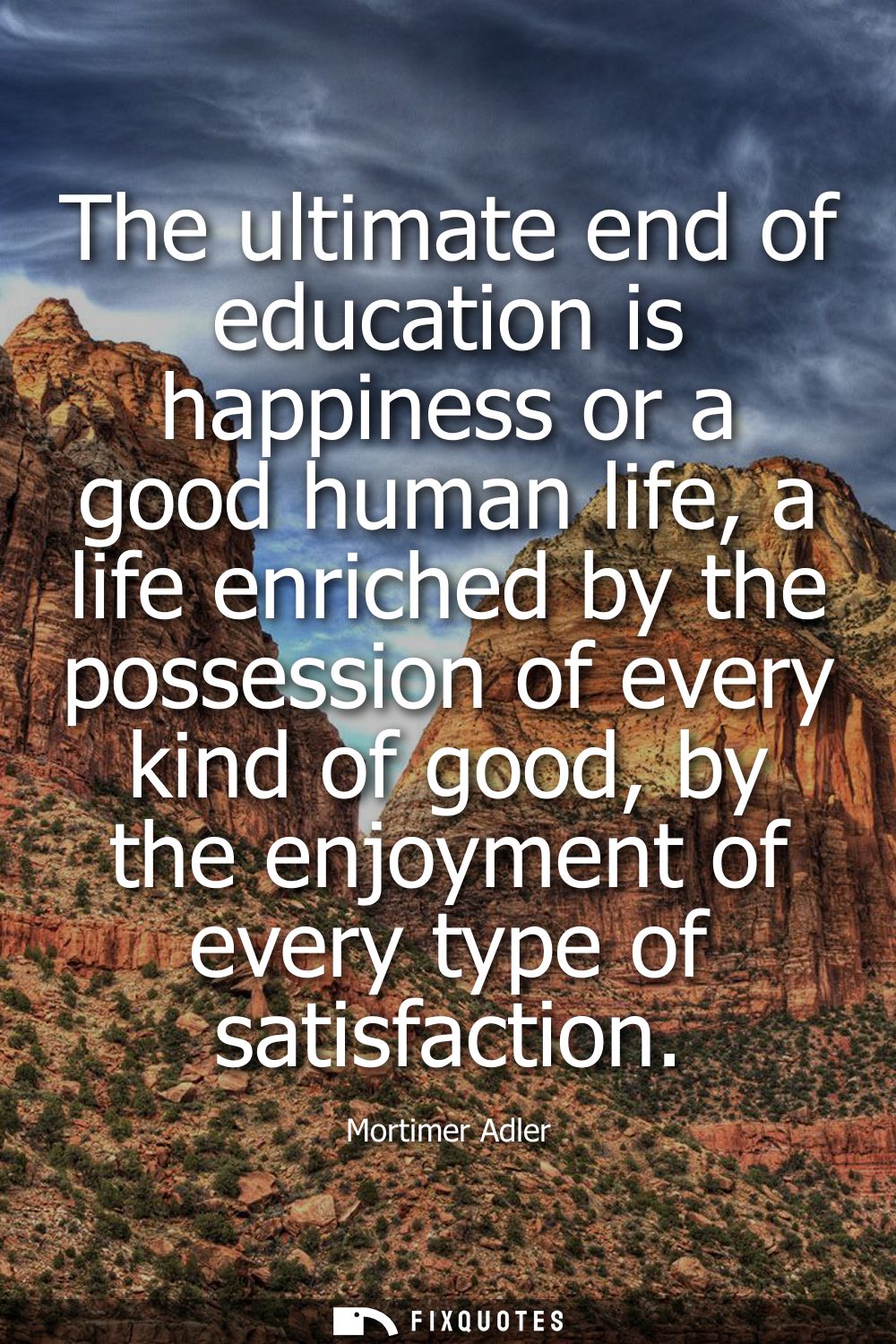
"The ultimate end of education is happiness or a good human life, a life enriched by the possession of every kind of good, by the enjoyment of every type of satisfaction"
About this Quote
Adler’s line is a quiet rebuke to the way modern institutions talk about schooling: not as formation, but as sorting. Where contemporary education policy loves measurable outputs (test scores, credentials, “workforce readiness”), Adler drags the conversation back to an older, sturdier claim: education is justified only if it helps a person live well. The phrase “ultimate end” is doing heavy lifting. It implies a hierarchy of goals, with everything instrumental - skills, literacy, even employability - subordinated to a final purpose that can’t be reduced to spreadsheets.
The subtext is Aristotelian, almost provocatively so for a 20th-century American philosopher. “Happiness” here isn’t the mood of a good weekend; it’s eudaimonia: flourishing, the kind that requires cultivated judgment, stable character, and a sense of what is worth wanting. Adler’s language also hints at the Great Books project he championed: education as access to the “every kind of good” that a culture has argued about for centuries. You don’t inherit that richness automatically; you learn your way into it.
There’s an egalitarian edge, too. By framing the aim as “a good human life,” Adler suggests education isn’t primarily a luxury good for the talented or the wealthy, but a public promise: that people can be equipped to pursue meaningful satisfactions, not just marketable ones. In an era increasingly anxious about utility, Adler insists that usefulness without direction is just efficient drift.
The subtext is Aristotelian, almost provocatively so for a 20th-century American philosopher. “Happiness” here isn’t the mood of a good weekend; it’s eudaimonia: flourishing, the kind that requires cultivated judgment, stable character, and a sense of what is worth wanting. Adler’s language also hints at the Great Books project he championed: education as access to the “every kind of good” that a culture has argued about for centuries. You don’t inherit that richness automatically; you learn your way into it.
There’s an egalitarian edge, too. By framing the aim as “a good human life,” Adler suggests education isn’t primarily a luxury good for the talented or the wealthy, but a public promise: that people can be equipped to pursue meaningful satisfactions, not just marketable ones. In an era increasingly anxious about utility, Adler insists that usefulness without direction is just efficient drift.
Quote Details
| Topic | Learning |
|---|---|
| Source | Help us find the source |
More Quotes by Mortimer
Add to List