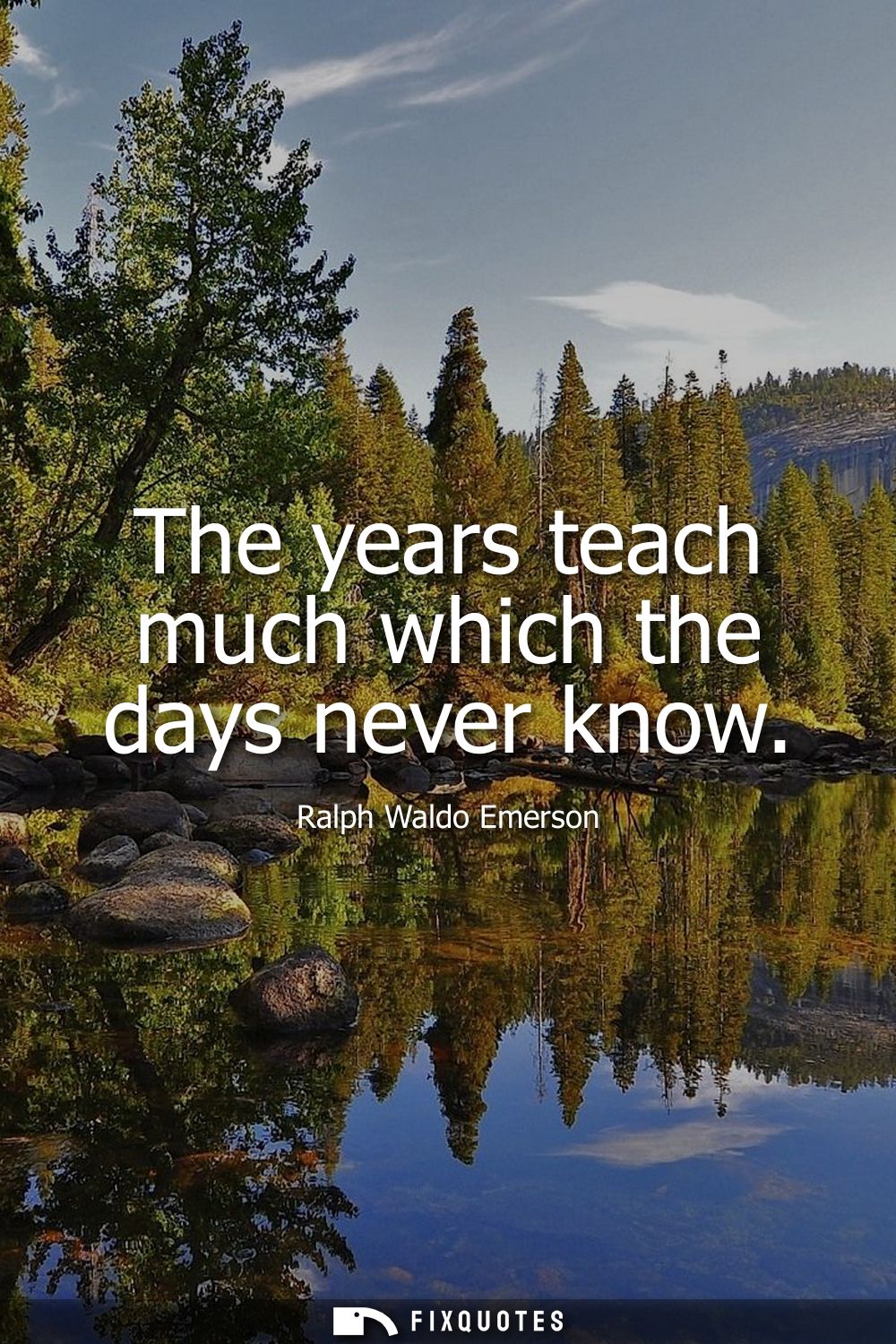
"The years teach much which the days never know"
About this Quote
Emerson’s line has the clean snap of a proverb, but its real force is a quiet rebuke to the cult of immediacy. “Days” stand in for the unit of experience we can tally: productivity, moods, headlines, the visible drama of effort. “Years” represent the slower chemistry of living, where meaning doesn’t arrive as a lesson but as sediment. The phrasing makes time itself the teacher, not a mentor or a book, and that matters: it shifts authority away from institutions and toward direct experience, a signature move of Emerson’s Transcendentalist worldview.
The subtext is anti-instrumental. You can’t brute-force the kind of understanding he’s talking about. Days “never know” because the day-to-day mind is busy interpreting, defending, optimizing; it confuses motion with progress. Years “teach” because they include repetition, disappointment, the erosion of certainty, the way patterns become visible only when you have enough distance to see them as patterns. There’s also a gentle correction to youthful confidence: not that young people are ignorant, but that certain truths are structurally inaccessible until time has done its work.
Context sharpens the point. Emerson was writing in a 19th-century America intoxicated by self-making, speed, and reformist zeal. He doesn’t reject ambition; he warns that insight is often retrospective. The sentence works because it dignifies waiting without romanticizing passivity: it’s not “time heals,” it’s “time reveals.”
The subtext is anti-instrumental. You can’t brute-force the kind of understanding he’s talking about. Days “never know” because the day-to-day mind is busy interpreting, defending, optimizing; it confuses motion with progress. Years “teach” because they include repetition, disappointment, the erosion of certainty, the way patterns become visible only when you have enough distance to see them as patterns. There’s also a gentle correction to youthful confidence: not that young people are ignorant, but that certain truths are structurally inaccessible until time has done its work.
Context sharpens the point. Emerson was writing in a 19th-century America intoxicated by self-making, speed, and reformist zeal. He doesn’t reject ambition; he warns that insight is often retrospective. The sentence works because it dignifies waiting without romanticizing passivity: it’s not “time heals,” it’s “time reveals.”
Quote Details
| Topic | Time |
|---|---|
| Source | Rejected source: Rubáiyát of Omar Khayyám, and Salámán and Absál: Together... (Omar Khayyam, 1122)EBook #22535
Evidence: opiate of hempleaves the indian bhang with which they maddened themselves to th Other candidates (2) The Works of Ralph Waldo Emerson (Ralph Waldo Emerson, 1883)95.0% Comprising His Essays, Lectures, Poems, and Orations... Ralph Waldo Emerson. not remember , ' he seems to say ... The... Ralph Waldo Emerson (Ralph Waldo Emerson) compilation37.5% tion fenced by etiquette but the thought which they did not uncover to their bos |
More Quotes by Ralph
Add to List