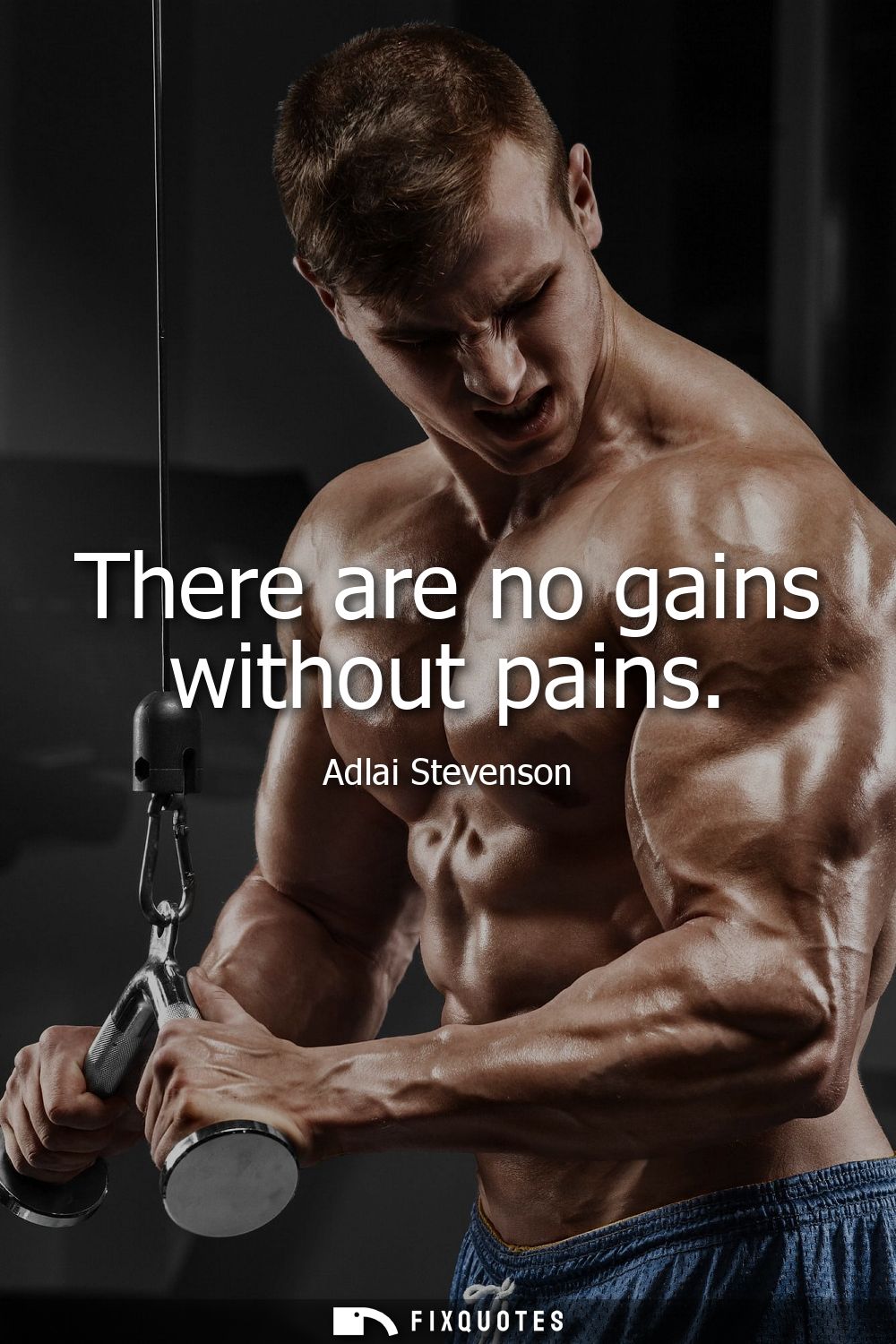
"There are no gains without pains"
About this Quote
Stevenson’s line lands like a civic version of “eat your vegetables”: blunt, unglamorous, and aimed at adults who’d prefer politics to feel painless. “There are no gains without pains” isn’t poetry so much as a governing ethic. Coming from a mid-century American politician trying to sell the public on serious trade-offs, it functions as preemptive realism: if you want security, prosperity, or reform, you’re going to pay for it in taxes, patience, restraint, or disrupted habits.
The phrase works because it narrows the moral universe. “Gains” are framed as legitimate, collective goods; “pains” become the unavoidable admission fee. That’s persuasive rhetoric in a democracy built on consumer comfort: it recasts sacrifice as maturity, and complaint as childishness. It also quietly launders political choice into natural law. Saying “no gains without pains” implies the pain is structurally necessary rather than a product of who gets protected, who gets cut, and which interests wrote the policy. It’s a line that can dignify shared hardship - wartime mobilization, civil rights enforcement, fiscal discipline - while also providing cover for avoidable suffering.
In Stevenson’s mouth, the subtext is: stop asking for miracles and start accepting responsibility. The intent isn’t to threaten; it’s to steel an audience against the seductive promise of cost-free progress. It’s the rhetoric of sober governance, and its danger is the same as its strength: it can tell the truth about trade-offs while discouraging scrutiny of whose pain counts, and why.
The phrase works because it narrows the moral universe. “Gains” are framed as legitimate, collective goods; “pains” become the unavoidable admission fee. That’s persuasive rhetoric in a democracy built on consumer comfort: it recasts sacrifice as maturity, and complaint as childishness. It also quietly launders political choice into natural law. Saying “no gains without pains” implies the pain is structurally necessary rather than a product of who gets protected, who gets cut, and which interests wrote the policy. It’s a line that can dignify shared hardship - wartime mobilization, civil rights enforcement, fiscal discipline - while also providing cover for avoidable suffering.
In Stevenson’s mouth, the subtext is: stop asking for miracles and start accepting responsibility. The intent isn’t to threaten; it’s to steel an audience against the seductive promise of cost-free progress. It’s the rhetoric of sober governance, and its danger is the same as its strength: it can tell the truth about trade-offs while discouraging scrutiny of whose pain counts, and why.
Quote Details
| Topic | Perseverance |
|---|---|
| Source | Rejected source: Looking Outward Years Of Crisis At The United Nation (Adlai E. Stevenson, 1961)IA: lookingoutwardye013117mbp
Evidence: questions they are not irrelevant because there can be no disarmament without ag Other candidates (2) Adlai Stevenson II (Adlai E. Stevenson) compilation95.0% an people lets tell them the truth that there are no gains without pains that we The Political Thought of Adlai E. Stevenson (William Robert Latimer, 1955) compilation95.0% ... Stevenson asked , coming to the heart of his case : Let's face it . Let's talk sense to the American people . Let... |
| Featured | This quote was our Quote of the Day on August 27, 2023 |
More Quotes by Adlai
Add to List