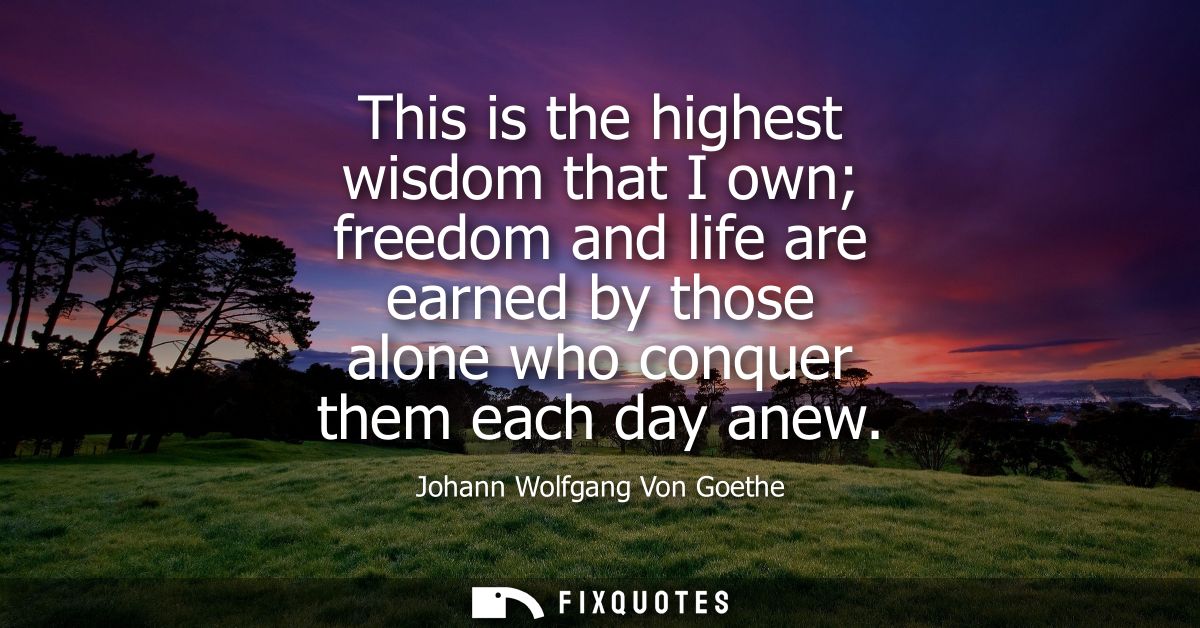
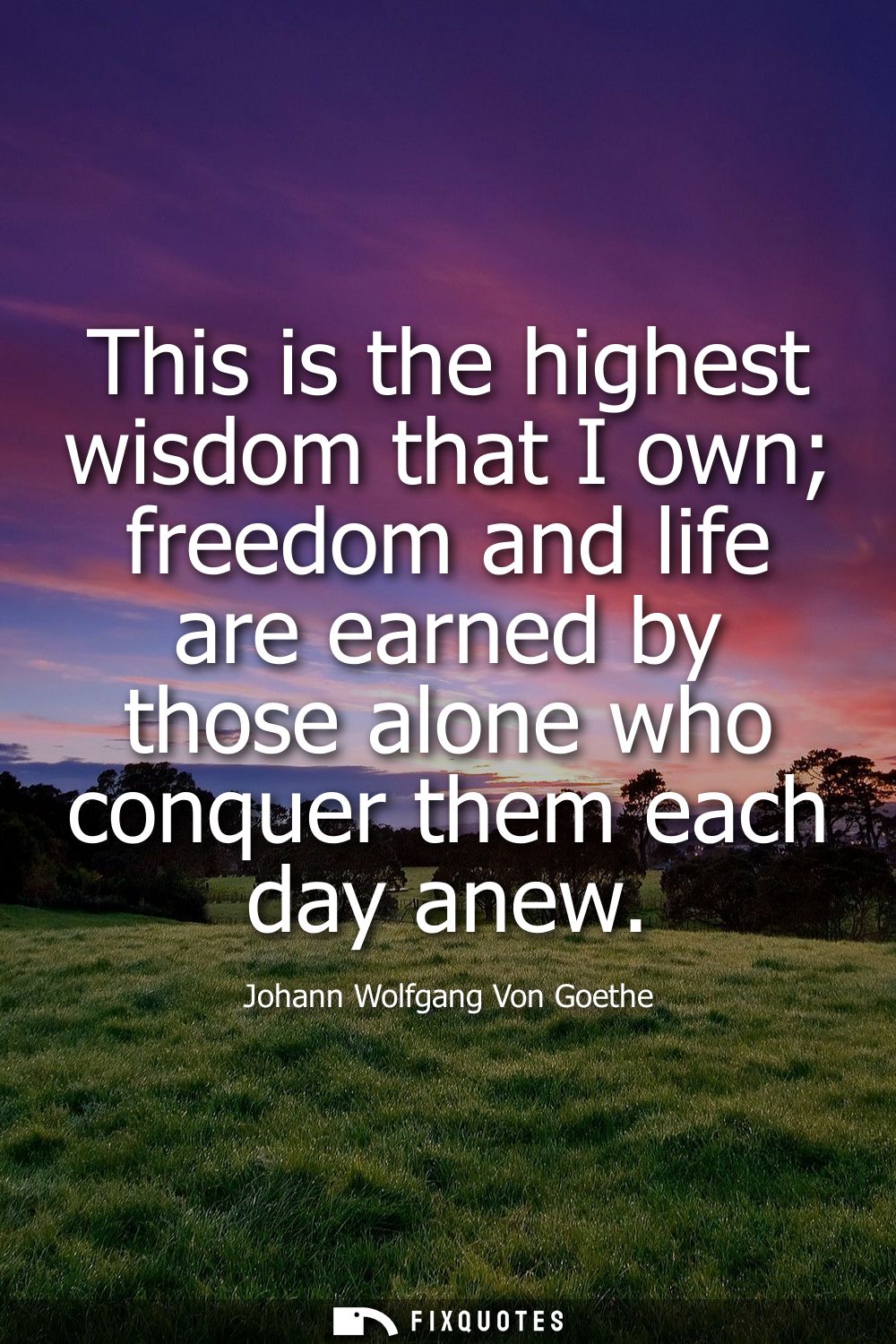
"This is the highest wisdom that I own; freedom and life are earned by those alone who conquer them each day anew"
About this Quote
Freedom, for Goethe, is not a birthright you cash once and spend forever; it is a daily expense. The line’s swaggering compression is the point: “highest wisdom” arrives not as mystical serenity but as a hard, almost muscular rule for living. He couples “freedom and life” as if they’re inseparable, implying that existence without agency is a kind of half-life, and agency without continual effort is a fantasy.
The verb choice does the heavy lifting. “Earned” yanks the thought out of abstraction and into ethics: you are responsible for the conditions of your own liberty. “Conquer” raises the temperature further. This isn’t gentle self-improvement; it’s a struggle against inertia, against complacency, against the creeping habit of letting systems (political, social, even personal) run on autopilot. Then Goethe tightens the screw with “each day anew,” a phrase that refuses the comforting arc of permanent achievement. Yesterday’s victory doesn’t accumulate interest; it expires.
Context matters: Goethe writes out of an age where Europe is convulsed by revolution, reaction, and the remaking of public life. He’s skeptical of utopias that promise freedom as a final destination, yet he’s equally suspicious of resignation. The subtext reads like a warning to the comfortable and a dare to the restless: if you treat liberty as a possession, you will lose it. If you treat it as a practice, you might keep both your freedom and your life from going stale.
The verb choice does the heavy lifting. “Earned” yanks the thought out of abstraction and into ethics: you are responsible for the conditions of your own liberty. “Conquer” raises the temperature further. This isn’t gentle self-improvement; it’s a struggle against inertia, against complacency, against the creeping habit of letting systems (political, social, even personal) run on autopilot. Then Goethe tightens the screw with “each day anew,” a phrase that refuses the comforting arc of permanent achievement. Yesterday’s victory doesn’t accumulate interest; it expires.
Context matters: Goethe writes out of an age where Europe is convulsed by revolution, reaction, and the remaking of public life. He’s skeptical of utopias that promise freedom as a final destination, yet he’s equally suspicious of resignation. The subtext reads like a warning to the comfortable and a dare to the restless: if you treat liberty as a possession, you will lose it. If you treat it as a practice, you might keep both your freedom and your life from going stale.
Quote Details
| Topic | Wisdom |
|---|---|
| Source | Help us find the source |
More Quotes by Johann
Add to List