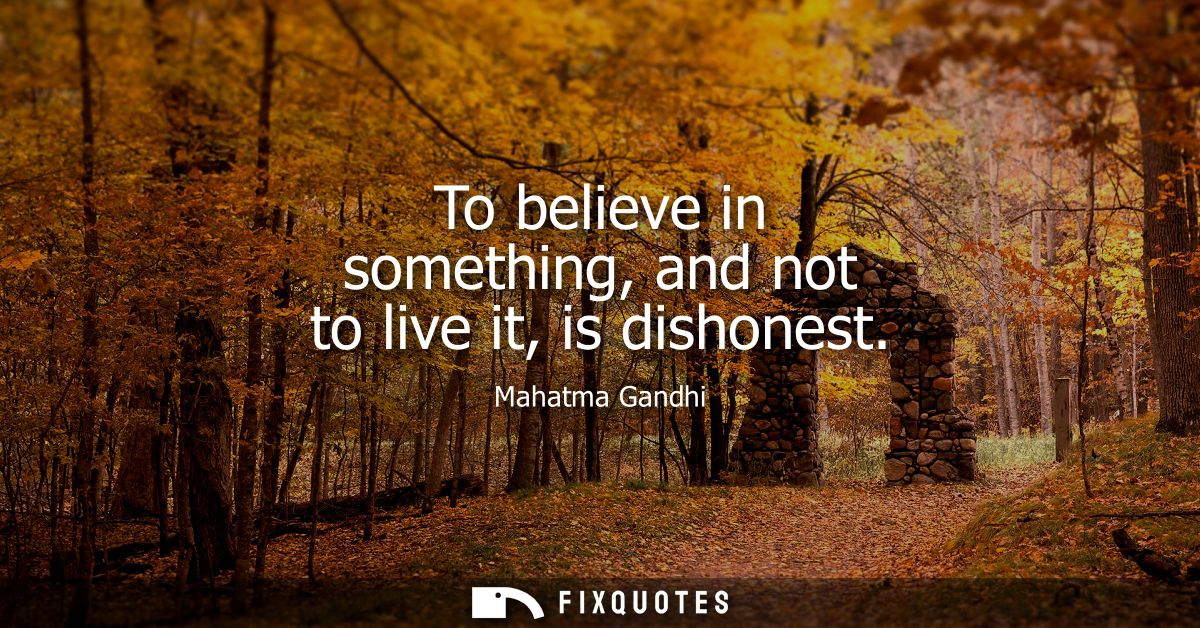
"To believe in something, and not to live it, is dishonest"
About this Quote
Gandhi’s line lands like a moral audit: belief is not a private possession, it’s a public claim on your behavior. In one sentence, he collapses the comfortable gap between what people say they stand for and what they actually do when the cost arrives. The genius is the blunt accusation embedded in the grammar. It doesn’t call inconsistency a weakness or a human slip; it calls it dishonesty. That word drags the issue out of the realm of mood and into the realm of ethics, where excuses don’t get you off the hook.
The subtext is aimed at multiple audiences at once. It chastises the colonizer who professes liberal ideals while administering an empire, but it also needles the nationalist who wants freedom without discipline, sacrifice, or restraint. Gandhi’s politics depended on credibility: nonviolent resistance only works if the resister’s life is legible, coherent, and hard to dismiss as opportunism. “Live it” is strategy disguised as sermon. It turns virtue into proof.
Context matters: Gandhi’s authority was built less on office than on personal example - fasting, simple dress, ascetic routines, an insistence that means and ends can’t be separated. In that world, hypocrisy wasn’t just personal failure; it was political sabotage, a gift to opponents who could write the entire movement off as theater. The line pressures you toward alignment, not purity. It asks whether your professed values show up where it hurts: in money, power, comfort, and how you treat people who can’t reward you.
The subtext is aimed at multiple audiences at once. It chastises the colonizer who professes liberal ideals while administering an empire, but it also needles the nationalist who wants freedom without discipline, sacrifice, or restraint. Gandhi’s politics depended on credibility: nonviolent resistance only works if the resister’s life is legible, coherent, and hard to dismiss as opportunism. “Live it” is strategy disguised as sermon. It turns virtue into proof.
Context matters: Gandhi’s authority was built less on office than on personal example - fasting, simple dress, ascetic routines, an insistence that means and ends can’t be separated. In that world, hypocrisy wasn’t just personal failure; it was political sabotage, a gift to opponents who could write the entire movement off as theater. The line pressures you toward alignment, not purity. It asks whether your professed values show up where it hurts: in money, power, comfort, and how you treat people who can’t reward you.
Quote Details
| Topic | Honesty & Integrity |
|---|---|
| Source | Help us find the source |
| Cite |
Citation Formats
APA Style (7th ed.)
Gandhi, Mahatma. (2026, January 15). To believe in something, and not to live it, is dishonest. FixQuotes. https://fixquotes.com/quotes/to-believe-in-something-and-not-to-live-it-is-26119/
Chicago Style
Gandhi, Mahatma. "To believe in something, and not to live it, is dishonest." FixQuotes. January 15, 2026. https://fixquotes.com/quotes/to-believe-in-something-and-not-to-live-it-is-26119/.
MLA Style (9th ed.)
"To believe in something, and not to live it, is dishonest." FixQuotes, 15 Jan. 2026, https://fixquotes.com/quotes/to-believe-in-something-and-not-to-live-it-is-26119/. Accessed 12 Feb. 2026.
More Quotes by Mahatma
Add to List