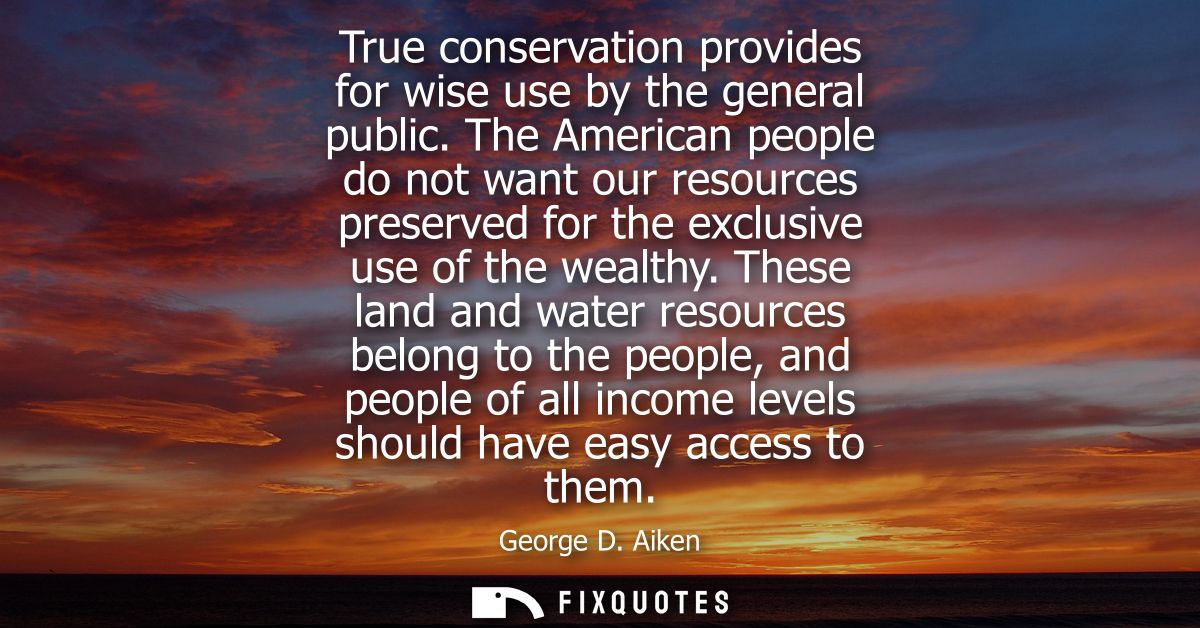
"True conservation provides for wise use by the general public. The American people do not want our resources preserved for the exclusive use of the wealthy. These land and water resources belong to the people, and people of all income levels should have easy access to them"
About this Quote
Aiken frames conservation not as a museum policy for scenery, but as a democratic entitlement. The key move is his insistence on "wise use" by "the general public" - a phrase that spikes the romantic, lock-it-up version of preservation and replaces it with a civic bargain: resources can be protected and still lived with. In mid-century American politics, that was a live wire. Conservation was being pulled between two poles: industrial extraction dressed up as progress, and a patrician strain of environmentalism that could feel like a country club with better views.
His real target is class gating. "Exclusive use of the wealthy" is less a literal accusation than a moral indictment of how access works in practice: private camps, posted land, expensive travel, leisure time, and the quiet social codes that decide who belongs outdoors. Aiken, a Vermont Republican with a farmer's instincts, is translating land ethics into populist politics. He suggests that public lands and waters are not just assets to be managed, but proof of equal standing - the kind of national inheritance that should be felt in an ordinary weekend, not only admired in a brochure.
The rhetoric works because it refuses to choose between stewardship and access. "Belong to the people" isn't just legal language; it's a claim about legitimacy. If conservation becomes a privilege, it will lose its political base and, eventually, its protection. Aiken is arguing that the surest way to save nature is to make it part of everyday citizenship.
His real target is class gating. "Exclusive use of the wealthy" is less a literal accusation than a moral indictment of how access works in practice: private camps, posted land, expensive travel, leisure time, and the quiet social codes that decide who belongs outdoors. Aiken, a Vermont Republican with a farmer's instincts, is translating land ethics into populist politics. He suggests that public lands and waters are not just assets to be managed, but proof of equal standing - the kind of national inheritance that should be felt in an ordinary weekend, not only admired in a brochure.
The rhetoric works because it refuses to choose between stewardship and access. "Belong to the people" isn't just legal language; it's a claim about legitimacy. If conservation becomes a privilege, it will lose its political base and, eventually, its protection. Aiken is arguing that the surest way to save nature is to make it part of everyday citizenship.
Quote Details
| Topic | Equality |
|---|
More Quotes by George
Add to List