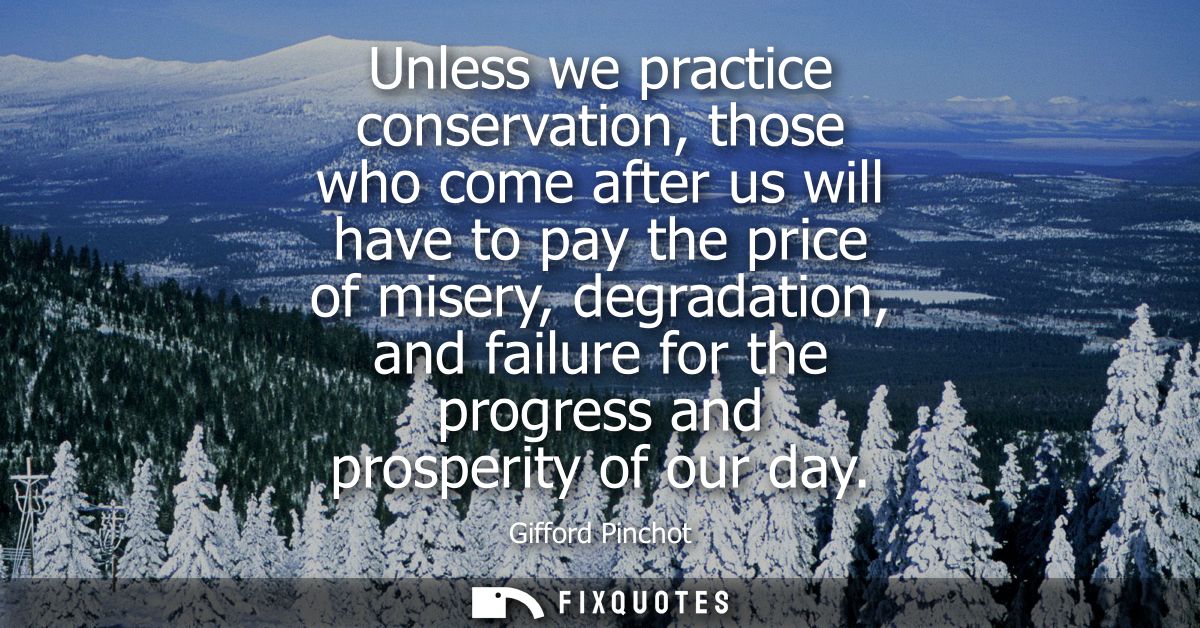
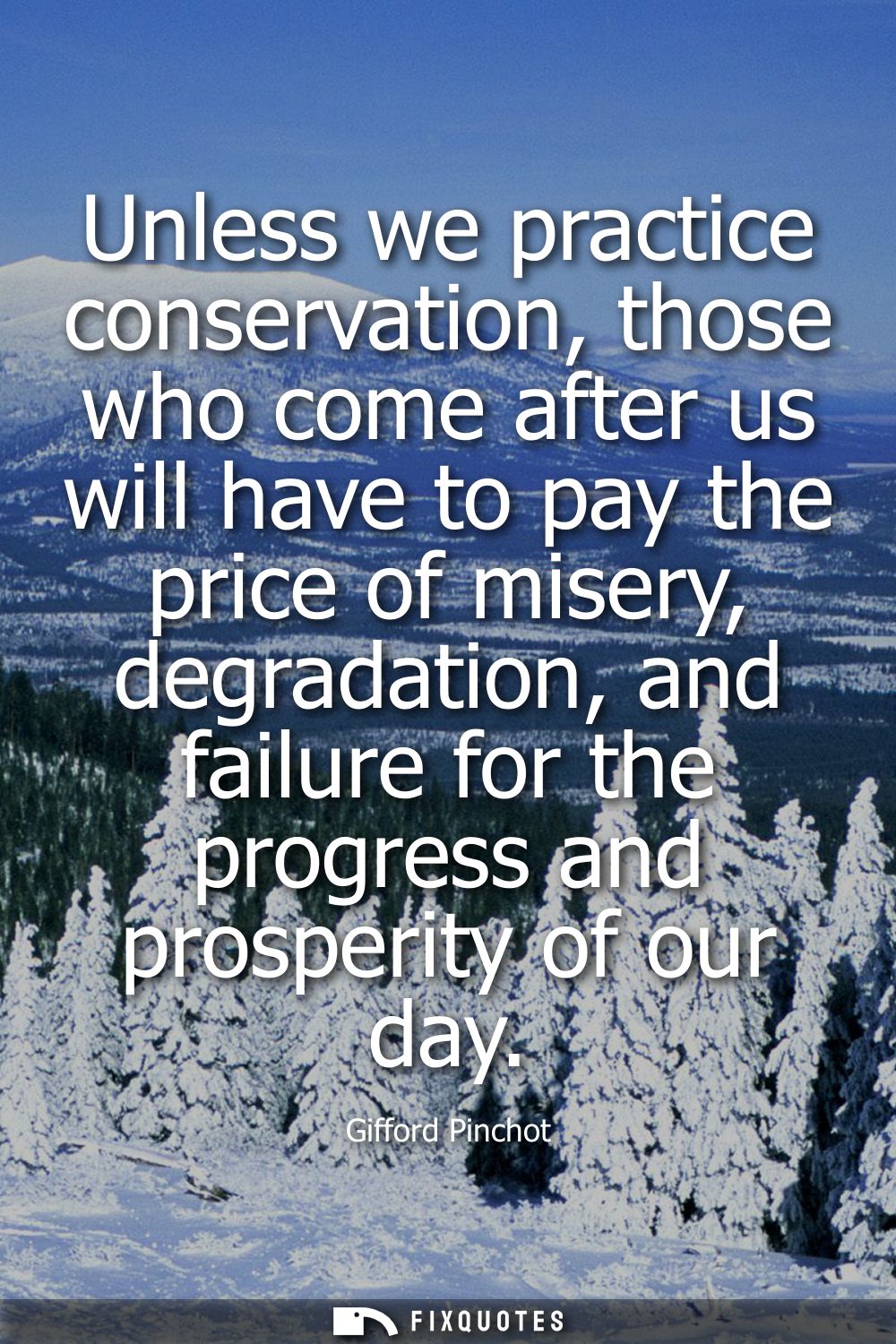
"Unless we practice conservation, those who come after us will have to pay the price of misery, degradation, and failure for the progress and prosperity of our day"
About this Quote
Pinchot writes like a man trying to rename “progress” before it hardens into an excuse. The sentence is built as a moral boomerang: whatever comfort and wealth the present is bragging about will snap back as “misery, degradation, and failure” for the future. It’s not a gentle appeal to stewardship; it’s a warning that prosperity can be a kind of theft when it’s financed with depleted forests, exhausted soils, and polluted water. The punch comes from the accounting language hiding inside the sermon: “pay the price.” Conservation isn’t framed as sentiment but as fiscal and civic discipline.
The subtext is political combat. Pinchot, a central architect of early 20th-century American conservation and the first chief of the U.S. Forest Service, was arguing against an economy that treated public land as a one-time giveaway. He’s also drawing a line between “progress” as extraction and progress as management. His conservation ethos was explicitly utilitarian: resources should be used, but used in a way that keeps them productive. That’s why he pairs “progress and prosperity” with their dark ledger entries. He’s speaking to a nation intoxicated by industrial expansion, urban growth, and corporate power, insisting that the bill doesn’t disappear just because it’s deferred.
What makes the rhetoric work is its temporal shame. Pinchot recruits the unborn as witnesses. “Those who come after us” turns policy into legacy and forces the reader to imagine being judged by descendants living among the wreckage of today’s “success.” It’s not abstract ecology; it’s consequence, framed as betrayal.
The subtext is political combat. Pinchot, a central architect of early 20th-century American conservation and the first chief of the U.S. Forest Service, was arguing against an economy that treated public land as a one-time giveaway. He’s also drawing a line between “progress” as extraction and progress as management. His conservation ethos was explicitly utilitarian: resources should be used, but used in a way that keeps them productive. That’s why he pairs “progress and prosperity” with their dark ledger entries. He’s speaking to a nation intoxicated by industrial expansion, urban growth, and corporate power, insisting that the bill doesn’t disappear just because it’s deferred.
What makes the rhetoric work is its temporal shame. Pinchot recruits the unborn as witnesses. “Those who come after us” turns policy into legacy and forces the reader to imagine being judged by descendants living among the wreckage of today’s “success.” It’s not abstract ecology; it’s consequence, framed as betrayal.
Quote Details
| Topic | Nature |
|---|
More Quotes by Gifford
Add to List