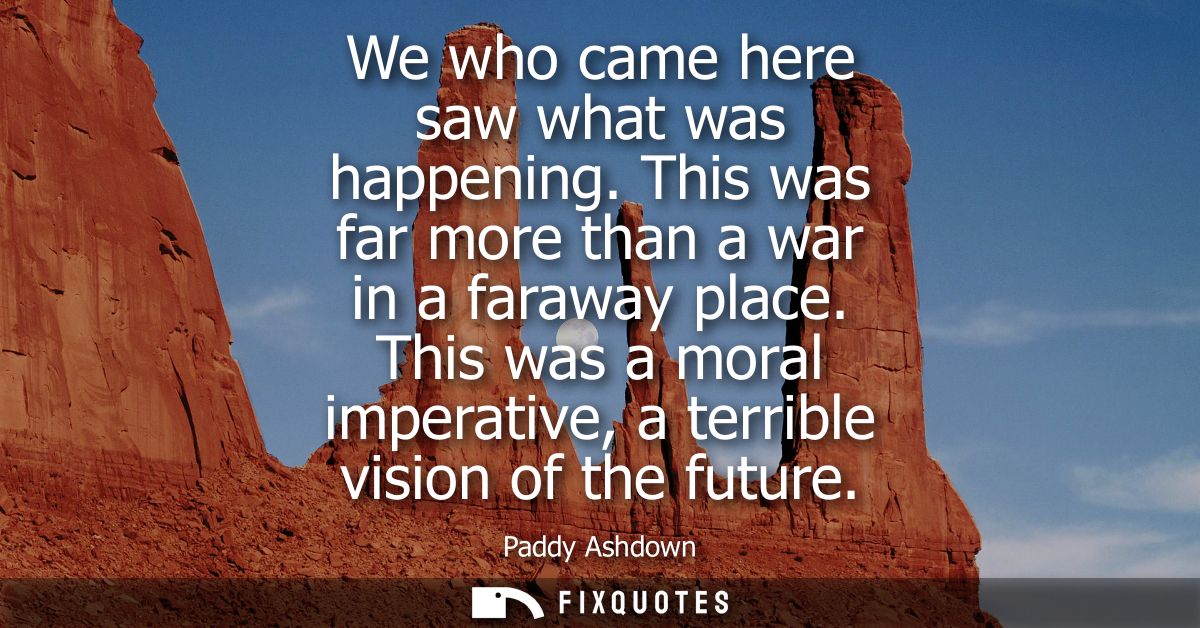
"We who came here saw what was happening. This was far more than a war in a faraway place. This was a moral imperative, a terrible vision of the future"
About this Quote
Ashdown’s line reads like a rebuke aimed as much at Western complacency as at the perpetrators of violence. “We who came here” draws a hard boundary between those with firsthand witness and those safely buffered by distance, media mediation, and diplomatic euphemism. It’s not just a memoirist’s “I was there” credential; it’s a moral claim to authority, implicitly accusing armchair skeptics and cautious policymakers of choosing ignorance when evidence was available.
The pivot from “a war in a faraway place” to “a moral imperative” is doing blunt political work. In the 1990s, Bosnia was routinely framed as ancient ethnic hatred, tragic but local, a problem for humanitarian aid rather than decisive intervention. Ashdown rejects that comforting categorization. “Faraway” becomes the alibi he’s stripping away: distance as permission to delay.
“Terrible vision of the future” widens the charge beyond a single theater. The subtext is prophetic warning: if Europe can watch mass atrocity return to its continent and treat it as someone else’s mess, then the post-Cold War promise of rules, human rights, and “never again” is theater. The future he gestures toward isn’t just more war; it’s a world where impunity is normalized and moral language is severed from policy.
As a politician, Ashdown is also retrofitting urgency into history, insisting that the correct response was obvious to anyone present. That insistence is strategic: it converts witness into indictment, and indictment into a mandate for action the next time “faraway” starts to sound like an excuse.
The pivot from “a war in a faraway place” to “a moral imperative” is doing blunt political work. In the 1990s, Bosnia was routinely framed as ancient ethnic hatred, tragic but local, a problem for humanitarian aid rather than decisive intervention. Ashdown rejects that comforting categorization. “Faraway” becomes the alibi he’s stripping away: distance as permission to delay.
“Terrible vision of the future” widens the charge beyond a single theater. The subtext is prophetic warning: if Europe can watch mass atrocity return to its continent and treat it as someone else’s mess, then the post-Cold War promise of rules, human rights, and “never again” is theater. The future he gestures toward isn’t just more war; it’s a world where impunity is normalized and moral language is severed from policy.
As a politician, Ashdown is also retrofitting urgency into history, insisting that the correct response was obvious to anyone present. That insistence is strategic: it converts witness into indictment, and indictment into a mandate for action the next time “faraway” starts to sound like an excuse.
Quote Details
| Topic | War |
|---|---|
| Source | Help us find the source |
More Quotes by Paddy
Add to List