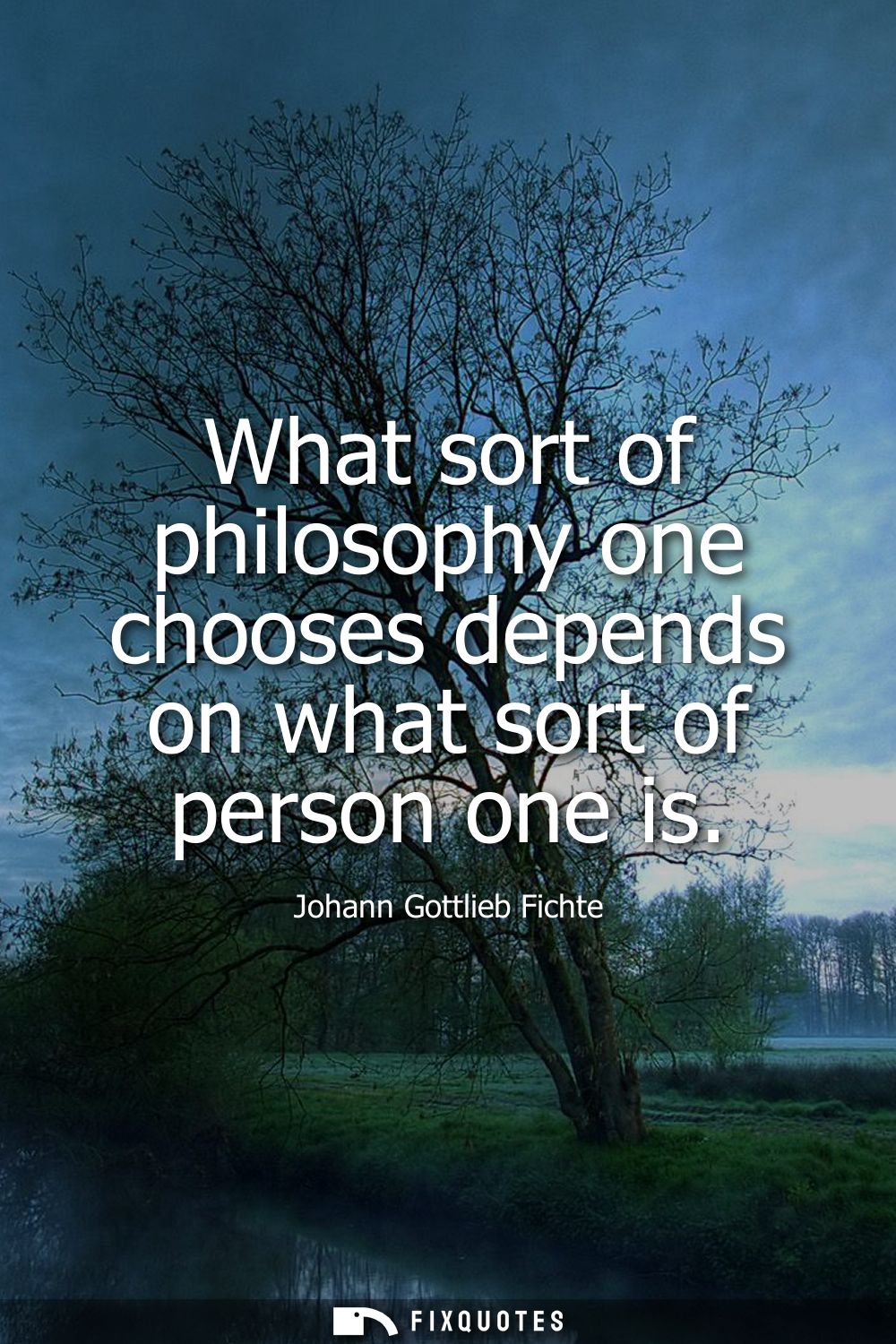
"What sort of philosophy one chooses depends on what sort of person one is"
About this Quote
Philosophy, Fichte implies, is less a neutral toolkit than a confession. The line lands like a rebuke to the Enlightenment fantasy that ideas are chosen the way a careful shopper compares products: rationally, objectively, free of personal baggage. For Fichte, that is self-deception. Your “system” is a portrait of your temperament, your moral courage, your appetite for freedom, even your willingness to accept responsibility for the world you help make.
The subtext is pointed: arguments are rarely just arguments. When someone insists that humans are basically passive, determined, or helpless, Fichte hears a kind of character claim hiding inside the metaphysics. His own project in German Idealism turns on the active “I,” the self that posits and shapes experience. So the quote doubles as a defense of his philosophy and a diagnosis of his opponents: to prefer a worldview that minimizes agency may be, in his eyes, to prefer moral comfort over moral demand.
Context matters. Writing in the wake of Kant, with Europe convulsed by revolution and reaction, Fichte is obsessed with autonomy: not only in the abstract, but as a civic and ethical posture. The sentence compresses that era’s stakes into a single psychological insight. It works because it drags philosophy down from the lecture hall and forces it to answer a personal question: what kind of life does this idea authorize? If your metaphysics lets you off the hook, Fichte suggests, that may be the point.
The subtext is pointed: arguments are rarely just arguments. When someone insists that humans are basically passive, determined, or helpless, Fichte hears a kind of character claim hiding inside the metaphysics. His own project in German Idealism turns on the active “I,” the self that posits and shapes experience. So the quote doubles as a defense of his philosophy and a diagnosis of his opponents: to prefer a worldview that minimizes agency may be, in his eyes, to prefer moral comfort over moral demand.
Context matters. Writing in the wake of Kant, with Europe convulsed by revolution and reaction, Fichte is obsessed with autonomy: not only in the abstract, but as a civic and ethical posture. The sentence compresses that era’s stakes into a single psychological insight. It works because it drags philosophy down from the lecture hall and forces it to answer a personal question: what kind of life does this idea authorize? If your metaphysics lets you off the hook, Fichte suggests, that may be the point.
Quote Details
| Topic | Wisdom |
|---|
More Quotes by Johann
Add to List