
Charlie Chaplin Biography Quotes 40 Report mistakes
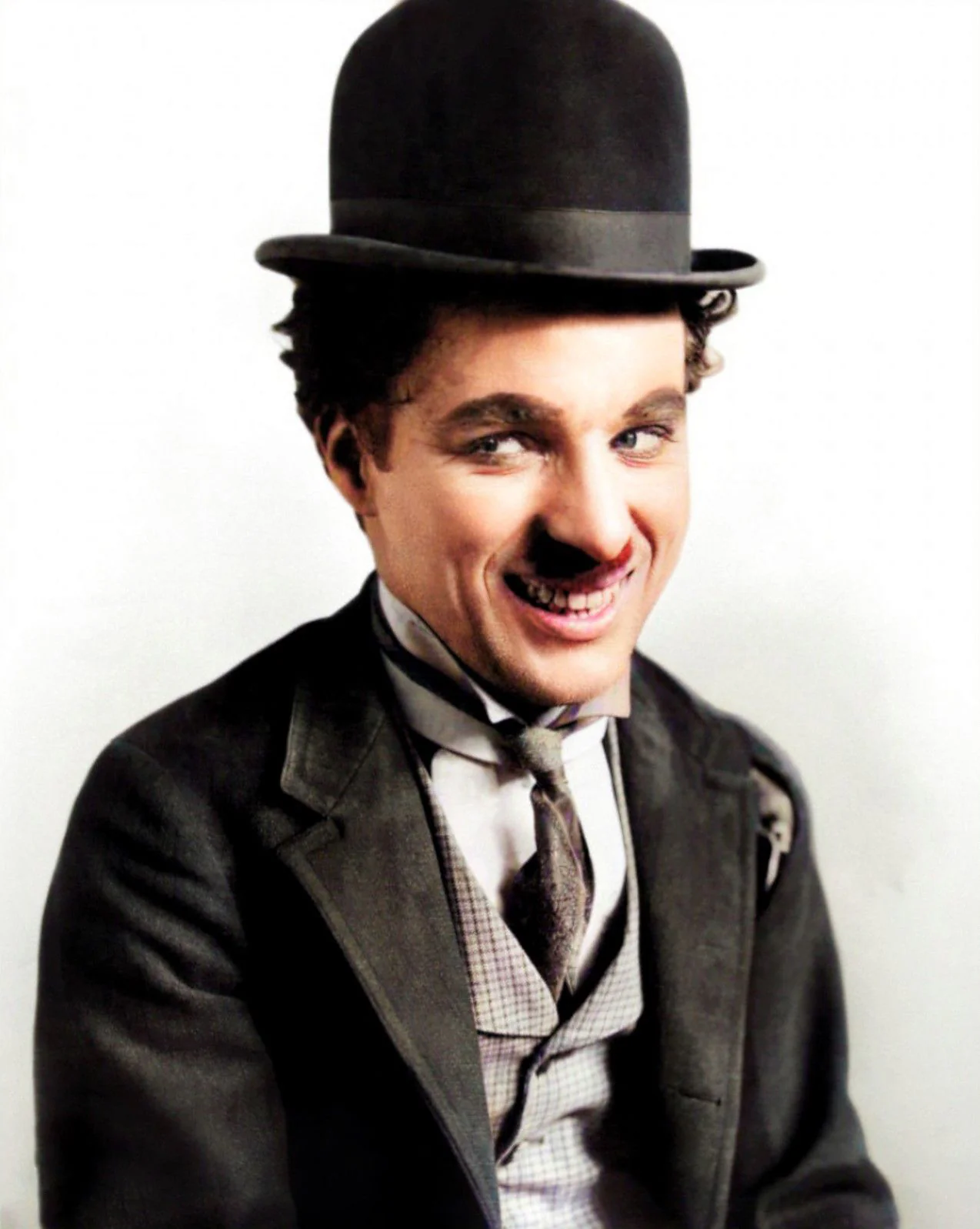
| 40 Quotes | |
| Born as | Charles Spencer Chaplin |
| Occup. | Actor |
| From | England |
| Spouses | Mildred Harris (1918-1920) Lita Grey (1924-1927) Paulette Goddard (1936-1942) Oona O'Neill (1943) |
| Born | April 16, 1889 London, England |
| Died | December 25, 1977 Corsier-sur-Vevey, Switzerland |
| Aged | 88 years |
| Cite | |
Citation Formats
APA Style (7th ed.)
Charlie chaplin biography, facts and quotes. (2026, February 1). FixQuotes. https://fixquotes.com/actors/charlie-chaplin/
Chicago Style
"Charlie Chaplin biography, facts and quotes." FixQuotes. February 1, 2026. https://fixquotes.com/actors/charlie-chaplin/.
MLA Style (9th ed.)
"Charlie Chaplin biography, facts and quotes." FixQuotes, 1 Feb. 2026, https://fixquotes.com/actors/charlie-chaplin/. Accessed 31 Mar. 2026.
Early Life and Background
Charles Spencer Chaplin was born on 1889-04-16 in Walworth, South London, into the precarious world of music hall. His parents, Hannah Hill (who performed as Lily Harley) and Charles Chaplin Sr., were stage entertainers whose livelihoods rose and fell with bookings, illness, and drink. The London of his childhood was a city of imperial wealth and grinding poverty, and Chaplin learned early how fast dignity could slip into destitution when rent, food, and health failed to keep pace.When Hannahs voice gave out and her mental health deteriorated, the family unraveled. Chaplin and his half-brother Sydney spent periods in the Lambeth Workhouse and the Central London District School for pauper children, institutions designed less for tenderness than for discipline and containment. Those years gave him his lifelong sensitivity to hunger, humiliation, and the thin line between public amusement and private despair - a psychological template he would later transmute into comedy that never forgot the taste of need.
Education and Formative Influences
Chaplin had little formal schooling; his education was the stage, the street, and the backstage economy of performers. He began working as a child dancer and comic, including time with the Eight Lancashire Lads, before apprenticing himself to the rigors of touring farce and pantomime. A crucial formation came with Fred Karnos company, where Chaplin absorbed precise physical timing, the grammar of slapstick, and the discipline of building a character from gesture. In 1912 the troupe toured the United States, and the era of mass entertainment - vaudeville circuits, nickelodeons, and the rapidly industrializing film business - opened to him like a new continent.Career, Major Works, and Turning Points
Signed by Mack Sennett at Keystone in 1913, Chaplin began shaping the Tramp in 1914, then quickly sought greater control at Essanay (1915), Mutual (1916-17), and First National (1918). His rise paralleled the maturation of cinema from novelty to art, and he became both star and auteur, writing, directing, editing, and composing. With Mary Pickford, Douglas Fairbanks, and D.W. Griffith he co-founded United Artists in 1919 to protect creative autonomy. Major works include The Kid (1921), The Gold Rush (1925), City Lights (1931), Modern Times (1936), and The Great Dictator (1940), whose anti-fascist satire made him a global political voice. Postwar America turned suspicious: accusations about morals and leftist sympathies, coupled with HUAC-era pressures, culminated in 1952 when, traveling for the premiere of Limelight, he was effectively barred from reentry; he settled in Switzerland. Later films such as A King in New York (1957) and A Countess from Hong Kong (1967) met a changed culture. He returned briefly to the United States in 1972 for an honorary Academy Award, a public reconciliation with a man once treated as an enemy.Philosophy, Style, and Themes
Chaplins genius lay in fusing music hall immediacy with cinematic tenderness, turning bodily comedy into moral perception. The Tramp - derby, cane, tight coat, and quick, defensive grace - is a survivalist who insists on elegance while the world insists on his disposability. Chaplin described the birth of this figure as an act of embodied imagination: “I had no idea of the character. But the moment I was dressed, the clothes and the make-up made me feel the person he was. I began to know him, and by the time I walked onto the stage he was fully born”. Psychologically, that is Chaplin in miniature: identity as performance, performance as refuge, and the costume as armor against shame.His films repeatedly pivot on distance - between observer and sufferer, crowd and individual, machine and body. He articulated his own aesthetic of perspective with the line, “Life is a tragedy when seen in close-up, but a comedy in long-shot”. The Tramp is often filmed as a small figure against vast streets, factories, and bureaucracies, inviting laughter that catches in the throat when the camera returns to the face. Chaplins suspicion of collective cruelty also hardens into political theory: “Man as an individual is a genius. But men in the mass form the headless monster, a great, brutish idiot that goes where prodded”. That fear animates Modern Times and The Great Dictator, where systems - industrial or ideological - grind human nuance into uniform motion, and where comedy becomes a plea for conscience.
Legacy and Influence
Chaplin died on 1977-12-25 in Corsier-sur-Vevey, Switzerland, leaving a body of work that helped define the language of screen acting and the possibilities of writer-director control. His pantomime, rhythmic editing, and sentimental restraint shaped everyone from Buster Keaton scholars to Jacques Tati, Federico Fellini, and later silent-influenced comedians and animators. More enduring still is the psychological courage of his central invention: a poor man who refuses to stop being human, insisting on charm as a form of resistance. In an era that oscillated between mass spectacle and mass fear, Chaplin proved that laughter could be both shelter and indictment - a universal art built from the smallest, most vulnerable gestures.Our collection contains 40 quotes written by Charlie, under the main topics: Witty One-Liners - Wisdom - Art - Puns & Wordplay - Friendship.
Other people related to Charlie: Stan Laurel (Actor), Benny Hill (Comedian), Claire Bloom (Actress), Emma Stone (Actress), Pola Negri (Actress), D. W. Griffith (Director), Fatty Arbuckle (Comedian), Walter Kerr (Critic), Tippi Hedren (Actress), Paul Merton (Comedian)
Source / external links