
John Donne Biography Quotes 30 Report mistakes
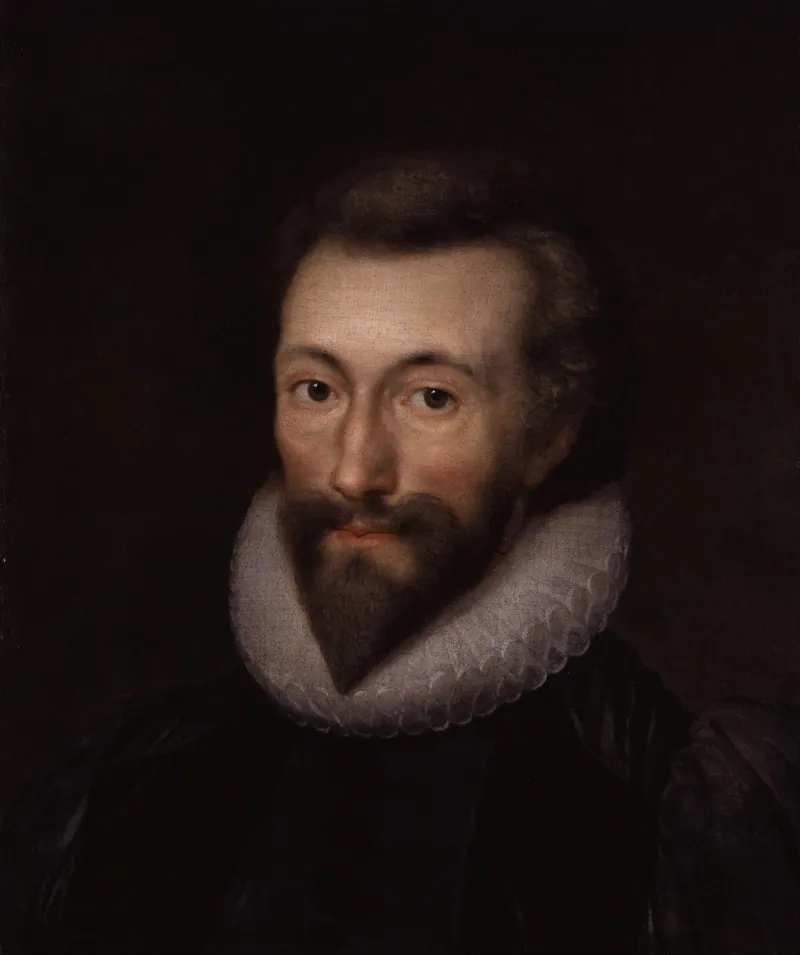
| 30 Quotes | |
| Occup. | Poet |
| From | United Kingdom |
| Born | January 24, 1572 London, England, UK |
| Died | March 31, 1631 London, England, UK |
| Cause | Fever |
| Aged | 59 years |
John Donne was born in London on January 24, 1572, into a recusant Catholic family living under the long shadow of Elizabethan anti-Catholic law. His father, John Donne, was a prosperous ironmonger; his mother, Elizabeth Heywood, connected him to a network of eminent Catholic kin, including the playwright John Heywood and, by lineage, the martyred Sir Thomas More. That pedigree brought both cultural capital and danger: in Donne's England, religion shaped careers, marriages, and the reach of state power into private conscience.
His father died when Donne was young, and the household was sustained by his widowed mother and guardians who aimed to secure him a gentleman's prospects. But the pressures of conformity were not abstract. His brother Henry was imprisoned for harboring a Catholic priest and died in Newgate in 1593, a family trauma that sharpened Donne's sense of the body as a political target and the soul as a contested jurisdiction. From early on he learned to write as someone both inside and outside his nation - intellectually ambitious, socially mobile, and spiritually wary.
Education and Formative Influences
Donne attended Hart Hall, Oxford, and later Cambridge, but could not take a degree without swearing the Oath of Supremacy. He then studied at Lincoln's Inn (from 1592), absorbing the habits of legal argument, casuistry, and the rhetoric of contradiction that later powered his poetry and sermons. He traveled widely, joining the Earl of Essex's expedition to Cadiz (1596) and the Azores voyage (1597), experiences that fed his sense of a world remade by navigation, imperial rivalry, and new science, even as he continued to probe the costs of belief and belonging in a confessional state.
Career, Major Works, and Turning Points
By the late 1590s Donne had become secretary to Sir Thomas Egerton, Lord Keeper of the Great Seal, placing him near the center of Jacobean patronage. His clandestine marriage in 1601 to Anne More, Egerton's niece, detonated that promise: Donne was briefly imprisoned, dismissed, and forced into years of financial strain as the couple raised a growing family. In this crucible he wrote much of the work that later defined him - the erotic and skeptical lyrics of the Songs and Sonnets, the Holy Sonnets, and the Anniversaries - while also producing prose of religious and political edge such as Pseudo-Martyr (1610) and Biathanatos (circulating in manuscript). After prolonged inward wrestling, he took Anglican orders in 1615 under James I's urging; in 1621 he became Dean of St Paul's Cathedral, London, where his preaching made him one of the era's most famous voices. Illness in 1623 prompted Devotions upon Emergent Occasions, and near the end he delivered the bleakly radiant sermon Death's Duel; he died March 31, 1631.
Philosophy, Style, and Themes
Donne's inner life reads as an argument conducted under pressure: desire versus discipline, skepticism versus craving for certainty, ambition versus the knowledge of mortality. He wrote in a period when inherited cosmologies were cracking, and he made that vertigo a poetic instrument: "And new Philosophy calls all in doubt, the element of fire is quite put out; the Sun is lost, and the earth, and no mans wit can well direct him where to look for it". The line is not merely topical anxiety about Copernicanism and scientific upheaval; it is a self-portrait of a mind that converts disorientation into method, using paradox and abrupt turns to stage the drama of thinking itself.
His celebrated "metaphysical" style - dense with conceits, legalistic pivots, and startling intimacy - is inseparable from his theology of relation. Love poems treat the body as both proof and problem; devotional works treat the soul as both pleading client and reluctant witness. Yet the most durable Donne is neither libertine nor dour moralist but the anatomist of interdependence, who insists that the self is always implicated in others: "Any man's death diminishes me, because I am involved in Mankind; And therefore never send to know for whom the bell tolls; it tolls for thee". Even his bleak self-scrutiny presses toward accountability rather than pose: "But I do nothing upon myself, and yet I am my own executioner". Behind the bravura lies a repeated psychological pattern - the fear that inaction is a kind of violence, and that salvation requires not only belief but the courage to be changed.
Legacy and Influence
Donne's poems circulated chiefly in manuscript during his lifetime, and the posthumous 1633 edition helped create the author modern readers know: a poet whose private voice could be made public without losing its heat. His sermons shaped Anglican devotional prose, while his lyrics influenced everything from the Augustans' argumentative precision to the modernists' fractured intensity; T. S. Eliot, among others, drew on Donne's ability to yoke intellect and passion without smoothing their conflict. Phrases from the Devotions entered common speech, and his vision of connected human fate became a moral vocabulary for crisis and community. Donne endures because he made the self a theater where history, science, desire, and death contend - and because he refused to let that contention end in mere cleverness.
Our collection contains 30 quotes who is written by John, under the main topics: Witty One-Liners - Wisdom - Truth - Art - Love.
Other people realated to John: George Herbert (Poet), John Heywood (Dramatist), Henry Wotton (Author)
John Donne Famous Works
- 1651 Letters to Several Persons of Honour (Collection of Letters)
- 1633 Divine Poems (Poetry Collection)
- 1633 Elegies (Poetry Collection)
- 1633 Holy Sonnets (Poetry Collection)
- 1631 Poems of John Donne (Poetry Collection)
- 1601 Songs and Sonnets (Poetry Collection)
- 1593 Satires (Poetry Collection)
Source / external links