
Langston Hughes Biography Quotes 14 Report mistakes
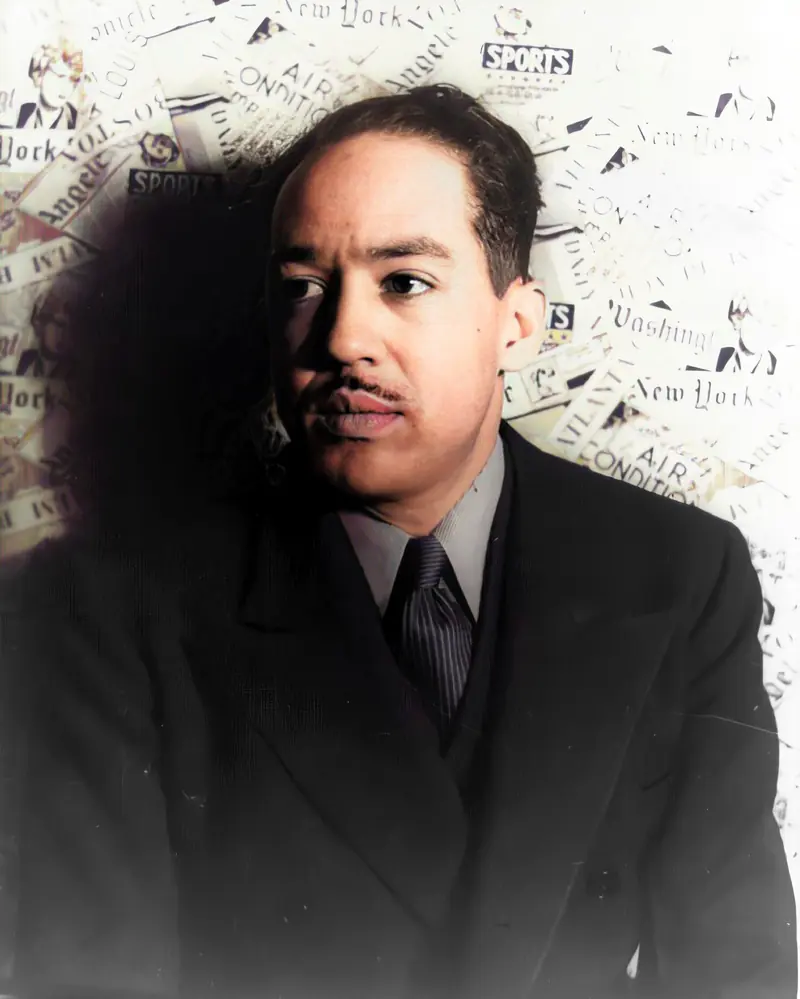
Attr: Carl Van Vechten
| 14 Quotes | |
| Born as | James Mercer Langston Hughes |
| Occup. | Poet |
| From | USA |
| Born | February 1, 1902 Joplin, Missouri, USA |
| Died | May 22, 1967 New York City, New York, USA |
| Cause | Prostate cancer |
| Aged | 65 years |
James Mercer Langston Hughes was born on February 1, 1902, in Joplin, Missouri, into a family whose history and stories shaped his sense of heritage and mission. His mother, Carrie Langston, carried forward the proud legacy of her own parents; his father, James Nathaniel Hughes, left the United States for Mexico when Langston was young, a separation that profoundly influenced the poet's recurring themes of distance, longing, and self-reliance. Much of his childhood was spent in Lawrence, Kansas, under the care of his grandmother, Mary Patterson Langston, whose memories of abolitionist struggles and Reconstruction-era hopes gave him an early, enduring sense of Black history. After her death, he lived with various relatives and eventually joined his mother in Midwestern cities, including Cleveland, where he attended high school and began writing seriously.
Education and First Publications
Hughes briefly attended Columbia University in New York in 1921, drawn to the promise of Harlem but disillusioned by racism on campus and the constraints of formal study. He left after a year, working a series of jobs that included seafaring stints to Africa and Europe. On a train to visit his father in Mexico, he composed "The Negro Speaks of Rivers", a signature poem that located African American identity in an ancient, global continuum; it appeared in The Crisis in 1921, championed by literary editor Jessie Fauset and welcomed within the orbit of W. E. B. Du Bois. By 1925, while working in Washington, D.C., he slipped poems to the visiting poet Vachel Lindsay, whose enthusiastic public reading brought national attention. That same year Hughes won prizes in Opportunity magazine's literary contest, curated by figures aligned with the Harlem Renaissance. He would earn a B.A. from Lincoln University in Pennsylvania in 1929, joining a cohort of talented peers; future civil rights leader Thurgood Marshall was among the students on that campus during Hughes's years there.
Harlem Renaissance and Literary Breakthrough
Hughes's first book of poems, The Weary Blues (1926), made him a leading voice of the Harlem Renaissance. The volume, encouraged and introduced by Carl Van Vechten and published by Knopf, announced a style that embraced blues cadences, jazz phrasing, and the vernacular speech of urban Black life. Alain Locke, the theorist of "The New Negro", saw in Hughes an artist willing to root poetry in everyday experience rather than genteel convention. The new community of writers and artists in Harlem included friends and peers such as Zora Neale Hurston, Countee Cullen, and Arna Bontemps. With Hurston, Hughes attempted the play "Mule Bone", though disagreements ended their collaboration. Fine Clothes to the Jew (1927) followed as a second poetry collection, sharper in its ear for street rhythms and less interested in respectability politics than some contemporaries preferred.
Patronage, Travel, and Political Engagement
In the late 1920s, Hughes received support from Charlotte Osgood Mason, a wealthy New York patron who also backed Hurston. The stipend allowed him to write and travel, but the relationship faltered over issues of creative control. Hughes's travels were central to his perspective: as a merchant seaman he visited Africa and Europe; he lived for a time in Paris; and in 1932 he went to the Soviet Union for a film project about African American life that ultimately collapsed. He later reported from Spain during the Civil War in 1937, filing dispatches for Black newspapers such as the Baltimore Afro-American and observing Black volunteers within the international struggle against fascism. These experiences deepened the social conscience evident in poems like "Let America Be America Again", affirming his conviction that art could be both beautiful and politically alert.
Prose, Theater, and Journalism
Hughes's range extended well beyond poetry. His novel Not Without Laughter (1930) won wide praise for its portrayal of Midwestern Black life, and he continued to publish short stories, essays, and children's books. With Arna Bontemps he collaborated on projects including the anthology The Poetry of the Negro, reflecting a shared commitment to mapping a broad African diaspora tradition. His character Jesse B. Semple, known simply as "Simple", debuted in a column for the Chicago Defender in the 1940s; through Simple's humor and barbed debates, Hughes chronicled everyday philosophy on race, work, and citizenship in a voice that felt both intimate and incisive. In theater, his play Mulatto (1935) reached Broadway, while later works such as Black Nativity (1961) brought gospel music and African American storytelling into mainstream performance spaces.
Style, Music, and Collaboration
Hughes insisted that Black music was a model for poetic form. Collections such as Shakespeare in Harlem (1942), Montage of a Dream Deferred (1951), and Ask Your Mama: 12 Moods for Jazz (1961) weave bebop speed, blues melancholy, and call-and-response into lyric structure. He collaborated closely with composers such as Margaret Bonds, creating song cycles and larger works like The Ballad of the Brown King that married poetry to orchestral and choral textures. The photographer Roy DeCarava worked with Hughes on The Sweet Flypaper of Life (1955), a hybrid of images and prose that celebrates neighborhood life in Harlem. Taken together, these partnerships show a writer who rarely stood alone on the page; he preferred the give-and-take of ensembles that echoed the improvisational energy he loved in jazz.
Public Controversies and Resilience
Hughes's left-leaning sympathies and his travels invited scrutiny in the Cold War climate. In 1953 he was called before a Senate subcommittee during the McCarthy era to answer questions about earlier poems and affiliations. He used the moment to clarify his commitments, rejecting dogma while defending the right of artists to dissent. The experience was chilling, but he continued publishing, lecturing across the country, and encouraging younger writers, among them Gwendolyn Brooks, whose breakthrough he publicly celebrated. The National Association for the Advancement of Colored People recognized his contributions with the Spingarn Medal in 1960, acknowledging both his literary achievement and his public leadership.
Autobiography and Later Years
Across two volumes of autobiography, The Big Sea (1940) and I Wonder as I Wander (1956), Hughes recounted the making of an artist forged by travel, community, and relentless work. He maintained a Harlem residence that became a gathering place for visitors, students, editors, and musicians. By the late 1950s and early 1960s, Selected Poems and later collections introduced new readers to his early work even as he kept experimenting with performance and sound. The "Simple" books continued to capture popular attention, and readings of Montage of a Dream Deferred cemented his reputation as the poet who most fully voiced the promises and pressures of midcentury urban Black life.
Death and Legacy
Langston Hughes died in New York City on May 22, 1967, from complications following abdominal surgery. His ashes were interred at the Schomburg Center for Research in Black Culture in Harlem, beneath a cosmogram bearing lines from "The Negro Speaks of Rivers", a fitting memorial to a writer who connected local detail to a vast historical river of experience. He left a body of work that stretched from lyric poetry to novels, children's stories, reportage, drama, and libretti, and he left a map of friendships and collaborations that included Zora Neale Hurston, Countee Cullen, Alain Locke, Jessie Fauset, W. E. B. Du Bois, Carl Van Vechten, Vachel Lindsay, Arna Bontemps, Margaret Bonds, Roy DeCarava, and many others. Through them, and through the communities that sustained him, Hughes turned the rhythms of Black speech and song into an enduring American art. His influence remains audible in poets and performers who follow the music of everyday language toward justice, complexity, and joy.
Our collection contains 14 quotes who is written by Langston, under the main topics: Witty One-Liners - Motivational - Never Give Up - Funny - Art.
Other people realated to Langston: Jean Toomer (Author), Thurgood Marshall (Judge), Nina Simone (Musician), Alfred A. Knopf (Publisher), James Weldon Johnson (Poet), Kurt Weill (Composer), Claude McKay (Writer)
Langston Hughes Famous Works
- 1961 Black Nativity (Play)
- 1957 Simply Heavenly (Play)
- 1956 I Wonder as I Wander (Memoir)
- 1951 Montage of a Dream Deferred (Poetry Collection)
- 1934 The Ways of White Folks (Short Story Collection)
- 1930 Not Without Laughter (Novel)
Source / external links