
Robert Indiana Biography Quotes 7 Report mistakes
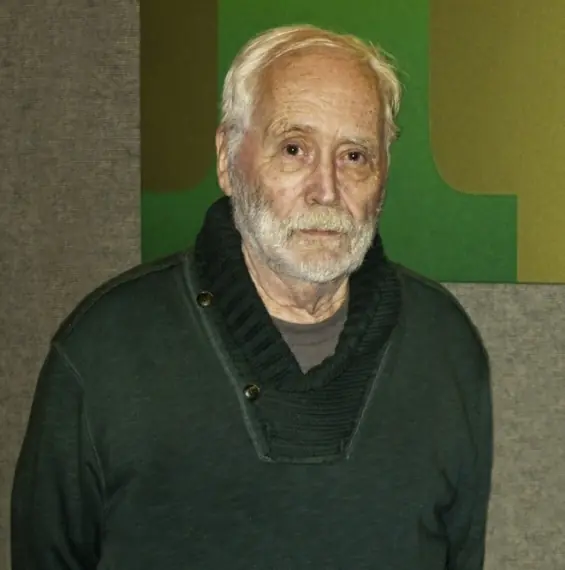
| 7 Quotes | |
| Born as | Robert Clark |
| Occup. | Artist |
| From | USA |
| Born | September 13, 1928 New Castle, Indiana, U.S. |
| Died | May 19, 2018 Vinalhaven, Maine, USA |
| Cause | respiratory failure |
| Aged | 89 years |
Robert Indiana was born Robert Clark on September 13, 1928, in New Castle, Indiana, into a working-class Midwestern world marked by the Great Depression and its aftershocks. His father worked in jobs that rose and fell with the era; his parents eventually separated, and the instability of home became a defining rhythm. The plainspoken signage of small-town America - highway markers, gas stations, diners, movie houses, church billboards - formed an early visual vocabulary that would later return as art: big letters, blunt commands, the democratic promise (and coercion) of public words.
Restlessness was not only emotional but geographic. As a child and teenager he moved repeatedly across Indiana and neighboring states, absorbing different local dialects of American optimism and fatigue. That itinerant youth sharpened his sense that identity could be both assigned and invented, and that numbers, names, and place labels could stand in for biography. Even before he had the language for it, he was collecting symbols that felt like fate: county routes, house numbers, and the kind of ordinary typography that tells you where you are and what you are supposed to do.
Education and Formative Influences
After serving in the U.S. Army Air Forces, he used the GI Bill to study art, first in Chicago at the School of the Art Institute, then in the mid-1950s at the Skowhegan School of Painting and Sculpture in Maine, and later at the Edinburgh College of Art in Scotland. Those years braided together European modernism, American vernacular design, and the moral urgency of postwar culture; he encountered abstraction and hard-edge painting while remaining drawn to the directness of commercial lettering and the emblematic power of words. In 1954 he moved to New York City, where the residue of Abstract Expressionism met an emerging Pop sensibility, and where his own work began to turn from painterly gesture toward the crisp, sign-like image.
Career, Major Works, and Turning Points
In the late 1950s and early 1960s, living and working in Lower Manhattan, he adopted the name Robert Indiana - a self-made banner linking him to a state and a set of American myths - and developed his signature "hard-edge" paintings built from stenciled letters, numbers, and heraldic forms. He gained visibility as Pop Art rose, yet he steered it toward personal allegory: The American Dream (1961-62) turned the language of aspiration into a tense, target-like emblem; EAT (1962) elevated a three-letter imperative into a cultural mirror; and his LOVE image, first explored in 1964-65 and later made iconic in prints and sculpture, became one of the most reproduced artworks of the 20th century. A key turning point came with its mass circulation - including a widely disseminated museum card - which gave him fame while intensifying his anxiety about authorship, control, and the difference between public symbol and private meaning. From the 1970s onward he often withdrew from the art-world center, eventually living in seclusion on Vinalhaven, Maine, where productivity continued alongside mounting disputes over fabrication, stewardship, and the afterlife of his brand.
Philosophy, Style, and Themes
Indiana treated painting as a form of compressed autobiography: a few blunt words could hold a whole life of desire, fear, and longing for order. He insisted that his work was not merely a mirror of consumer culture but an ethical argument staged in the language of signs. "I was the least Pop of all the Pop artists". The claim reveals a self-protective psychology - a need to separate his inner stakes from the cool detachment associated with Pop - even as he used Pop's clarity to reach a mass audience. His canvases behave like public posters, yet their emotional charge is intimate: they ask what America promises, what it sells, and what it cannot keep.
His most enduring motifs - LOVE, EAT, HUG, and sequences of numbers - were never decorative to him; they were metaphors for human craving and the attempt to assign meaning to chaos. "Some people like to paint trees. I like to paint love. I find it more meaningful than painting trees". That sentence is not just preference but confession: a man shaped by instability turning to a single word as shelter, talisman, and test. Likewise, his numerals functioned as memory architecture, an inventory of motion and displacement: "I've always been fascinated by numbers. Before I was seventeen years old, I had lived in twenty-one different houses. In my mind, each of those houses had a number". In an era that celebrated slick surfaces, Indiana used surface to expose vulnerability, making the most public language possible carry the private ache of counting where he had been.
Legacy and Influence
Robert Indiana died on May 19, 2018, on Vinalhaven, leaving behind an oeuvre that fused the billboard and the confession, the civic command and the personal prayer. LOVE became a near-universal emblem - celebrated, parodied, politicized, commodified - while his broader body of work has increasingly been reread as a complex meditation on American ideals, sexuality, faith, and the loneliness beneath national optimism. His influence runs through generations of text-based and graphic-minded art, from conceptual practices to street aesthetics, but his deeper legacy lies in his insistence that a single word, rendered with absolute clarity, can be both a public monument and a private reckoning.
Our collection contains 7 quotes who is written by Robert, under the main topics: Love - Art - Nostalgia.
Source / external links