
Ross Perot Biography Quotes 23 Report mistakes
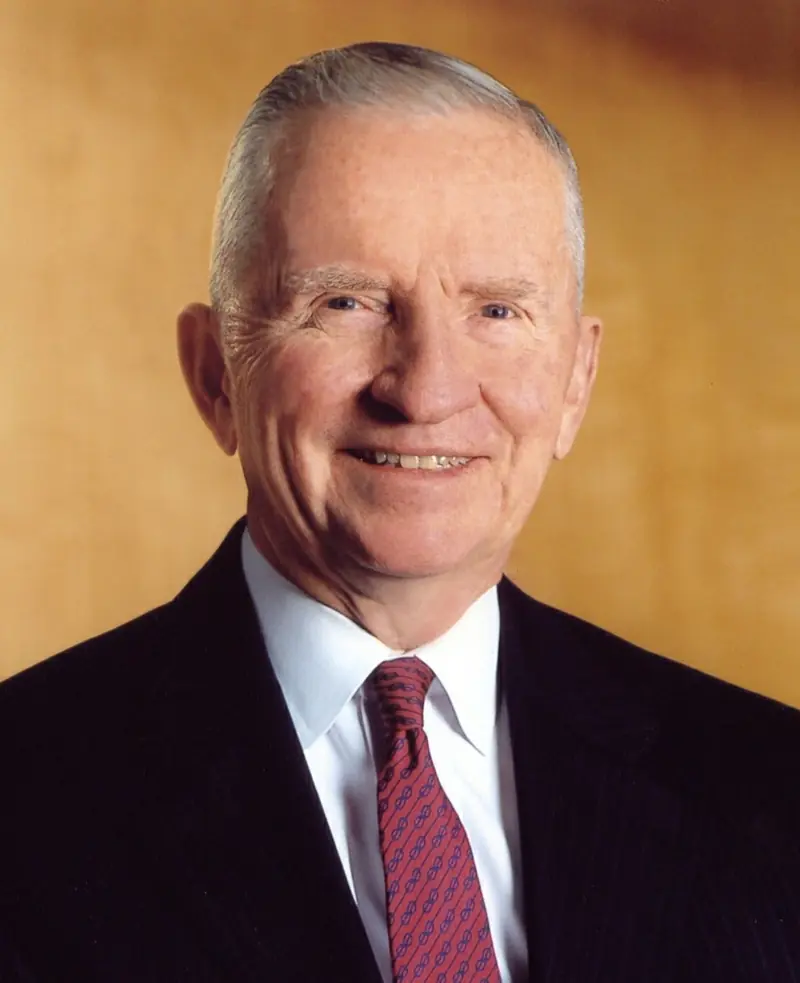
| 23 Quotes | |
| Born as | Henry Ross Perot |
| Occup. | Businessman |
| From | USA |
| Born | June 27, 1930 Texarkana, Texas |
| Age | 95 years |
Henry Ross Perot was born on June 27, 1930, in Texarkana, Texas. He grew up in a tight-knit community during the Great Depression and World War II, and from an early age he earned money through small jobs, learned salesmanship, and absorbed lessons in persistence and self-reliance. He became an Eagle Scout as a teenager and later received recognition as a Distinguished Eagle Scout, an experience he often credited with shaping his emphasis on preparation, standards, and leadership. After graduating from high school in Texarkana, he entered the United States Naval Academy and was commissioned in the early 1950s. The Academy instilled in him the discipline and mission-oriented approach that would mark his business and political life.
Naval Service and Path to Entrepreneurship
Perot served as a naval officer during the post-Korean War era. When his active duty ended, he moved into sales at IBM. He quickly rose to the top ranks of IBM sales performers, demonstrating a knack for understanding complex technology and translating it into practical value for clients. Frustrated by what he saw as bureaucratic limits, he left in 1962 to start Electronic Data Systems (EDS) with a focus on outsourcing data processing for corporations and government agencies. The bet was that organizations would prefer reliable, disciplined service from a specialist rather than building their own capacity from scratch.
Building Electronic Data Systems
EDS grew swiftly by combining rigorous processes with a missionary culture. Perot cultivated an image of crisp professionalism and built teams that embraced uniforms, standards, and a service ethos. The company won major contracts to manage large, sensitive information systems and became an early force in the outsourcing industry. Its 1968 initial public offering was a milestone in the emergence of information technology services as a stand-alone sector. In 1984, General Motors acquired EDS in a multibillion-dollar deal, bringing Perot onto GM's board. His clashes with GM leadership, especially chairman Roger Smith, over accountability and product quality were widely reported; GM ultimately paid him to exit the boardroom. In 1988 he founded Perot Systems, applying similar principles to a new generation of IT services and consulting. The firm later became part of Dell, joining the enterprise of Michael Dell as the tech-services landscape consolidated.
Crisis Missions and Public Advocacy
Perot's leadership style extended beyond boardrooms. During the Iranian Revolution, two EDS employees, Paul Chiapparone and William Gaylord, were imprisoned. Perot enlisted retired Special Forces legend Arthur "Bull" Simons to lead a daring mission that helped free them amid the chaos. The episode, chronicled by author Ken Follett in On Wings of Eagles, reinforced Perot's reputation for loyalty and decisive action. He was also active on Vietnam War POW/MIA issues, pressing for information on Americans missing in Southeast Asia and advocating for humane treatment of prisoners. These efforts underscored his belief that obligations to employees and veterans were nonnegotiable.
Political Career
In 1992, Perot launched an independent presidential campaign centered on fiscal discipline, deficit reduction, government reform, and opposition to what he saw as job-destroying trade policies. He used television infomercials and charts to explain the federal budget and debt, a style that became part of his public persona. Admiral James Stockdale, a Medal of Honor recipient and former POW, served as his running mate. He briefly hired Republican strategist Ed Rollins and later reorganized his campaign, even suspending and then reentering the race. In nationally televised debates with George H. W. Bush and Bill Clinton, Perot pressed his themes with punchy clarity and won 18.9 percent of the popular vote, the strongest third-party showing in generations, though he captured no electoral votes.
After the election he founded United We Stand America to keep reform issues in the spotlight. In 1993 he debated Vice President Al Gore on Larry King Live over NAFTA, arguing that the trade pact would spur a "giant sucking sound" of jobs moving abroad. He later created the Reform Party and ran again in 1996 with economist Pat Choate as his running mate, carrying a smaller but still notable share of the vote. The movement drew a range of figures and helped push balanced budgets and government efficiency into mainstream discussion.
Later Business Ventures and Philanthropy
Perot remained active in business through Perot Systems and investments in real estate, technology, and aviation. He became a fixture in Dallas civic life, supporting medical research, veterans organizations, and education. The Perot Museum of Nature and Science, named in honor of his family's philanthropy, became a prominent Dallas institution. He provided major support to hospitals and universities, including UT Southwestern, and maintained close ties to the Boy Scouts, reflecting his longstanding interest in leadership development. His emphasis on ethics, customer service, and results influenced a generation of managers in the IT services industry.
Family and Personal Life
Perot married Margot Birmingham in 1956, and the couple raised five children. Family was central to his identity, and he often credited Margot with steadiness during turbulent chapters. His son, Ross Perot Jr., became a leading Dallas businessman in real estate and technology and later took on leadership roles associated with the family enterprises. Perot enjoyed flying, remained physically active into later life, and kept a tight daily routine. He was known for personal gestures of loyalty, including paying attention to the families of employees and veterans he encountered.
Legacy
Ross Perot left an imprint on American business and politics that exceeded titles or offices. In business, he helped define IT outsourcing as a high-trust, mission-critical service and showed how disciplined culture could scale. In public life, he made deficits, debt, and government performance into kitchen-table issues and demonstrated that a determined outsider could mobilize millions without traditional party machinery. Along the way he worked with and debated figures across the spectrum, from Bill Clinton and George H. W. Bush to Al Gore, James Stockdale, Pat Choate, Ed Rollins, Roger Smith, and Michael Dell, while sustaining a reputation for personal tenacity. He died on July 9, 2019, in Dallas, Texas, at age 89, widely recognized as a singular American businessman, reform advocate, and civic leader.
Our collection contains 23 quotes who is written by Ross, under the main topics: Witty One-Liners - Motivational - Never Give Up - Leadership - Meaning of Life.
Other people realated to Ross: George H. W. Bush (President), Jesse Ventura (Politician), Maya Lin (Architect), Pat Buchanan (Journalist), Patrick Buchanan (Politician), Larry King (Entertainer), Hamilton Jordan (Public Servant)
Ross Perot Famous Works
- 1996 The Dollar Crisis: A Blueprint to Help Rebuild the American Dream (Book)
- 1993 Not for Sale at Any Price: How We Can Save America for Our Children (Book)
- 1992 United We Stand: How We Can Take Back Our Country (Book)
Source / external links