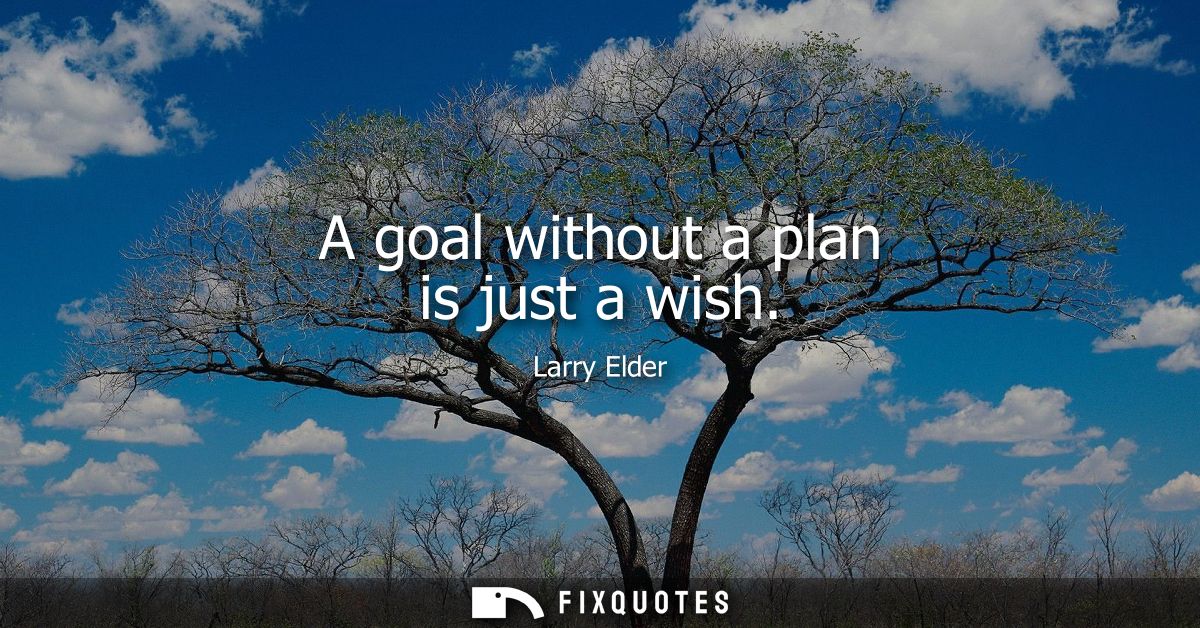
"A goal without a plan is just a wish"
About this Quote
The line lands like a motivational poster, but it’s really a rebuke: stop flattering yourself with intention. Elder’s phrasing draws a hard border between aspiration (a “goal”) and execution (a “plan”), then demotes the former to something flimsy and private - a “wish” you can keep without consequences. That’s the hook. It weaponizes practicality as moral clarity, implying that failure isn’t tragic or complicated so much as self-inflicted through negligence.
As a journalist and political commentator, Elder’s context matters. He’s built a public persona around personal responsibility and skepticism toward excuses, and this quote fits that worldview perfectly. It doesn’t entertain structural barriers or bad luck; it insists that agency is the only respectable story. The subtext is almost disciplinary: if you say you want something but haven’t mapped the steps, you’re not merely unprepared, you’re unserious. “Wish” is doing the shaming work here. It evokes childhood, superstition, passivity - the opposite of adulthood, competence, and grit.
The sentence also works because it’s cleanly binary. No gradations, no nuance, just a before-and-after switch that makes listeners instantly inventory their own lives: fitness goal, career move, debt payoff. It converts a fuzzy self-image (“I’m someone who wants X”) into a testable claim (“I’m someone doing Y on Tuesday”). In a media culture flooded with affirmations, Elder offers something colder: accountability dressed as common sense.
As a journalist and political commentator, Elder’s context matters. He’s built a public persona around personal responsibility and skepticism toward excuses, and this quote fits that worldview perfectly. It doesn’t entertain structural barriers or bad luck; it insists that agency is the only respectable story. The subtext is almost disciplinary: if you say you want something but haven’t mapped the steps, you’re not merely unprepared, you’re unserious. “Wish” is doing the shaming work here. It evokes childhood, superstition, passivity - the opposite of adulthood, competence, and grit.
The sentence also works because it’s cleanly binary. No gradations, no nuance, just a before-and-after switch that makes listeners instantly inventory their own lives: fitness goal, career move, debt payoff. It converts a fuzzy self-image (“I’m someone who wants X”) into a testable claim (“I’m someone doing Y on Tuesday”). In a media culture flooded with affirmations, Elder offers something colder: accountability dressed as common sense.
Quote Details
| Topic | Goal Setting |
|---|---|
| Source | Later attribution: Life Skills Curriculum: ARISE Droupout Prevention, Book 1... (2011) modern compilationISBN: 9781586142810 · ID: mGWjeLG6-6wC
Evidence:
... A goal without a plan is just a wish . " -Larry Elder Ask learners what this quote means to them . Write their answers on a board or large piece of paper . ( If you don't plan the steps you must take to achieve a goal , you will never ... |
| Cite |
Citation Formats
APA Style (7th ed.)
Elder, Larry. (2026, February 8). A goal without a plan is just a wish. FixQuotes. https://fixquotes.com/quotes/a-goal-without-a-plan-is-just-a-wish-142695/
Chicago Style
Elder, Larry. "A goal without a plan is just a wish." FixQuotes. February 8, 2026. https://fixquotes.com/quotes/a-goal-without-a-plan-is-just-a-wish-142695/.
MLA Style (9th ed.)
"A goal without a plan is just a wish." FixQuotes, 8 Feb. 2026, https://fixquotes.com/quotes/a-goal-without-a-plan-is-just-a-wish-142695/. Accessed 4 Apr. 2026.
More Quotes by Larry
Add to List