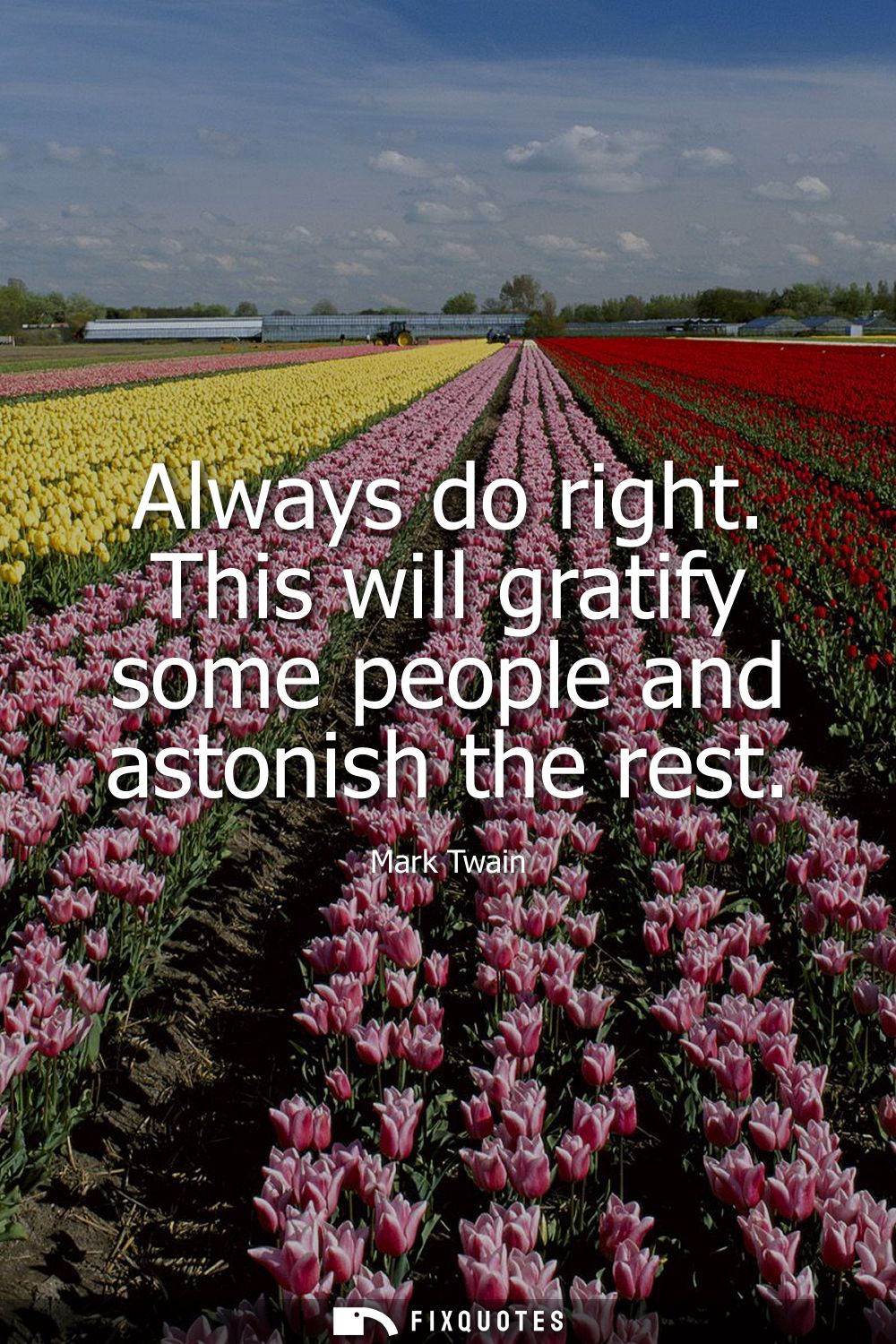
"Always do right. This will gratify some people and astonish the rest"
About this Quote
Twain turns moral advice into a prank on polite society. "Always do right" arrives like a courthouse plaque, stiff with virtue. Then he twists the knife: the reward for decency isn't sainthood, it's the delicious social chaos of it. Some people will be "gratified" because your behavior confirms their self-image as decent folk adjacent to decency. Everyone else will be "astonish[ed]" because Twain assumes a darker baseline: most of us are so used to opportunism, excuses, and quietly negotiated ethics that straightforward rightness reads as a glitch in the system.
The subtext is less sermon than diagnosis. Twain isn't claiming goodness is rare in the abstract; he's pointing at how often "right" is treated as optional, performative, or strategically timed. By framing ethical action as surprising, he exposes a culture where moral consistency is suspicious, even disruptive. The line flatters no one: the gratified are complacent, the astonished are implicated.
Context matters. Twain wrote in an America turbocharged by the Gilded Age, where wealth, political graft, and public piety frequently shared a zip code. His own work skewered sanctimony, racism, and the self-serving narratives that make injustice feel normal. In that world, "do right" isn't quaint advice; it's a quietly radical act because it refuses the wink-and-nod arrangements society runs on.
The wit is that Twain sells integrity not as martyrdom, but as a social weapon: be ethical, and you'll instantly reveal who was counting on you not to be.
The subtext is less sermon than diagnosis. Twain isn't claiming goodness is rare in the abstract; he's pointing at how often "right" is treated as optional, performative, or strategically timed. By framing ethical action as surprising, he exposes a culture where moral consistency is suspicious, even disruptive. The line flatters no one: the gratified are complacent, the astonished are implicated.
Context matters. Twain wrote in an America turbocharged by the Gilded Age, where wealth, political graft, and public piety frequently shared a zip code. His own work skewered sanctimony, racism, and the self-serving narratives that make injustice feel normal. In that world, "do right" isn't quaint advice; it's a quietly radical act because it refuses the wink-and-nod arrangements society runs on.
The wit is that Twain sells integrity not as martyrdom, but as a social weapon: be ethical, and you'll instantly reveal who was counting on you not to be.
Quote Details
| Topic | Honesty & Integrity |
|---|
More Quotes by Mark
Add to List