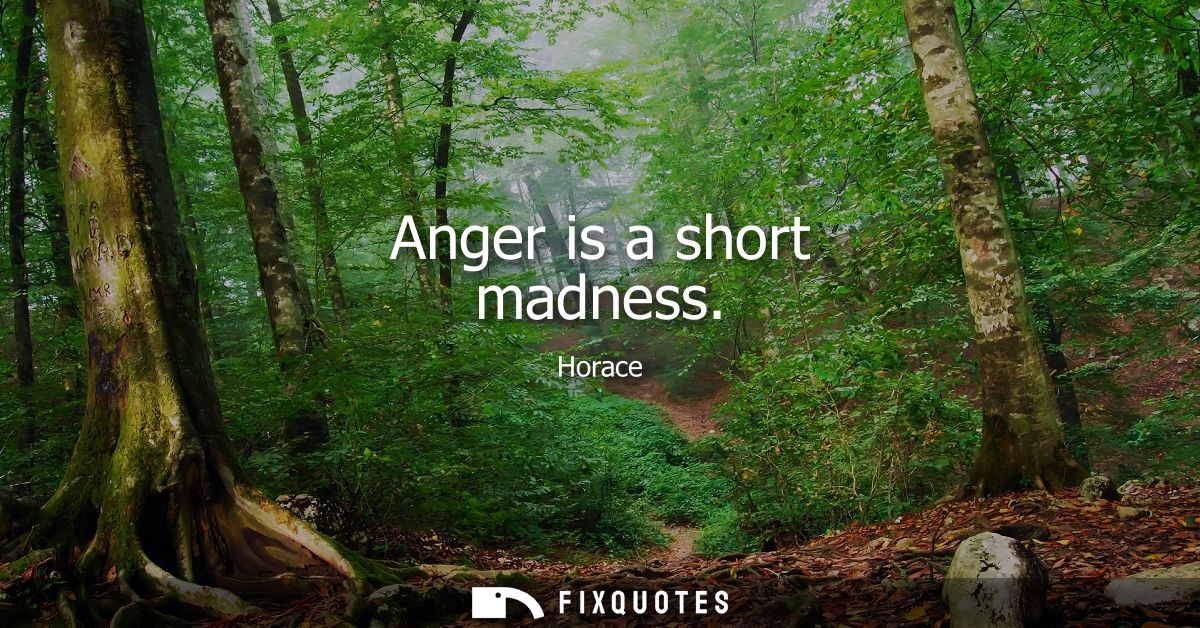
"Anger is a short madness"
About this Quote
Anger, Horace suggests, is not a principled stance but a temporary loss of self-governance: a brief psychosis you willingly rent. The sting in "short" is doing real work. It concedes the feeling’s intensity while downgrading its legitimacy. Anger isn’t framed as righteous fire or moral clarity; it’s a cognitive weather event that makes you unpredictable, embarrassingly so, and then passes, leaving you to deal with whatever you said and broke while you were "not yourself."
The line lands with the clean authority of Roman moral common sense, but Horace’s intent is sharper than a proverb. As a poet of measured pleasures and cultivated restraint, he’s advertising an ethic: self-control as a social technology. In a world where status, patronage, and reputation were fragile currencies, to "go mad" even briefly was to invite political and personal ruin. Calling anger "madness" isn’t medical; it’s rhetorical shaming. It recasts the angry person as someone who has abdicated reason, and therefore forfeited credibility.
Subtext: anger flatters you in the moment by making you feel certain and powerful. Horace punctures that fantasy by equating it with insanity - not the romantic kind, the kind that gets you laughed at once the heat dissipates. The phrase is compact enough to function as self-surveillance: a line you can repeat to yourself mid-eruption. That’s the craft here. Horace turns an emotion into a diagnosis, and the diagnosis into a brake.
The line lands with the clean authority of Roman moral common sense, but Horace’s intent is sharper than a proverb. As a poet of measured pleasures and cultivated restraint, he’s advertising an ethic: self-control as a social technology. In a world where status, patronage, and reputation were fragile currencies, to "go mad" even briefly was to invite political and personal ruin. Calling anger "madness" isn’t medical; it’s rhetorical shaming. It recasts the angry person as someone who has abdicated reason, and therefore forfeited credibility.
Subtext: anger flatters you in the moment by making you feel certain and powerful. Horace punctures that fantasy by equating it with insanity - not the romantic kind, the kind that gets you laughed at once the heat dissipates. The phrase is compact enough to function as self-surveillance: a line you can repeat to yourself mid-eruption. That’s the craft here. Horace turns an emotion into a diagnosis, and the diagnosis into a brake.
Quote Details
| Topic | Anger |
|---|---|
| Source | Horace, Epistles (Epistulae), Latin: "Ira furor brevis est" — commonly translated "Anger is a short madness". |
More Quotes by Horace
Add to List