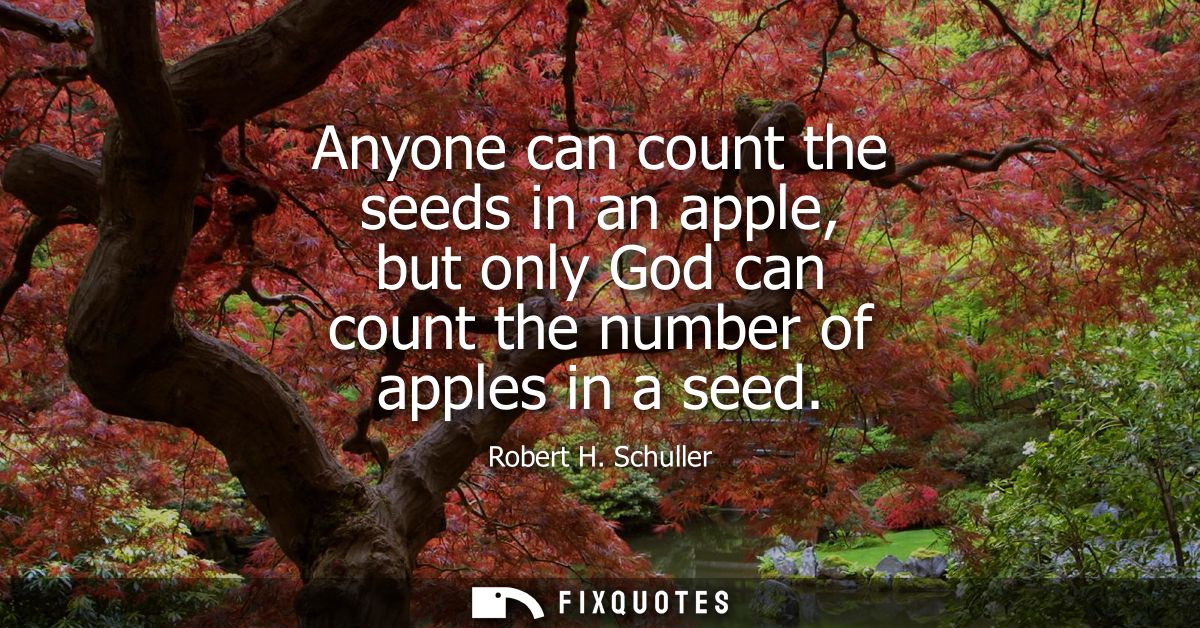
"Anyone can count the seeds in an apple, but only God can count the number of apples in a seed"
About this Quote
Schuller’s line is a tidy piece of pastoral persuasion: it takes a childlike observation about nature and flips it into a confidence trick for faith. Counting seeds in an apple is the kind of knowledge that feels empirical and controllable; it’s the realm of the visible, the measurable, the small satisfactions of certainty. Then he pivots: the real math is hidden inside potential. You can’t audit what a seed might become, because the future is not a spreadsheet. Only God can “count” it.
That word choice matters. “Count” is scientific-sounding, almost managerial, which lets Schuller smuggle a theological claim into the language of common sense. He isn’t arguing for God through doctrine; he’s arguing for God through scale. Human vision is reduced to inventory, while divinity is framed as the only perspective big enough to see generational consequence. It’s comforting, but also corrective: stop pretending you can fully calculate outcomes, especially your own.
The subtext is classic Schuller, a televangelist-era architect of optimistic Christianity. This isn’t fire-and-brimstone; it’s empowerment with a surrender clause. Your job is to plant and believe, not to control. That plays well in a late-20th-century American culture hooked on self-improvement and anxious about risk: careers, families, personal “potential.” The seed becomes a metaphor for the self, for a congregation, for a nation. The line whispers that your apparent smallness is not evidence against you; it’s the setup for a miracle.
That word choice matters. “Count” is scientific-sounding, almost managerial, which lets Schuller smuggle a theological claim into the language of common sense. He isn’t arguing for God through doctrine; he’s arguing for God through scale. Human vision is reduced to inventory, while divinity is framed as the only perspective big enough to see generational consequence. It’s comforting, but also corrective: stop pretending you can fully calculate outcomes, especially your own.
The subtext is classic Schuller, a televangelist-era architect of optimistic Christianity. This isn’t fire-and-brimstone; it’s empowerment with a surrender clause. Your job is to plant and believe, not to control. That plays well in a late-20th-century American culture hooked on self-improvement and anxious about risk: careers, families, personal “potential.” The seed becomes a metaphor for the self, for a congregation, for a nation. The line whispers that your apparent smallness is not evidence against you; it’s the setup for a miracle.
Quote Details
| Topic | God |
|---|
More Quotes by Robert
Add to List