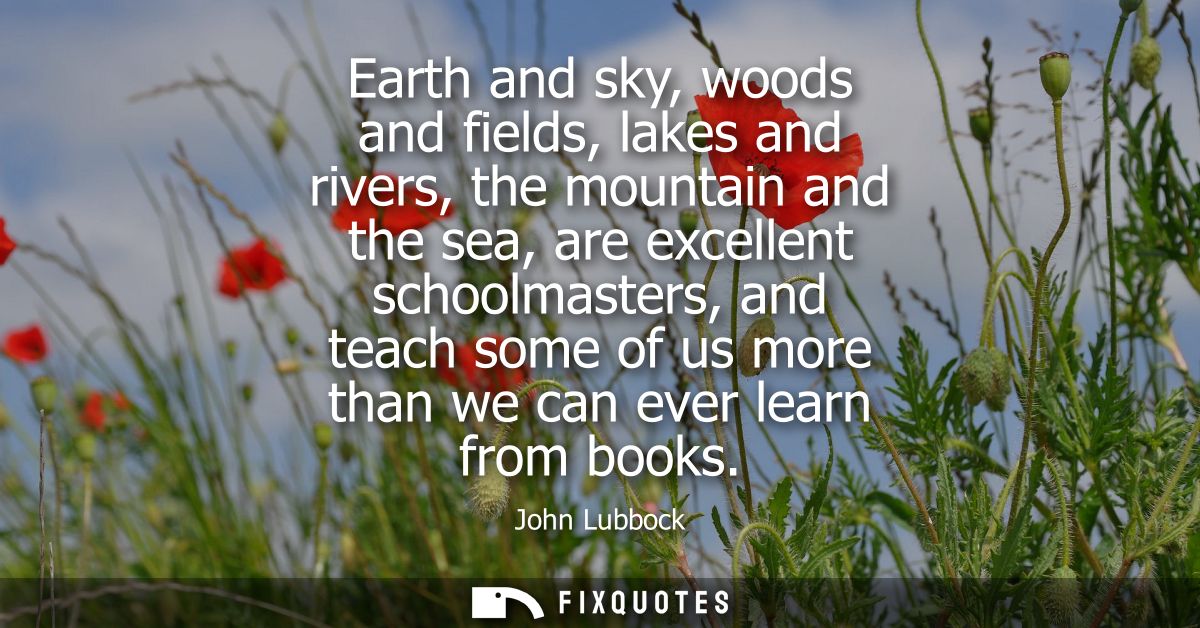
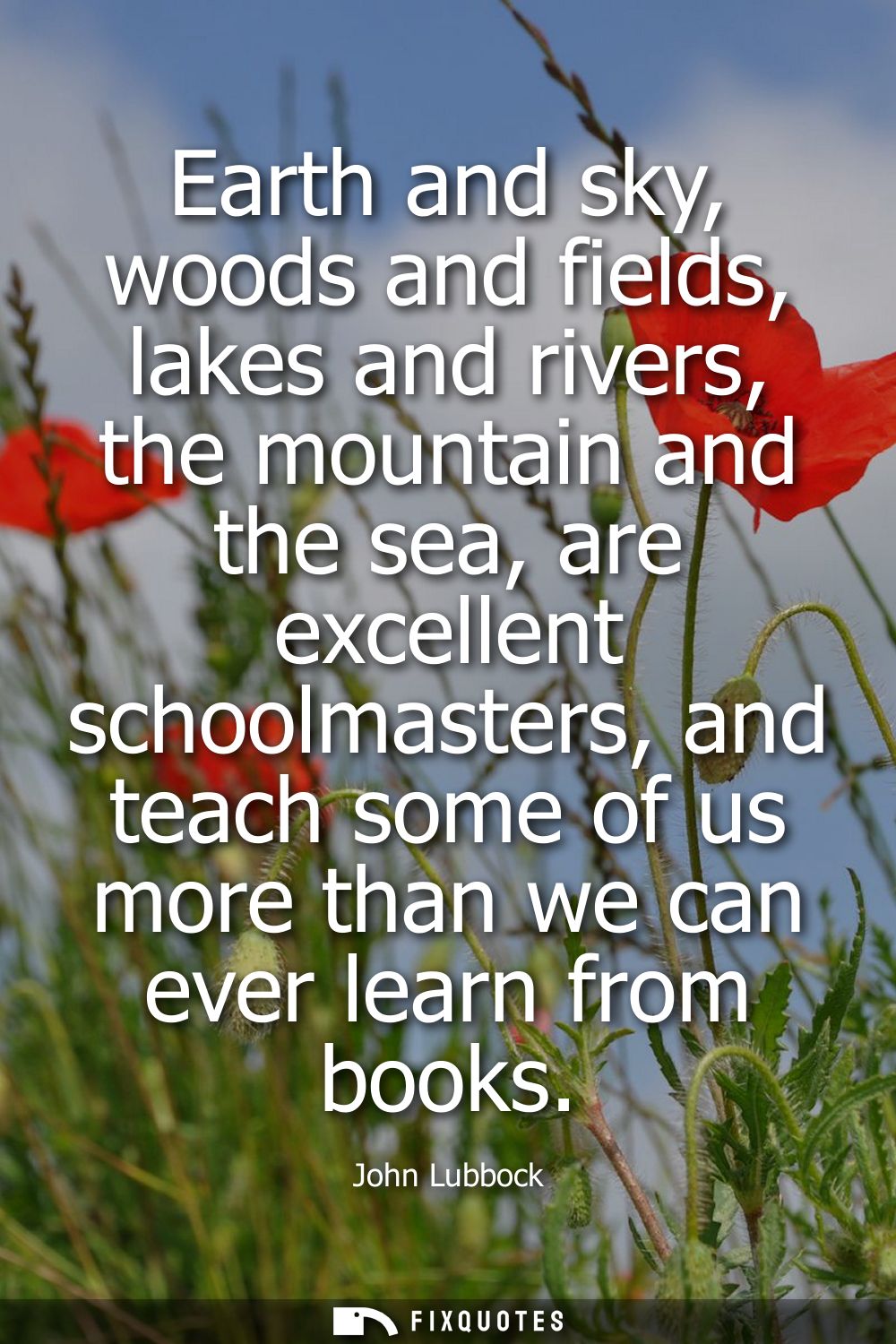
"Earth and sky, woods and fields, lakes and rivers, the mountain and the sea, are excellent schoolmasters, and teach some of us more than we can ever learn from books"
About this Quote
Lubbock isn’t offering a pretty postcard of nature; he’s making a political argument about what counts as education, and who gets to claim it. As a Victorian statesman and public intellectual, he lived in a Britain where “learning” was increasingly professionalized, examined, credentialed, and used to sort people into classes. By calling earth and sky “excellent schoolmasters,” he quietly demotes the library from temple to tool. The line flatters the self-taught and the observant - those who may lack elite schooling but possess attention, patience, and lived contact with the world.
The subtext is also a critique of modern indoor life: the industrial city, the office, the cramped routine that turns knowledge into paperwork. Nature here isn’t romantic escape; it’s an alternative curriculum. Listing “woods and fields, lakes and rivers, the mountain and the sea” works like a roll call of witnesses. Each landscape suggests a different discipline: weather teaches time and change; rivers teach systems; mountains teach scale and humility. The sentence’s momentum mimics a walk that keeps opening onto new views.
There’s an implied jab at bookish arrogance, too. “Some of us” is doing sly work: it grants that books matter, then claims there are minds for whom the world itself is a better text. For a statesman, that’s not anti-intellectualism; it’s a push for education that’s democratic, empirical, and restorative - the kind that can’t be gated by tuition or locked behind institutional doors.
The subtext is also a critique of modern indoor life: the industrial city, the office, the cramped routine that turns knowledge into paperwork. Nature here isn’t romantic escape; it’s an alternative curriculum. Listing “woods and fields, lakes and rivers, the mountain and the sea” works like a roll call of witnesses. Each landscape suggests a different discipline: weather teaches time and change; rivers teach systems; mountains teach scale and humility. The sentence’s momentum mimics a walk that keeps opening onto new views.
There’s an implied jab at bookish arrogance, too. “Some of us” is doing sly work: it grants that books matter, then claims there are minds for whom the world itself is a better text. For a statesman, that’s not anti-intellectualism; it’s a push for education that’s democratic, empirical, and restorative - the kind that can’t be gated by tuition or locked behind institutional doors.
Quote Details
| Topic | Nature |
|---|
More Quotes by John
Add to List