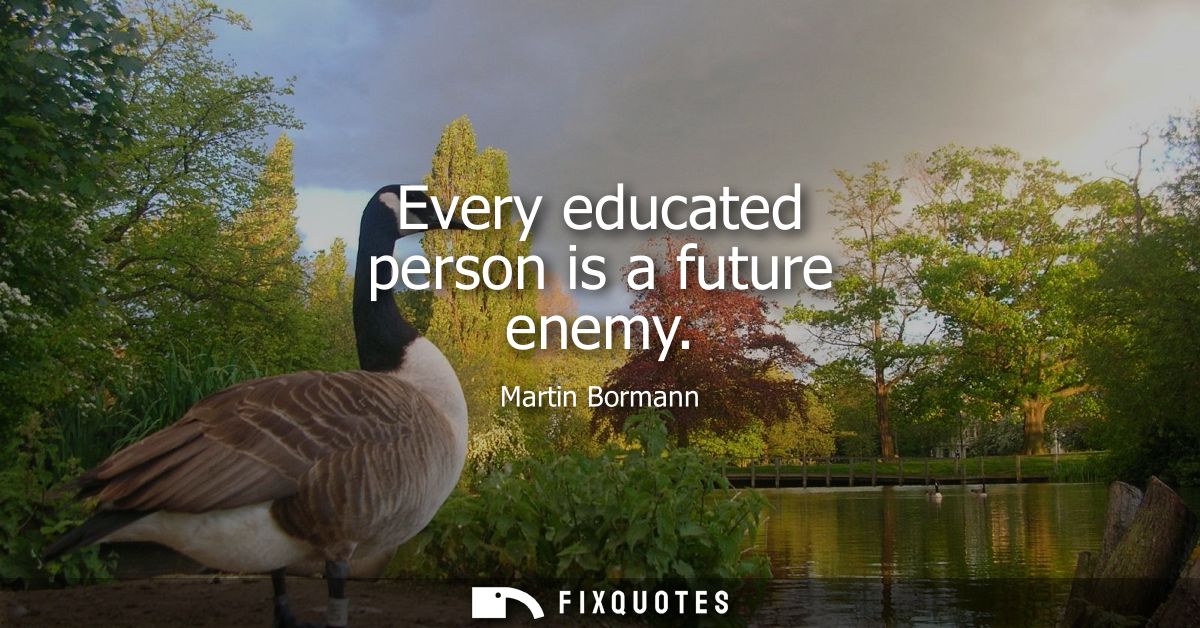
"Every educated person is a future enemy"
About this Quote
Tyranny always has a reading problem. In Bormann's blunt aphorism, education isn’t framed as uplift or civic glue; it’s treated like a ticking insurgency. The line works because it compresses an entire authoritarian worldview into a paranoid syllogism: knowledge produces independence; independence produces dissent; dissent becomes treason. It’s not a warning about bad teachers. It’s a preemptive indictment of anyone who might develop a private interior life.
The phrasing is key. "Every" makes the threat total, not conditional. "Future" turns persecution into strategy: you don’t wait for opposition to form, you identify it in advance. "Enemy" militarizes the relationship between state and citizen, converting schools and libraries into hostile territory. That’s propaganda doing its most effective trick: redefining ordinary social goods as security risks.
Context sharpens the menace. As a senior Nazi official and Hitler’s secretary, Bormann helped engineer a regime obsessed with ideological control: purging universities, subjugating youth organizations, and replacing curiosity with catechism. The Nazi state didn’t merely fear educated elites; it feared educated people, period, because mass literacy without pluralism invites comparison. Once citizens can cross-check claims, read banned authors, or even just notice contradictions, the spell weakens.
There’s also an admission embedded in the sneer: the regime expects to be hated by anyone who understands it. That’s the dark elegance of the line. It’s not confidence; it’s confession.
The phrasing is key. "Every" makes the threat total, not conditional. "Future" turns persecution into strategy: you don’t wait for opposition to form, you identify it in advance. "Enemy" militarizes the relationship between state and citizen, converting schools and libraries into hostile territory. That’s propaganda doing its most effective trick: redefining ordinary social goods as security risks.
Context sharpens the menace. As a senior Nazi official and Hitler’s secretary, Bormann helped engineer a regime obsessed with ideological control: purging universities, subjugating youth organizations, and replacing curiosity with catechism. The Nazi state didn’t merely fear educated elites; it feared educated people, period, because mass literacy without pluralism invites comparison. Once citizens can cross-check claims, read banned authors, or even just notice contradictions, the spell weakens.
There’s also an admission embedded in the sneer: the regime expects to be hated by anyone who understands it. That’s the dark elegance of the line. It’s not confidence; it’s confession.
Quote Details
| Topic | Knowledge |
|---|
More Quotes by Martin
Add to List