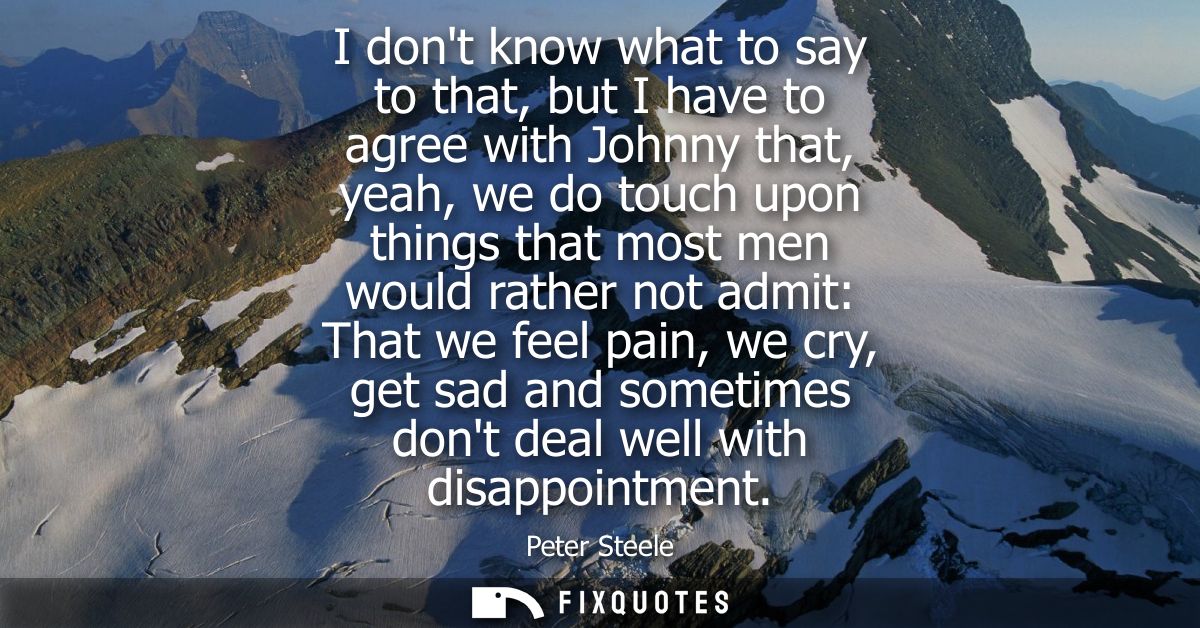
"I don't know what to say to that, but I have to agree with Johnny that, yeah, we do touch upon things that most men would rather not admit: That we feel pain, we cry, get sad and sometimes don't deal well with disappointment"
About this Quote
Steele’s “I don’t know what to say to that” isn’t a dodge so much as a tell: vulnerability arriving late, half-reluctant, still wearing its armor. As a frontman whose whole aesthetic traded in exaggerated darkness and swagger, he frames emotional honesty as something he’s been backed into admitting. That hesitation is the point. It mirrors the cultural script he’s naming, where male feeling is allowed only if it’s accidental, ironic, or filtered through performance.
The key move is the shift from “I” to “we.” He’s not confessing in a vacuum; he’s speaking for a band, a scene, a demographic of listeners who recognized themselves in Type O Negative’s gothic melodrama. Referencing “Johnny” (likely bandmate Johnny Kelly) makes it sound like an internal band conversation spilling into public view, and that casualness matters. It positions softness as camaraderie rather than therapy-speak, a way men grant each other permission without making a ceremony of it.
The list of verbs is blunt and domestic: feel pain, cry, get sad, don’t deal well. No poetic metaphors, no heroic suffering. Just ordinary emotional malfunction, which is exactly what many versions of masculinity try to quarantine. Steele’s subtext is that the “unmanly” part isn’t feeling; it’s the pretense of not feeling, and the private damage that pretense causes.
Contextually, this reads like a late-90s/early-2000s crack in the tough-guy rock persona: heavy music that looked like intimidation, quietly functioning as a support group for people taught to call their grief anything but grief.
The key move is the shift from “I” to “we.” He’s not confessing in a vacuum; he’s speaking for a band, a scene, a demographic of listeners who recognized themselves in Type O Negative’s gothic melodrama. Referencing “Johnny” (likely bandmate Johnny Kelly) makes it sound like an internal band conversation spilling into public view, and that casualness matters. It positions softness as camaraderie rather than therapy-speak, a way men grant each other permission without making a ceremony of it.
The list of verbs is blunt and domestic: feel pain, cry, get sad, don’t deal well. No poetic metaphors, no heroic suffering. Just ordinary emotional malfunction, which is exactly what many versions of masculinity try to quarantine. Steele’s subtext is that the “unmanly” part isn’t feeling; it’s the pretense of not feeling, and the private damage that pretense causes.
Contextually, this reads like a late-90s/early-2000s crack in the tough-guy rock persona: heavy music that looked like intimidation, quietly functioning as a support group for people taught to call their grief anything but grief.
Quote Details
| Topic | Sadness |
|---|
More Quotes by Peter
Add to List