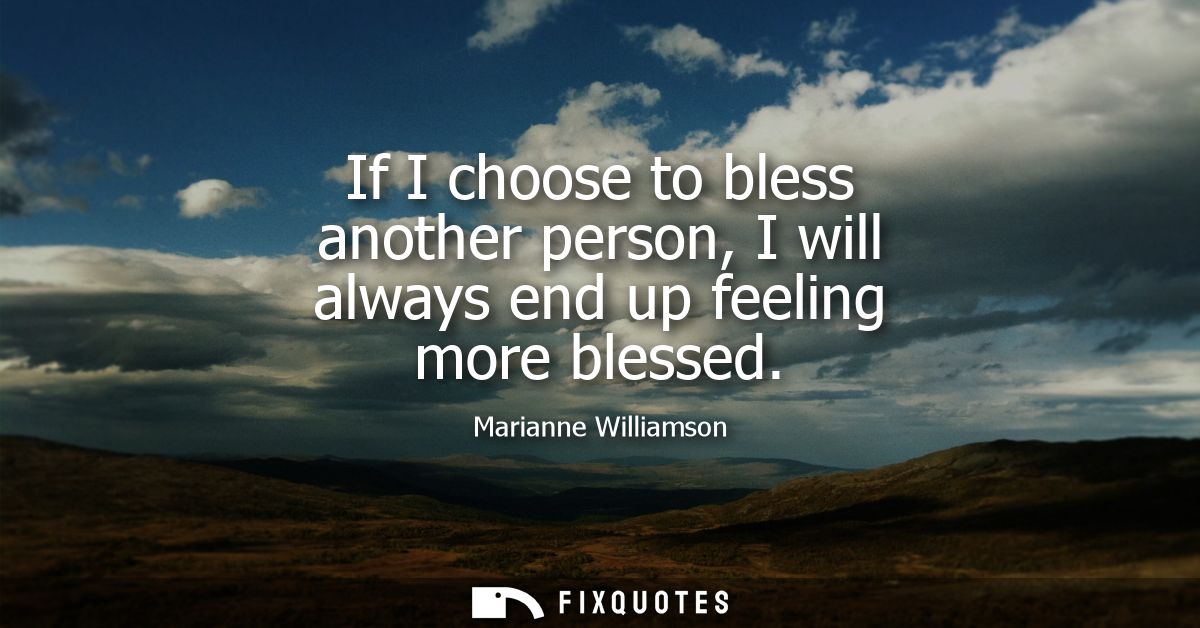
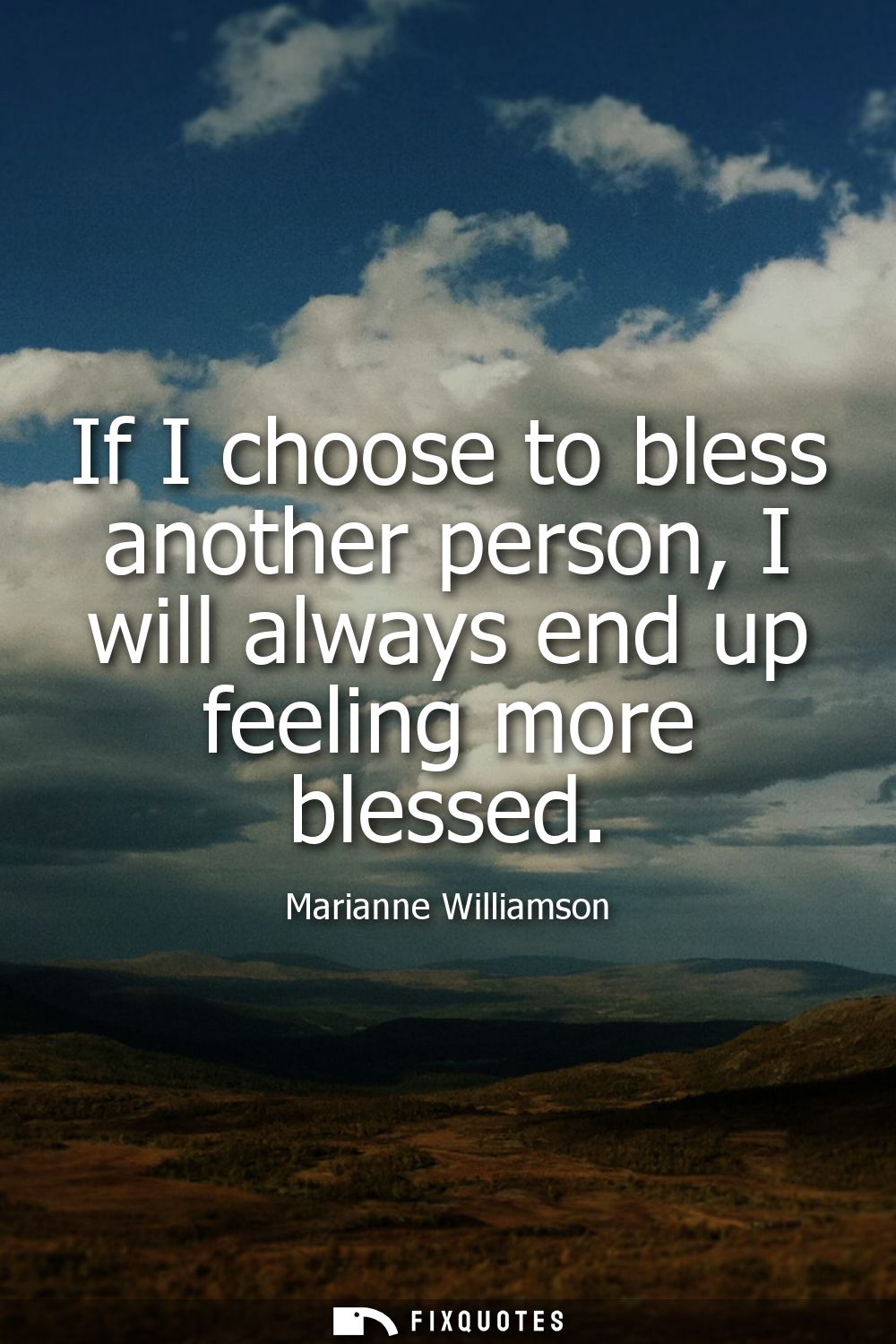
"If I choose to bless another person, I will always end up feeling more blessed"
About this Quote
The subtext is transactional, but carefully sanitized. “Bless” sounds lofty, even religious, yet she pairs it with an almost behavioral-economics payoff: you “end up” feeling “more blessed.” The promise isn’t that the other person changes, or even that you become virtuous; it’s that your inner weather shifts. That’s canny rhetoric for a modern audience fluent in self-care: altruism as an emotional return on investment. It also defuses cynicism. If you’re suspicious of do-gooding, she’s offering a motive that doesn’t require sainthood.
Context matters: Williamson’s work sits in the New Thought/self-help lineage where intention and perception are treated as powerful levers. In that ecosystem, blessing functions less as a supernatural act than as an attention strategy: when you look at someone through a lens of goodwill, you loosen the grip of grievance and scarcity thinking. The line’s optimism is strategic, not naive. It recasts compassion as a form of self-liberation, making kindness feel less like self-sacrifice and more like reclaiming your own peace.
Quote Details
| Topic | Kindness |
|---|---|
| Source | Help us find the source |
| Cite |
Citation Formats
APA Style (7th ed.)
Williamson, Marianne. (2026, January 15). If I choose to bless another person, I will always end up feeling more blessed. FixQuotes. https://fixquotes.com/quotes/if-i-choose-to-bless-another-person-i-will-always-14834/
Chicago Style
Williamson, Marianne. "If I choose to bless another person, I will always end up feeling more blessed." FixQuotes. January 15, 2026. https://fixquotes.com/quotes/if-i-choose-to-bless-another-person-i-will-always-14834/.
MLA Style (9th ed.)
"If I choose to bless another person, I will always end up feeling more blessed." FixQuotes, 15 Jan. 2026, https://fixquotes.com/quotes/if-i-choose-to-bless-another-person-i-will-always-14834/. Accessed 5 Feb. 2026.