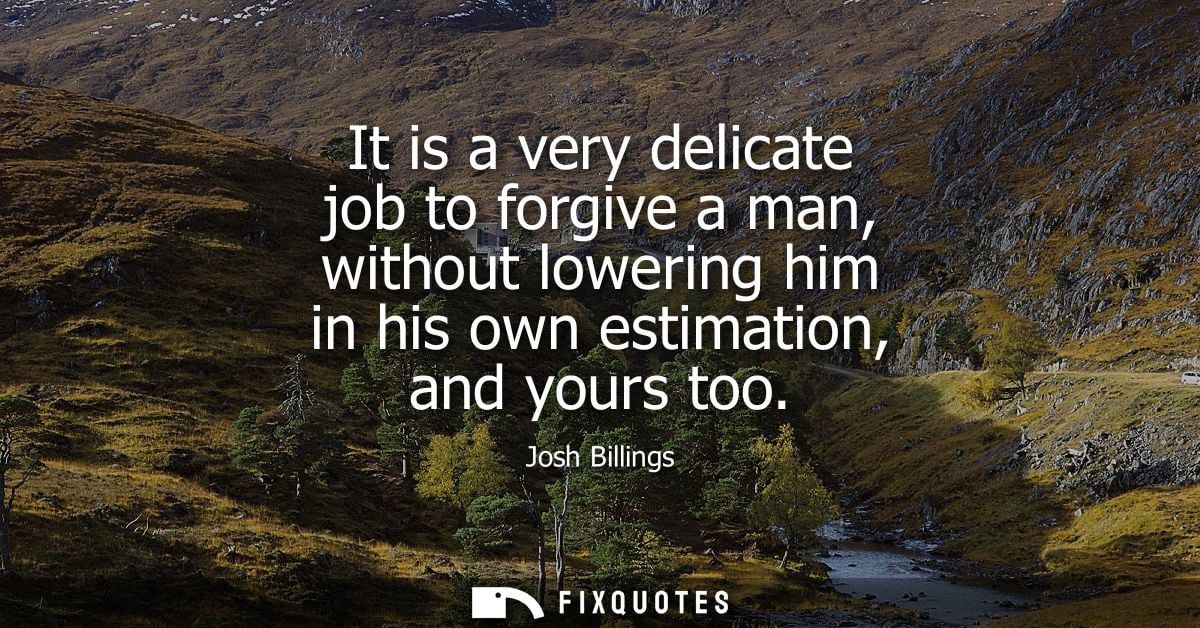
"It is a very delicate job to forgive a man, without lowering him in his own estimation, and yours too"
About this Quote
Forgiveness, Billings suggests, is less a halo than a high-wire act. The line lands because it refuses the sentimental version of pardon-the offender kneels, the virtuous forgiver smiles, everyone exits morally upgraded. Instead, Billings points to the social mechanics underneath: forgiveness is a negotiation over status.
The “delicate job” isn’t emotional fragility; it’s reputational engineering. If you forgive clumsily, you can humiliate the other person by confirming their worst self-image: you are the sinner, I am the magnanimous judge. That kind of mercy is just domination with softer lighting. But Billings also warns about the forgiver’s self-regard. Offer forgiveness too easily and you risk lowering yourself in your own estimation, not because mercy is weak, but because indiscriminate pardon can feel like complicity or poor boundaries. The best forgiveness, in this cynical-but-accurate frame, has to preserve dignity on both sides: it acknowledges harm without turning the offender into a permanent subordinate or turning the forgiver into a doormat.
Context matters: Billings was a 19th-century American humorist writing in dialect, poking at moral posturing in a culture saturated with public piety and private grievance. His comedy works like a pin to a balloon. By couching the insight in practical language (“job”), he makes virtue sound like craft, not purity. That’s the sting: forgiveness is not a saintly impulse but a social skill, and most of us botch it by using it to keep score.
The “delicate job” isn’t emotional fragility; it’s reputational engineering. If you forgive clumsily, you can humiliate the other person by confirming their worst self-image: you are the sinner, I am the magnanimous judge. That kind of mercy is just domination with softer lighting. But Billings also warns about the forgiver’s self-regard. Offer forgiveness too easily and you risk lowering yourself in your own estimation, not because mercy is weak, but because indiscriminate pardon can feel like complicity or poor boundaries. The best forgiveness, in this cynical-but-accurate frame, has to preserve dignity on both sides: it acknowledges harm without turning the offender into a permanent subordinate or turning the forgiver into a doormat.
Context matters: Billings was a 19th-century American humorist writing in dialect, poking at moral posturing in a culture saturated with public piety and private grievance. His comedy works like a pin to a balloon. By couching the insight in practical language (“job”), he makes virtue sound like craft, not purity. That’s the sting: forgiveness is not a saintly impulse but a social skill, and most of us botch it by using it to keep score.
Quote Details
| Topic | Forgiveness |
|---|---|
| Source | Help us find the source |
More Quotes by Josh
Add to List