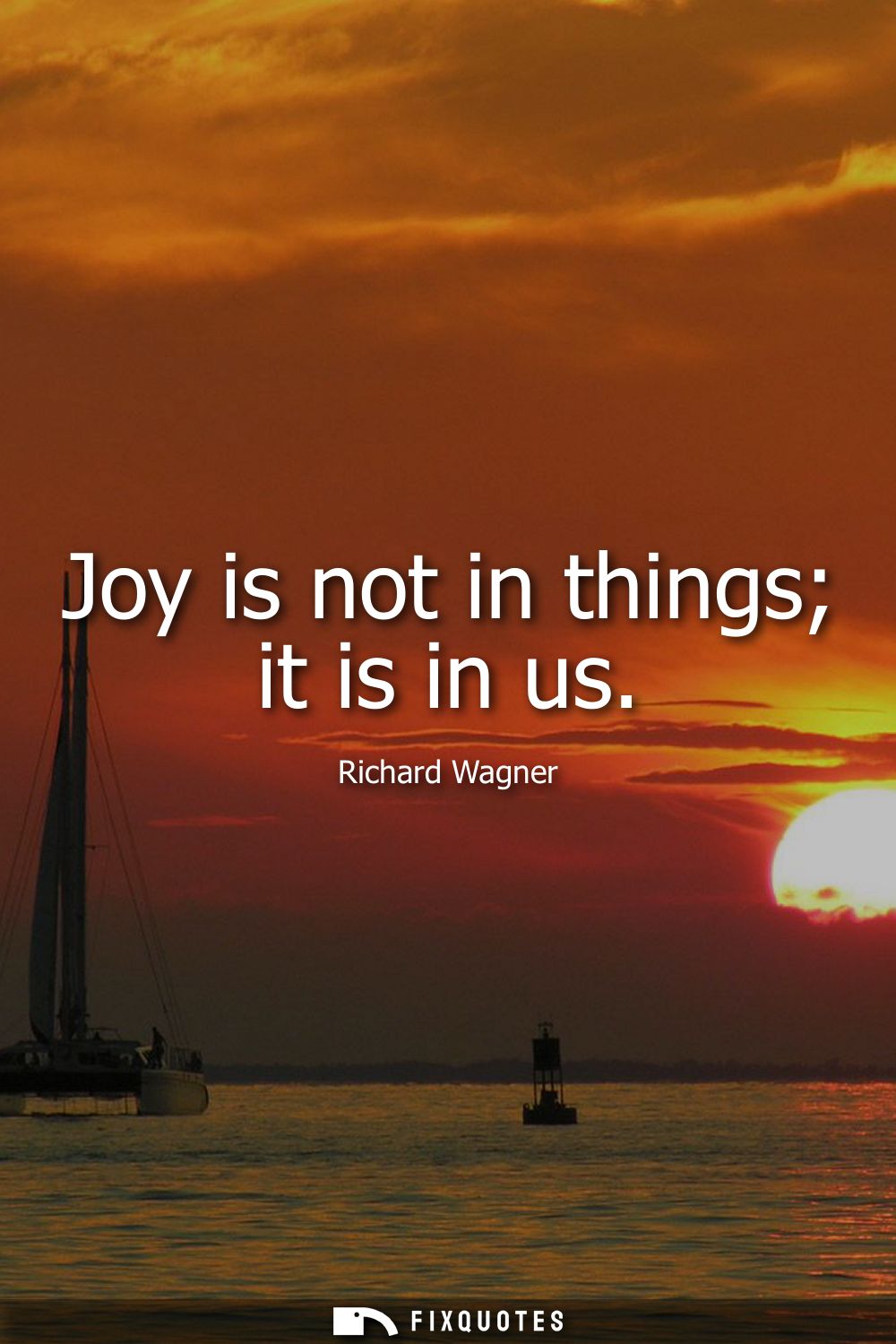
"Joy is not in things; it is in us"
About this Quote
Wagner’s line lands like a tidy piece of spiritual counsel, but coming from him it reads less like a greeting-card platitude and more like a manifesto for how art is supposed to function. A composer who built entire worlds out of leitmotifs and longing is insisting that the world itself isn’t the point; the listener is. Joy, he implies, isn’t a property you can purchase, possess, or even reliably stumble upon. It’s a capacity - trained, unlocked, sometimes coerced - by the inner life.
The subtext is a quiet rebuke to the material crowd and, just as pointedly, to passive consumers of culture. Wagner didn’t want audiences to “like” his operas the way they might like a new wallpaper pattern. He wanted surrender: total psychological buy-in. If joy is “in us,” then the external object (the ring, the grail, the love potion, the luxury) is merely a trigger for a drama already wired into the human nervous system. That aligns neatly with Romantic-era suspicion of bourgeois comfort and its faith in interior depth over surface acquisition.
Context matters because Wagner is both prophet and salesman. The statement flatters the audience’s autonomy while also expanding the artist’s power: if joy is internal, art can claim to awaken it, not just decorate it. It’s an elegant bit of rhetoric that relocates responsibility - and possibility - into the self, even as Wagner’s own work argues that the self is dangerously susceptible to myth, music, and desire.
The subtext is a quiet rebuke to the material crowd and, just as pointedly, to passive consumers of culture. Wagner didn’t want audiences to “like” his operas the way they might like a new wallpaper pattern. He wanted surrender: total psychological buy-in. If joy is “in us,” then the external object (the ring, the grail, the love potion, the luxury) is merely a trigger for a drama already wired into the human nervous system. That aligns neatly with Romantic-era suspicion of bourgeois comfort and its faith in interior depth over surface acquisition.
Context matters because Wagner is both prophet and salesman. The statement flatters the audience’s autonomy while also expanding the artist’s power: if joy is internal, art can claim to awaken it, not just decorate it. It’s an elegant bit of rhetoric that relocates responsibility - and possibility - into the self, even as Wagner’s own work argues that the self is dangerously susceptible to myth, music, and desire.
Quote Details
| Topic | Joy |
|---|
More Quotes by Richard
Add to List