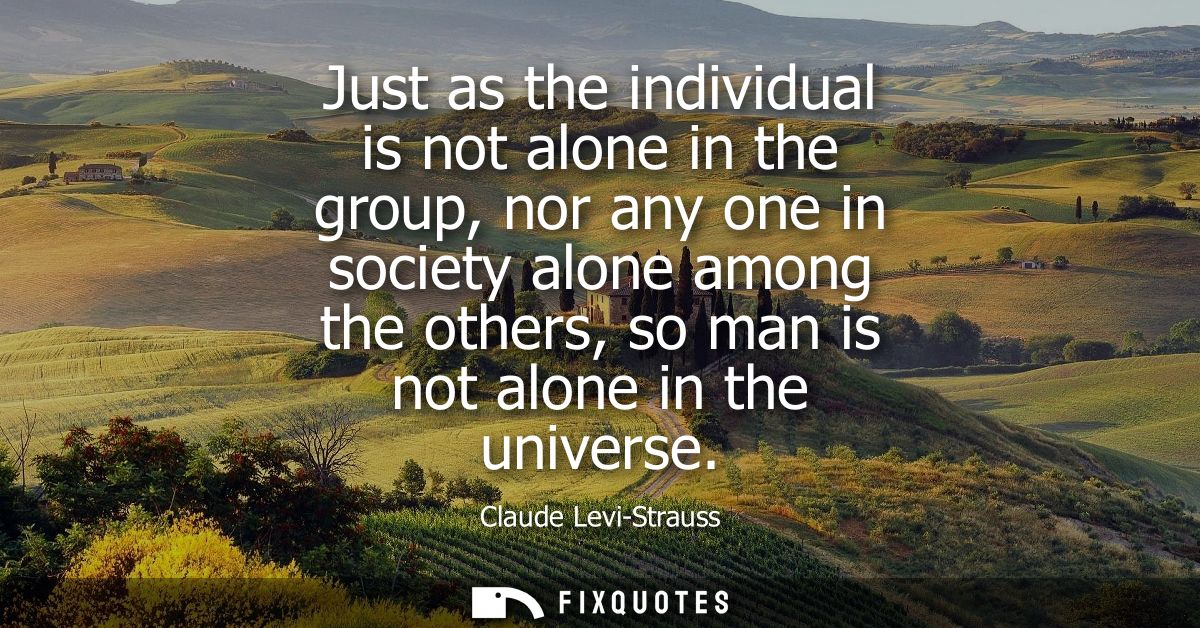
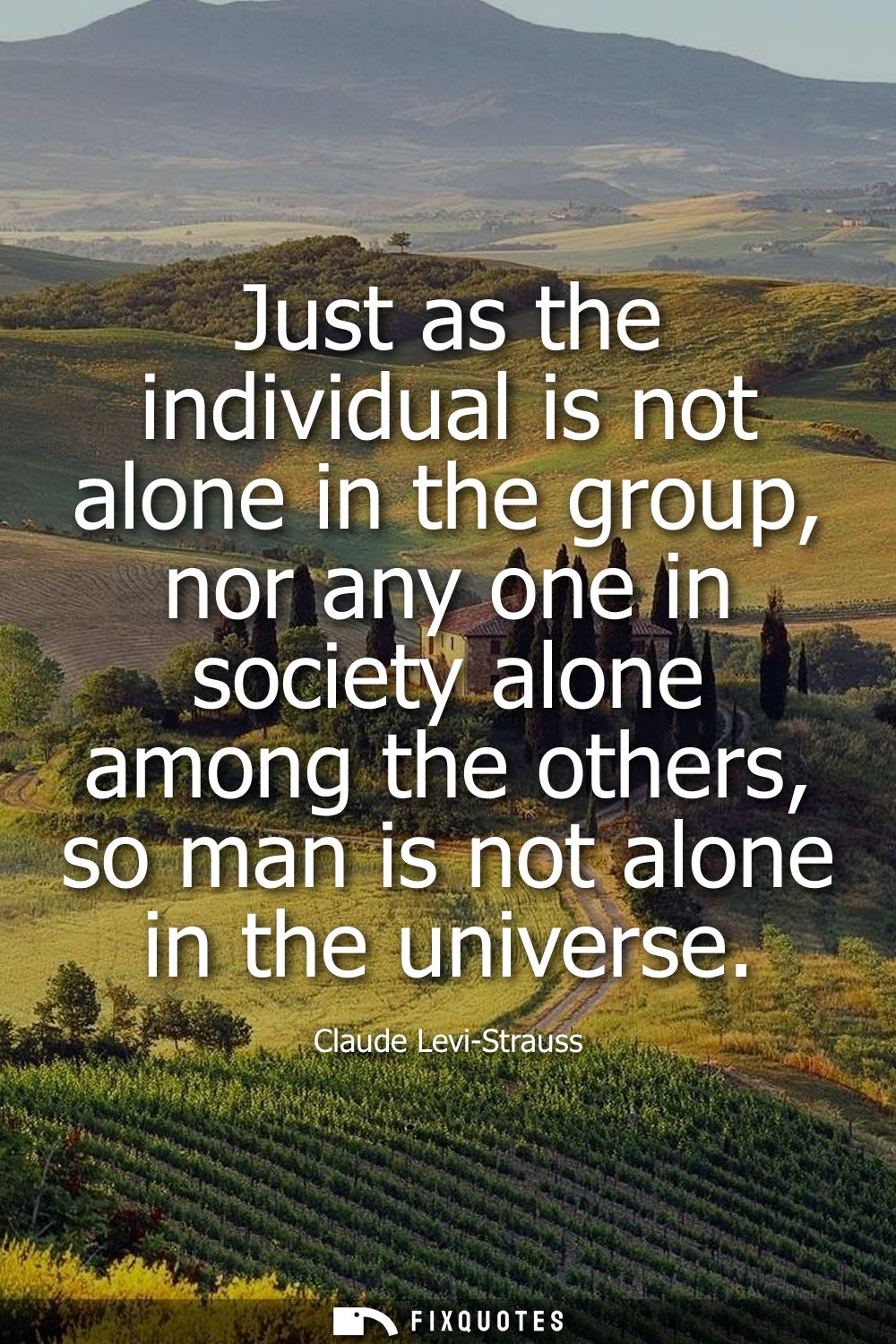
"Just as the individual is not alone in the group, nor any one in society alone among the others, so man is not alone in the universe"
About this Quote
Claude Levi-Strauss evokes a vision of human life as fundamentally relational, built from patterns that tie persons to groups, societies to one another, and humanity to the wider cosmos. Identity is not an essence sealed within an individual; it emerges through differences and connections. Language makes this clear: a word has meaning only because of its place in a system. So too with kinship, exchange, and law, which give each person a position from which their actions make sense. The individual is not diminished by this embedding; rather, the network is what allows individuality to appear at all.
Extending the same logic outward, the human species occupies a position among other beings, forces, and forms of life. Structural anthropology challenged the idea that humans stand apart from nature. By studying myths, totemic classifications, and cosmologies among Indigenous peoples of the Americas, Levi-Strauss showed how societies understand themselves through analogies with animals, plants, and celestial cycles. These systems are not naive; they are rigorous ways of mapping relationships between the social and the natural. To say man is not alone in the universe is to decenter the human and recognize a web of correspondences that precedes and exceeds us.
The statement carries both epistemological and ethical force. Knowledge comes from tracing relations, not from isolating a sovereign subject. And if we are constituted by our ties, then responsibilities follow: toward those in our group, toward strangers who make up society, and toward the nonhuman world that sustains and signifies with us. Levi-Strauss often urged modesty, reminding readers that the world began without humans and will outlast them. Far from nihilism, this is a call to humility and solidarity. We become more fully ourselves when we acknowledge the structures that bind us, and we act more wisely when we accept that our fate is woven into a larger order.
Extending the same logic outward, the human species occupies a position among other beings, forces, and forms of life. Structural anthropology challenged the idea that humans stand apart from nature. By studying myths, totemic classifications, and cosmologies among Indigenous peoples of the Americas, Levi-Strauss showed how societies understand themselves through analogies with animals, plants, and celestial cycles. These systems are not naive; they are rigorous ways of mapping relationships between the social and the natural. To say man is not alone in the universe is to decenter the human and recognize a web of correspondences that precedes and exceeds us.
The statement carries both epistemological and ethical force. Knowledge comes from tracing relations, not from isolating a sovereign subject. And if we are constituted by our ties, then responsibilities follow: toward those in our group, toward strangers who make up society, and toward the nonhuman world that sustains and signifies with us. Levi-Strauss often urged modesty, reminding readers that the world began without humans and will outlast them. Far from nihilism, this is a call to humility and solidarity. We become more fully ourselves when we acknowledge the structures that bind us, and we act more wisely when we accept that our fate is woven into a larger order.
Quote Details
| Topic | Wisdom |
|---|
More Quotes by Claude
Add to List