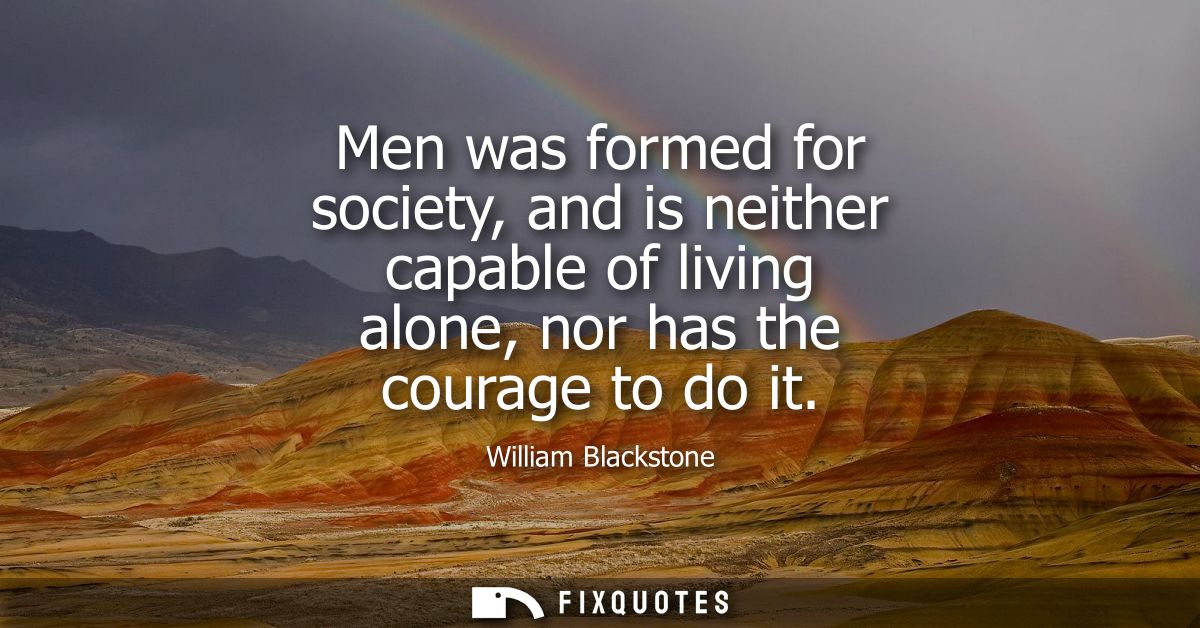
"Men was formed for society, and is neither capable of living alone, nor has the courage to do it"
About this Quote
The bite is in the second clause. Blackstone doesn’t just argue that humans can’t live alone; he adds that we don’t have the courage to. That’s a subtle downgrade from capacity to character. It suggests that the fantasy of radical self-sufficiency is less about strength than about denial: we need others for survival, but also for validation, witness, and restraint. “Courage” here carries a hint of contempt for the pose of the lone individual, the kind of pose Enlightenment rhetoric could inadvertently encourage. He’s puncturing the myth before it becomes politically inconvenient.
Context matters: Blackstone wrote in a Britain stabilizing around commerce, empire, and a property-centered order. Society wasn’t merely companionship; it was infrastructure. His subtext is conservative in the classic sense: the individual is real, but never primary. The law can treat you as a unit; it also assumes you’re knitted into obligations you didn’t choose and can’t realistically escape.
Quote Details
| Topic | Wisdom |
|---|---|
| Source | Help us find the source |
| Cite |
Citation Formats
APA Style (7th ed.)
Blackstone, William. (2026, January 16). Men was formed for society, and is neither capable of living alone, nor has the courage to do it. FixQuotes. https://fixquotes.com/quotes/men-was-formed-for-society-and-is-neither-capable-129754/
Chicago Style
Blackstone, William. "Men was formed for society, and is neither capable of living alone, nor has the courage to do it." FixQuotes. January 16, 2026. https://fixquotes.com/quotes/men-was-formed-for-society-and-is-neither-capable-129754/.
MLA Style (9th ed.)
"Men was formed for society, and is neither capable of living alone, nor has the courage to do it." FixQuotes, 16 Jan. 2026, https://fixquotes.com/quotes/men-was-formed-for-society-and-is-neither-capable-129754/. Accessed 12 Feb. 2026.