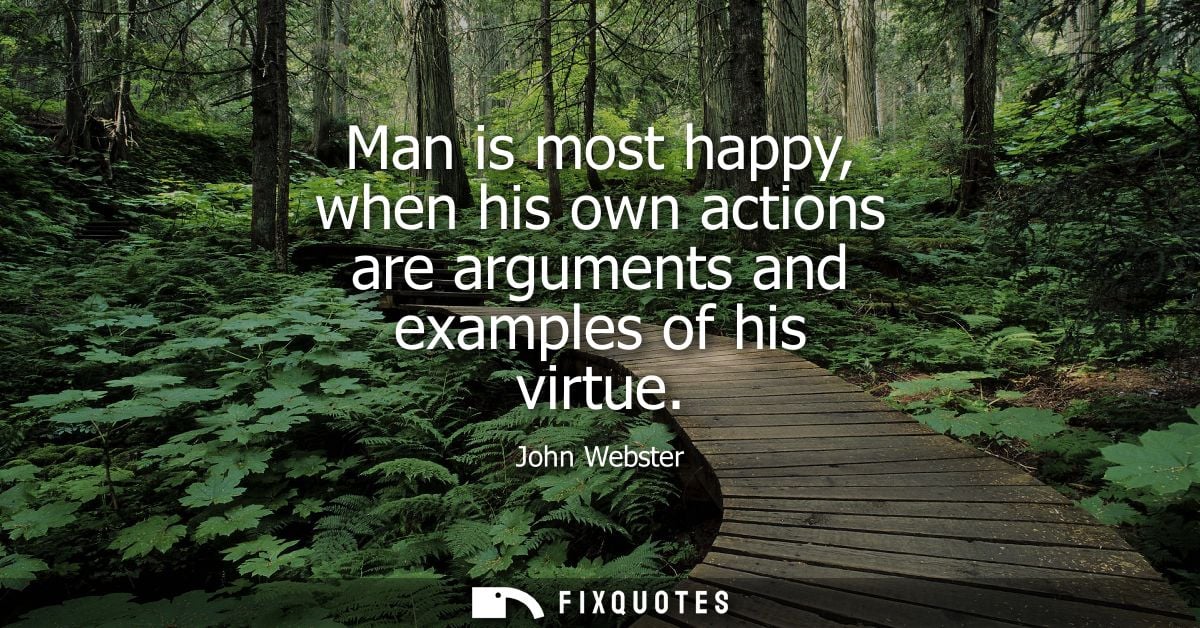
"Man is most happy, when his own actions are arguments and examples of his virtue"
About this Quote
The subtext is bracingly pragmatic. Webster doesn t trust mere intention, or even the comforting story we tell ourselves about being good. Virtue has to survive scrutiny, and the only durable defense is conduct that can stand as evidence. There s also a faintly cynical awareness of how morality functions socially: you are judged, and you judge yourself, by what can be shown. If you want peace, make your behavior unambiguous.
As a Jacobean playwright, Webster knew how easily virtue becomes performance, how quickly "goodness" can be mimicked for applause. By demanding that actions be arguments, he raises the bar above appearance: the deed must not just look righteous; it must convince. The line flatters no one. It offers a severe consolation: the closest thing to happiness is integrity that doesn t need alibis.
Quote Details
| Topic | Ethics & Morality |
|---|---|
| Source | Help us find the source |
| Cite |
Citation Formats
APA Style (7th ed.)
Webster, John. (2026, January 16). Man is most happy, when his own actions are arguments and examples of his virtue. FixQuotes. https://fixquotes.com/quotes/man-is-most-happy-when-his-own-actions-are-113570/
Chicago Style
Webster, John. "Man is most happy, when his own actions are arguments and examples of his virtue." FixQuotes. January 16, 2026. https://fixquotes.com/quotes/man-is-most-happy-when-his-own-actions-are-113570/.
MLA Style (9th ed.)
"Man is most happy, when his own actions are arguments and examples of his virtue." FixQuotes, 16 Jan. 2026, https://fixquotes.com/quotes/man-is-most-happy-when-his-own-actions-are-113570/. Accessed 10 Feb. 2026.