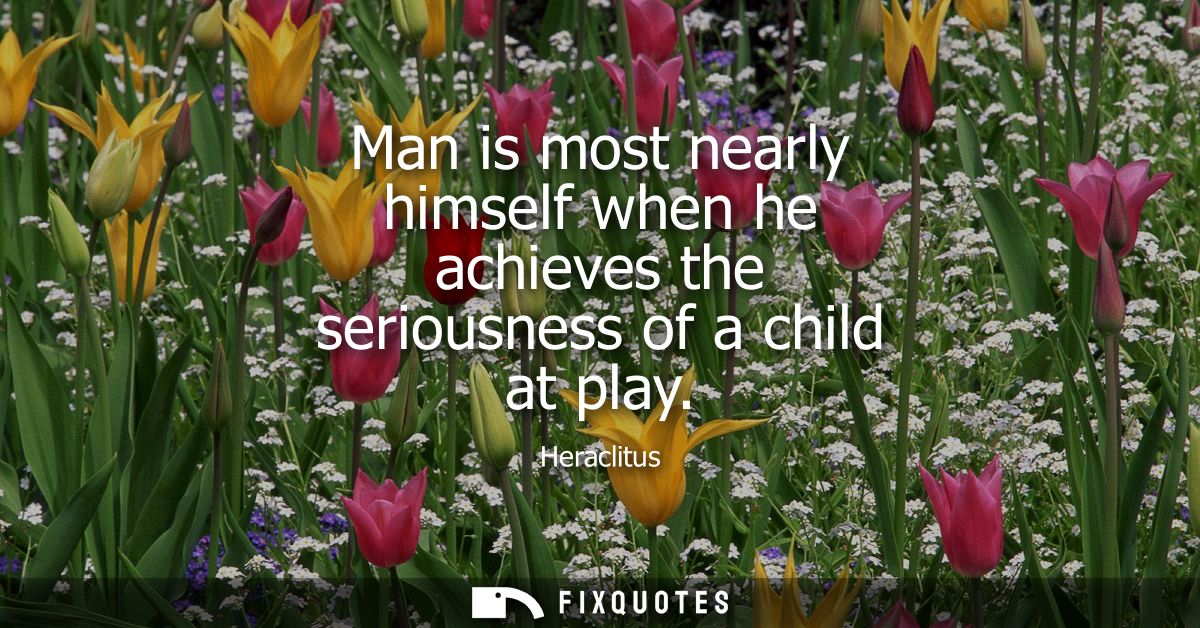
"Man is most nearly himself when he achieves the seriousness of a child at play"
About this Quote
Heraclitus links authenticity to a paradox: the truest self appears when we bring to life the focused, joyous absorption of a child at play. A child at play is not casual; the attention is fierce, the rules matter, the stakes feel real. Yet there is no calculation about status or gain. The play matters for its own sake. That form of seriousness, stripped of anxiety and performance, reveals a person most nearly aligned with what they are.
Adults often equate seriousness with gravity, worry, and usefulness. We tighten around outcomes and perform versions of ourselves to meet expectations. Heraclitus suggests that this is not genuineness but a distortion. When attention is wholehearted and activity is undertaken because it is intrinsically compelling, the divided self quiets. Modern language would call this a flow state: time thins, self-consciousness recedes, and action and awareness merge. Artists, scientists, and athletes recognize this as the zone where good work happens and personality feels least artificial.
The line also resonates with Heraclitus’s larger vision. He saw reality as flux, ruled by a logos, a hidden order. He elsewhere imagines eternity as a child at play with a game board. The world is game-like: patterned yet unpredictable, demanding skill yet open to surprise. To meet it well requires a posture that is both disciplined and playful. The unity of opposites runs through the thought: seriousness that is not heavy, play that is not frivolous.
There is an ethical invitation here. Do not abandon rigor; infuse it with wonder. Care deeply about how you play, but loosen your grip on outcomes. Seek work and practices that allow for absorbed engagement, where curiosity leads and the ego does not strain for applause. In that stance, effort becomes expression rather than performance, and the self feels less like a mask and more like a living act.
Adults often equate seriousness with gravity, worry, and usefulness. We tighten around outcomes and perform versions of ourselves to meet expectations. Heraclitus suggests that this is not genuineness but a distortion. When attention is wholehearted and activity is undertaken because it is intrinsically compelling, the divided self quiets. Modern language would call this a flow state: time thins, self-consciousness recedes, and action and awareness merge. Artists, scientists, and athletes recognize this as the zone where good work happens and personality feels least artificial.
The line also resonates with Heraclitus’s larger vision. He saw reality as flux, ruled by a logos, a hidden order. He elsewhere imagines eternity as a child at play with a game board. The world is game-like: patterned yet unpredictable, demanding skill yet open to surprise. To meet it well requires a posture that is both disciplined and playful. The unity of opposites runs through the thought: seriousness that is not heavy, play that is not frivolous.
There is an ethical invitation here. Do not abandon rigor; infuse it with wonder. Care deeply about how you play, but loosen your grip on outcomes. Seek work and practices that allow for absorbed engagement, where curiosity leads and the ego does not strain for applause. In that stance, effort becomes expression rather than performance, and the self feels less like a mask and more like a living act.
Quote Details
| Topic | Wisdom |
|---|
More Quotes by Heraclitus
Add to List