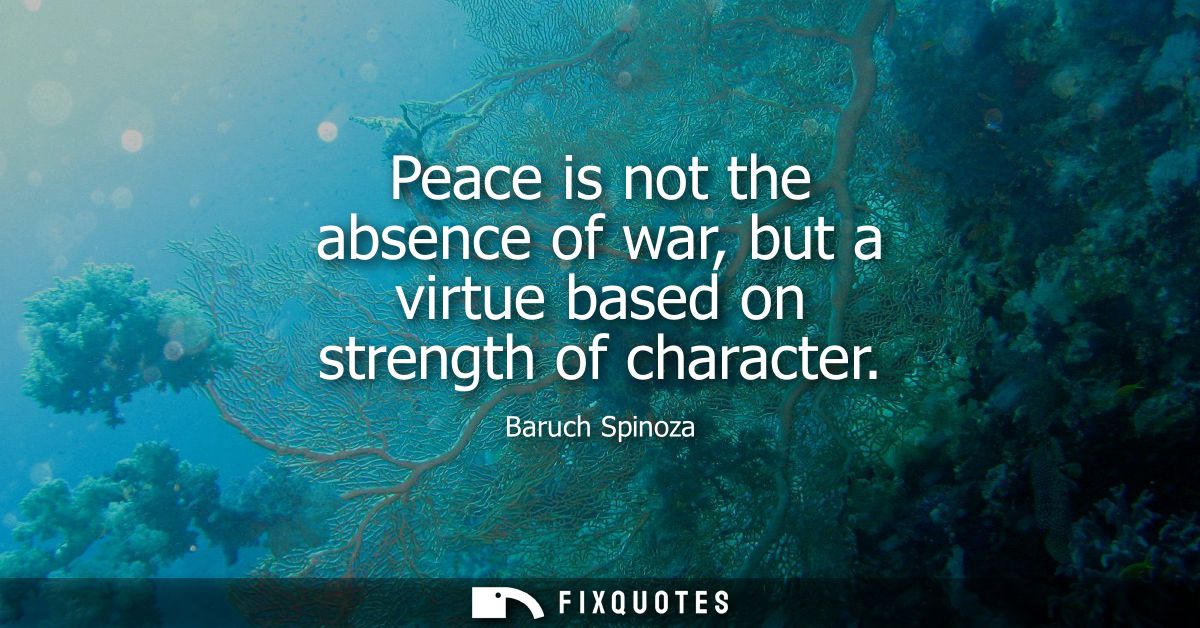
"Peace is not the absence of war, but a virtue based on strength of character"
About this Quote
Spinoza refuses the lazy definition of peace as merely what happens when the cannons go quiet. In his hands, peace becomes an achievement, not a pause: an active moral posture rooted in what he calls virtue, and what a modern reader might translate as disciplined self-command. The line is a rebuke to politics built on exhaustion or stalemate. A ceasefire can be accidental; peace, for Spinoza, is cultivated.
The subtext is classic Spinoza: human beings are not naturally serene, rational creatures who only occasionally get derailed. We are bundles of appetites, fears, resentments, and imitations of one another's emotions. If that is the raw material of social life, then tranquility is not the default setting; it is a hard-won capacity. Peace requires strength of character because it requires resisting the easy satisfactions of vengeance, tribal pride, and panic. It demands the ability to be governed by reason rather than by the emotional contagion of the crowd.
The context is a 17th-century Europe addicted to religious warfare and factional purges, and a Dutch Republic that prided itself on tolerance while remaining politically fragile. Spinoza, excommunicated and skeptical of sacred certainties, understood how quickly "piety" becomes a pretext for domination. His definition quietly shifts the burden: peace is not something rulers declare, it's something citizens and institutions embody through restraint, fairness, and stable norms.
There's also a sting in the phrasing. Strength of character isn't macho force; it's the opposite of the hair-trigger ego that confuses aggression with power. Spinoza frames peace as a form of courage: the courage to stay coherent when conflict would be more flattering.
The subtext is classic Spinoza: human beings are not naturally serene, rational creatures who only occasionally get derailed. We are bundles of appetites, fears, resentments, and imitations of one another's emotions. If that is the raw material of social life, then tranquility is not the default setting; it is a hard-won capacity. Peace requires strength of character because it requires resisting the easy satisfactions of vengeance, tribal pride, and panic. It demands the ability to be governed by reason rather than by the emotional contagion of the crowd.
The context is a 17th-century Europe addicted to religious warfare and factional purges, and a Dutch Republic that prided itself on tolerance while remaining politically fragile. Spinoza, excommunicated and skeptical of sacred certainties, understood how quickly "piety" becomes a pretext for domination. His definition quietly shifts the burden: peace is not something rulers declare, it's something citizens and institutions embody through restraint, fairness, and stable norms.
There's also a sting in the phrasing. Strength of character isn't macho force; it's the opposite of the hair-trigger ego that confuses aggression with power. Spinoza frames peace as a form of courage: the courage to stay coherent when conflict would be more flattering.
Quote Details
| Topic | Peace |
|---|---|
| Source | Help us find the source |
More Quotes by Baruch
Add to List