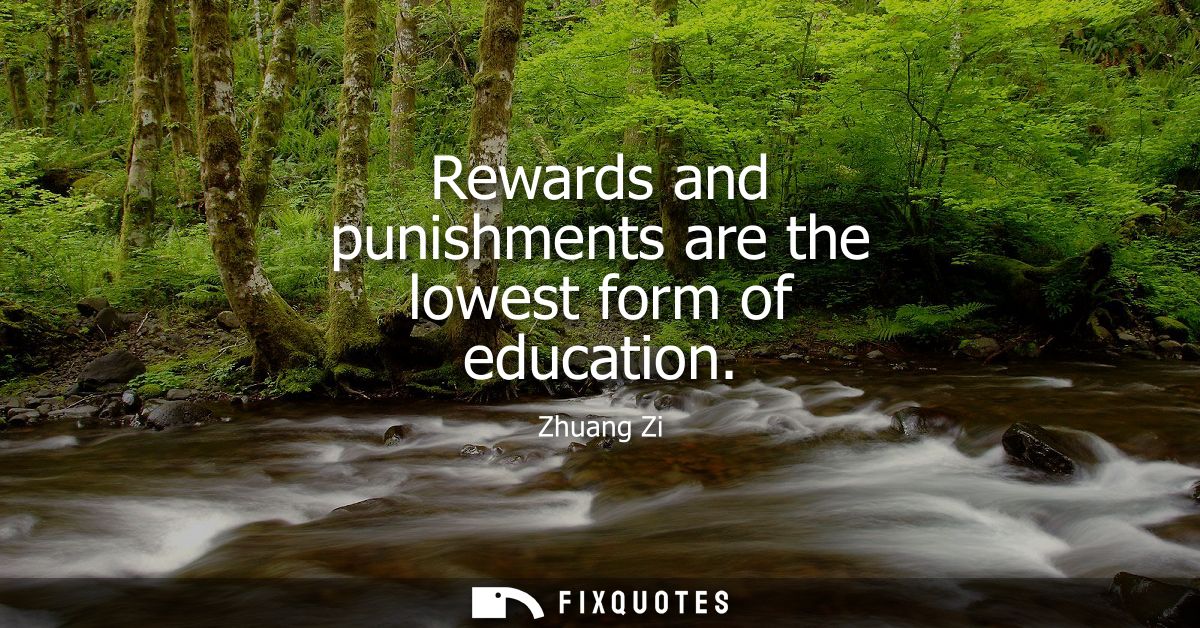
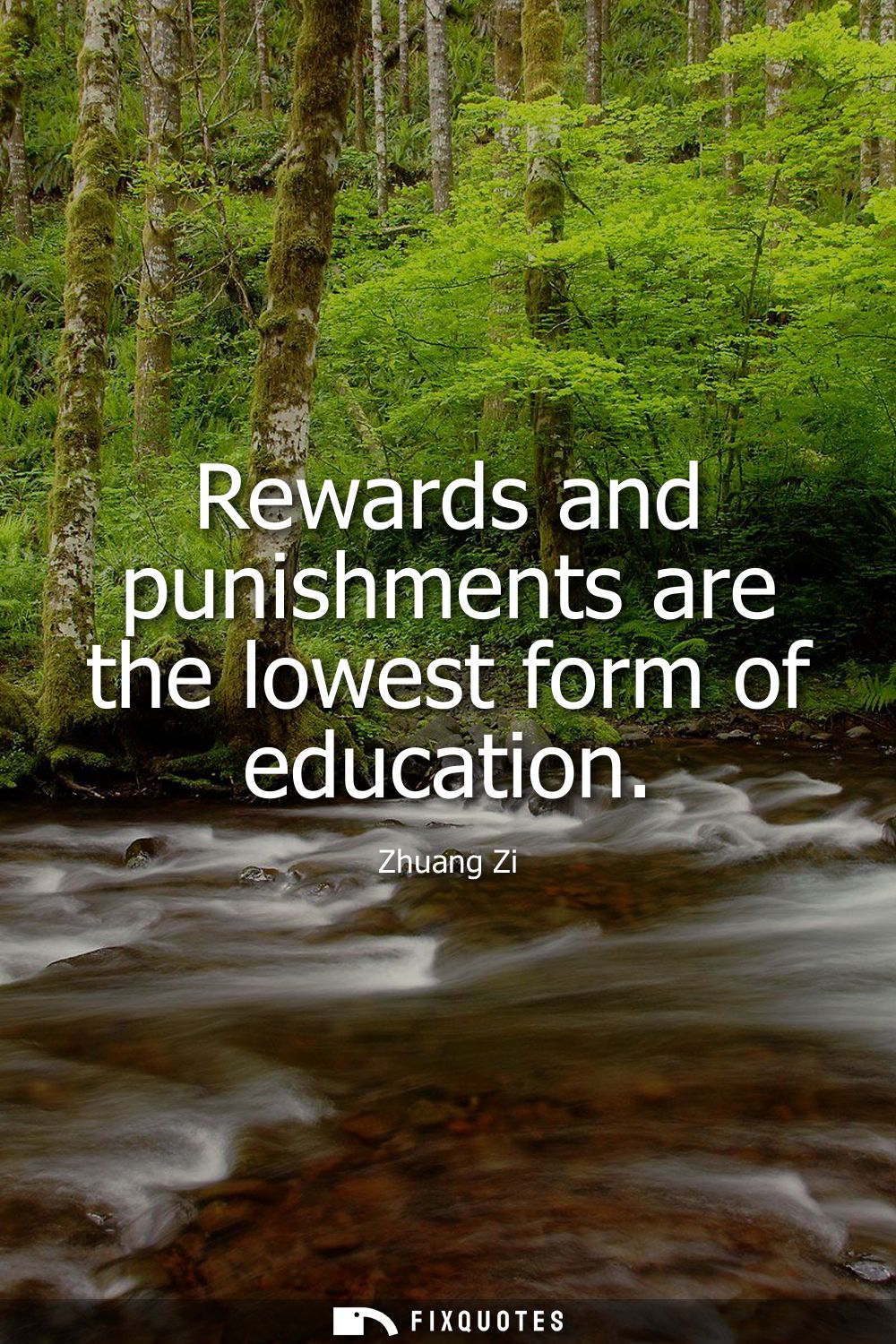
"Rewards and punishments are the lowest form of education"
About this Quote
In Zhuang Zi's hands, "Rewards and punishments" aren’t just crude classroom tools; they’re the whole Confucian project of social management shrunk to a blunt instrument. The line lands like a quiet demolition. It implies that when you teach by dangling treats or threatening pain, you’re not cultivating understanding at all-you’re training reflexes. The student learns the leash, not the path.
The specific intent is to separate genuine transformation from mere compliance. Reward and punishment operate from the outside in: they press behavior into shape without touching the inner currents that Zhuang Zi cares about-intuition, spontaneity, the capacity to move with the Dao rather than perform for an audience. That’s why he calls it the "lowest" form, not an ineffective one. It works, but only in the way a cage works: it produces predictable motion.
The subtext is a critique of how power smuggles itself into moral language. Systems that promise order often rely on a transactional psyche: do this, get that; deviate, suffer. Zhuang Zi hears in that bargain a subtle violence, because it replaces a living relationship to the world with constant self-surveillance. Even "goodness" becomes a strategy.
Context matters: late Warring States China was an era of bureaucratic expansion, codified law, and rival schools offering rulers techniques for control. Against that backdrop, Zhuang Zi’s aphorism reads less like gentle pedagogy and more like resistance literature. He’s warning that the more education is fused to incentives and penalties, the more it stops being education-and becomes administration.
The specific intent is to separate genuine transformation from mere compliance. Reward and punishment operate from the outside in: they press behavior into shape without touching the inner currents that Zhuang Zi cares about-intuition, spontaneity, the capacity to move with the Dao rather than perform for an audience. That’s why he calls it the "lowest" form, not an ineffective one. It works, but only in the way a cage works: it produces predictable motion.
The subtext is a critique of how power smuggles itself into moral language. Systems that promise order often rely on a transactional psyche: do this, get that; deviate, suffer. Zhuang Zi hears in that bargain a subtle violence, because it replaces a living relationship to the world with constant self-surveillance. Even "goodness" becomes a strategy.
Context matters: late Warring States China was an era of bureaucratic expansion, codified law, and rival schools offering rulers techniques for control. Against that backdrop, Zhuang Zi’s aphorism reads less like gentle pedagogy and more like resistance literature. He’s warning that the more education is fused to incentives and penalties, the more it stops being education-and becomes administration.
Quote Details
| Topic | Teaching |
|---|---|
| Source | Help us find the source |
| Cite | Cite this Quote |
Citation Formats
APA Style (7th ed.)
Zi, Zhuang. (n.d.). Rewards and punishments are the lowest form of education. FixQuotes. https://fixquotes.com/quotes/rewards-and-punishments-are-the-lowest-form-of-225/
Chicago Style
Zi, Zhuang. "Rewards and punishments are the lowest form of education." FixQuotes. Accessed February 1, 2026. https://fixquotes.com/quotes/rewards-and-punishments-are-the-lowest-form-of-225/.
MLA Style (9th ed.)
"Rewards and punishments are the lowest form of education." FixQuotes, https://fixquotes.com/quotes/rewards-and-punishments-are-the-lowest-form-of-225/. Accessed 1 Feb. 2026.
More Quotes by Zhuang
Add to List