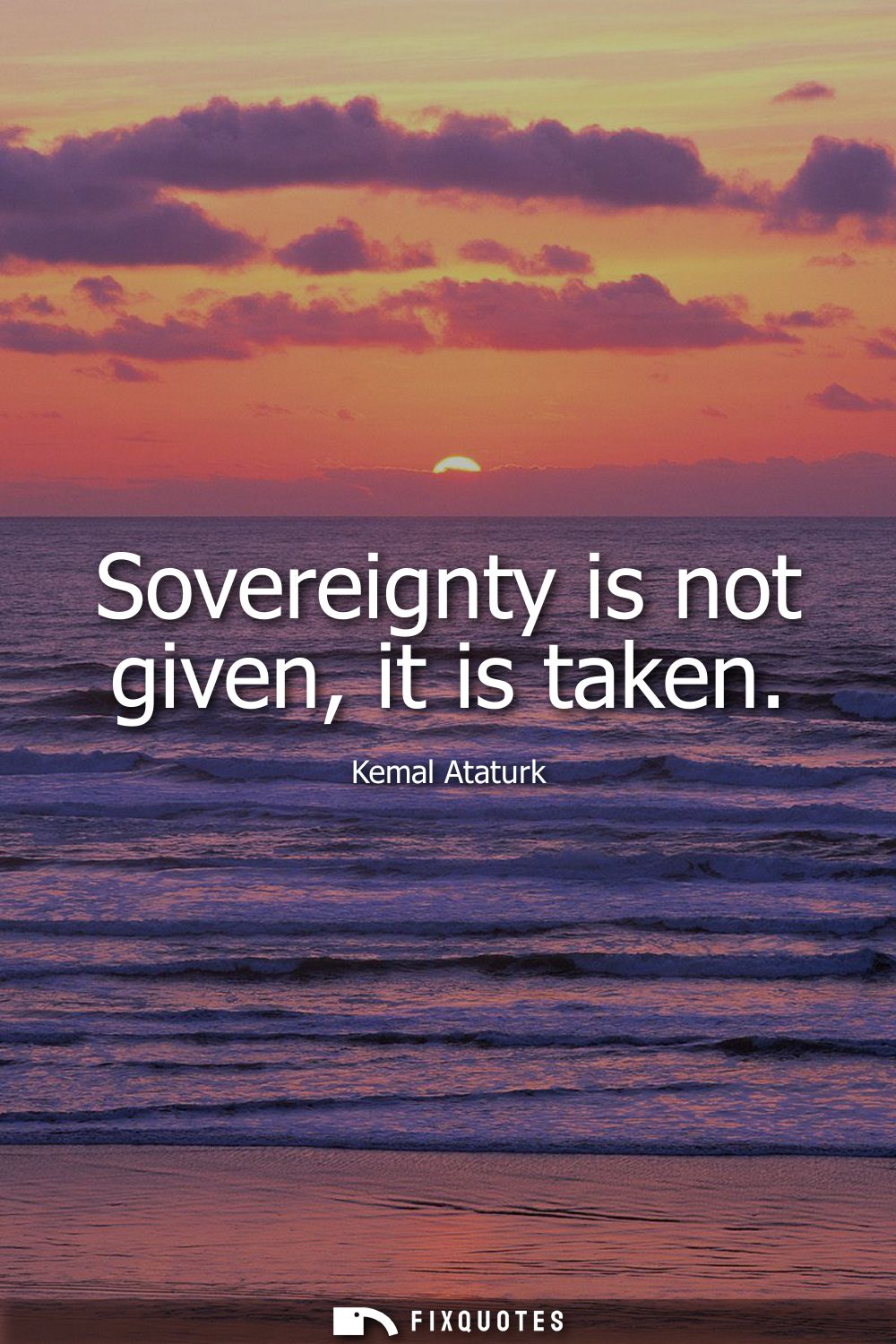
"Sovereignty is not given, it is taken"
About this Quote
“Sovereignty is not given, it is taken” lands like a field order disguised as a philosophy. Ataturk isn’t offering a meditation on political theory so much as a hard-edged diagnosis of how power actually changes hands when empires crack and new states are born. The sentence has the clipped certainty of a soldier: no passive voice, no plea for permission, no faith in benevolent rulers. Sovereignty arrives through organized force, disciplined will, and a population prepared to act like a people - not subjects.
The subtext is aimed at two audiences. To internal skeptics, it’s a warning against waiting for legitimacy to be handed down by sultans, foreign powers, or international conferences. To external arbiters, it’s a refusal to accept that independence is something to be “granted” as a favor - a word that smuggles hierarchy into the moment of liberation. “Given” implies a giver who remains superior; “taken” cancels that relationship and replaces it with self-authorship, even if the cost is confrontation.
Context sharpens the edge. Ataturk’s Turkey emerged from the wreckage of the Ottoman Empire and the humiliations of post-World War I partition plans. In that landscape, sovereignty wasn’t a legal abstraction; it was a contested territory, a mandate system, a border drawn by someone else’s pen. The line works rhetorically because it turns national independence from a diplomatic endgame into a moral posture: if you want modern statehood, act like you already own it, then build the institutions to make that claim real.
The subtext is aimed at two audiences. To internal skeptics, it’s a warning against waiting for legitimacy to be handed down by sultans, foreign powers, or international conferences. To external arbiters, it’s a refusal to accept that independence is something to be “granted” as a favor - a word that smuggles hierarchy into the moment of liberation. “Given” implies a giver who remains superior; “taken” cancels that relationship and replaces it with self-authorship, even if the cost is confrontation.
Context sharpens the edge. Ataturk’s Turkey emerged from the wreckage of the Ottoman Empire and the humiliations of post-World War I partition plans. In that landscape, sovereignty wasn’t a legal abstraction; it was a contested territory, a mandate system, a border drawn by someone else’s pen. The line works rhetorically because it turns national independence from a diplomatic endgame into a moral posture: if you want modern statehood, act like you already own it, then build the institutions to make that claim real.
Quote Details
| Topic | Freedom |
|---|---|
| Source | Help us find the source |
More Quotes by Kemal
Add to List