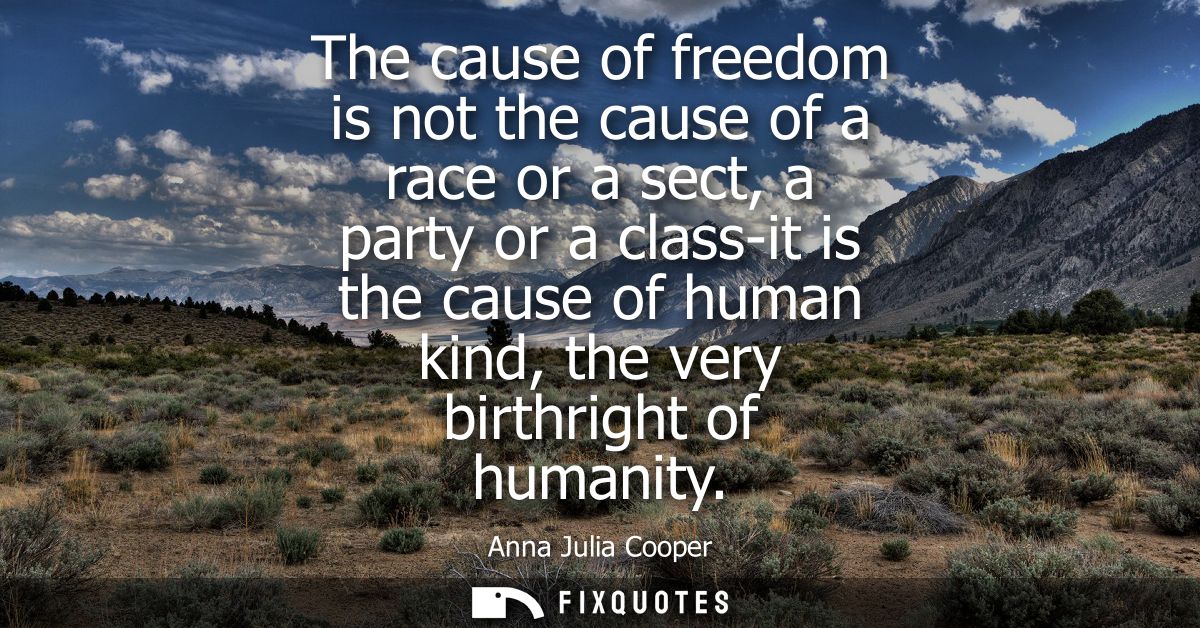
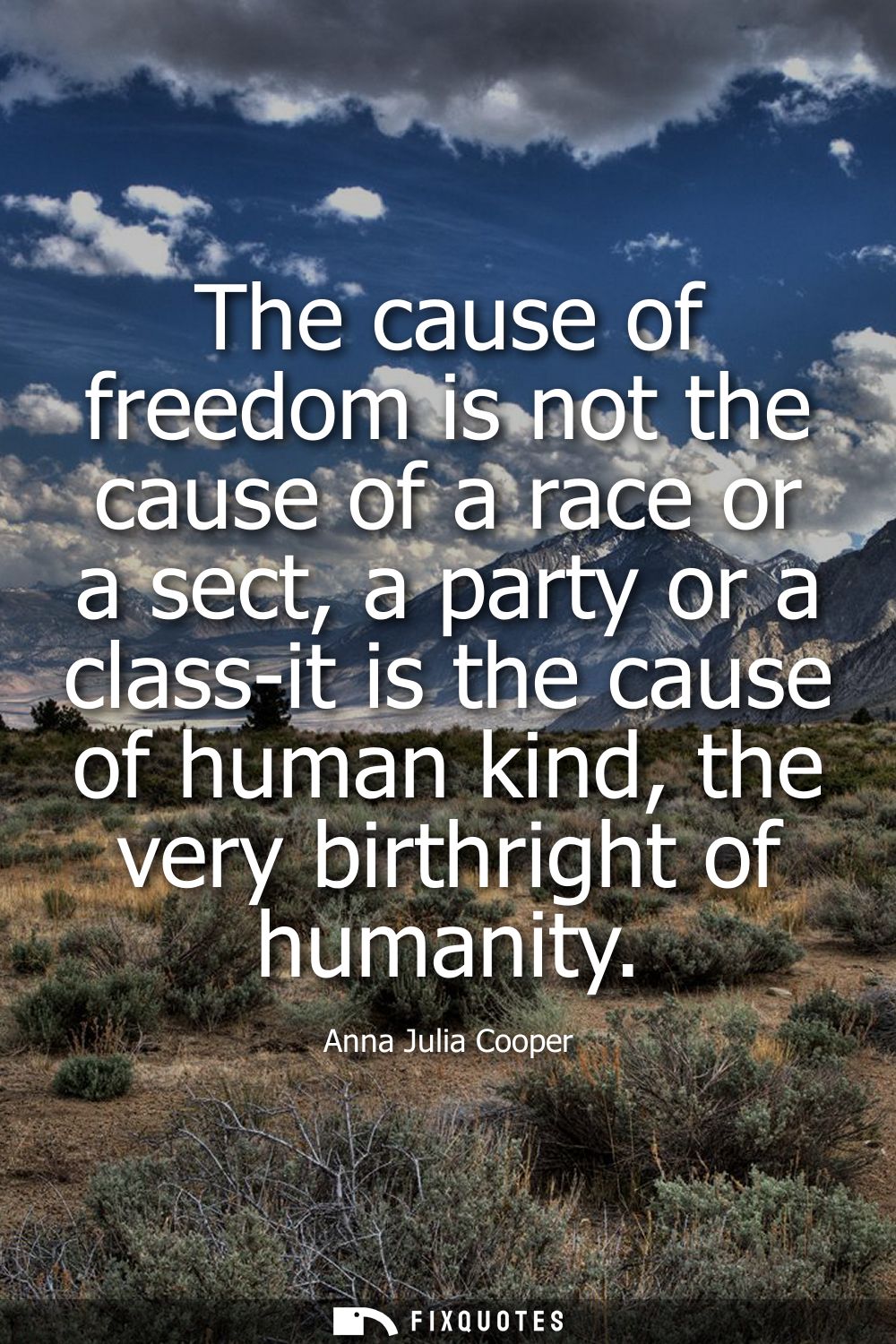
"The cause of freedom is not the cause of a race or a sect, a party or a class-it is the cause of human kind, the very birthright of humanity"
About this Quote
Freedom, Cooper insists, is not a boutique cause - not a banner to be waved by whichever group can claim the most injury or the purest politics. The sentence is engineered to pry liberty loose from the cramped ownership models that dominate public debate: race, sect, party, class. She lists these categories like a set of narrowing rooms, then kicks out the wall. The dash before "it is the cause of human kind" works like a moral reset button, forcing the reader to feel how small our usual factions are compared to the claim she’s making.
The subtext is pointed: movements fracture when they mistake representation for liberation, or when freedom becomes a credential distributed only to the deserving. Cooper, a Black woman educator speaking across the post-Reconstruction era into Jim Crow, knew exactly how often "freedom" was rhetorically promised and practically rationed. Her universal language isn’t naïve; it’s strategic. By framing freedom as "birthright", she borrows the authority of founding-era ideals while indicting a nation that treats those ideals as selective inheritance.
Context matters here: Cooper lived in a United States that loved abstract liberty and feared its concrete implications - voting rights, education, economic autonomy, safety. As an educator, she anchors freedom not in sentimental uplift but in entitlement: something owed, not begged for. The line doubles as coalition politics and moral trap. If freedom belongs to humankind, then any system that denies it to some is not merely unjust - it’s counterfeit.
The subtext is pointed: movements fracture when they mistake representation for liberation, or when freedom becomes a credential distributed only to the deserving. Cooper, a Black woman educator speaking across the post-Reconstruction era into Jim Crow, knew exactly how often "freedom" was rhetorically promised and practically rationed. Her universal language isn’t naïve; it’s strategic. By framing freedom as "birthright", she borrows the authority of founding-era ideals while indicting a nation that treats those ideals as selective inheritance.
Context matters here: Cooper lived in a United States that loved abstract liberty and feared its concrete implications - voting rights, education, economic autonomy, safety. As an educator, she anchors freedom not in sentimental uplift but in entitlement: something owed, not begged for. The line doubles as coalition politics and moral trap. If freedom belongs to humankind, then any system that denies it to some is not merely unjust - it’s counterfeit.
Quote Details
| Topic | Freedom |
|---|
More Quotes by Anna
Add to List