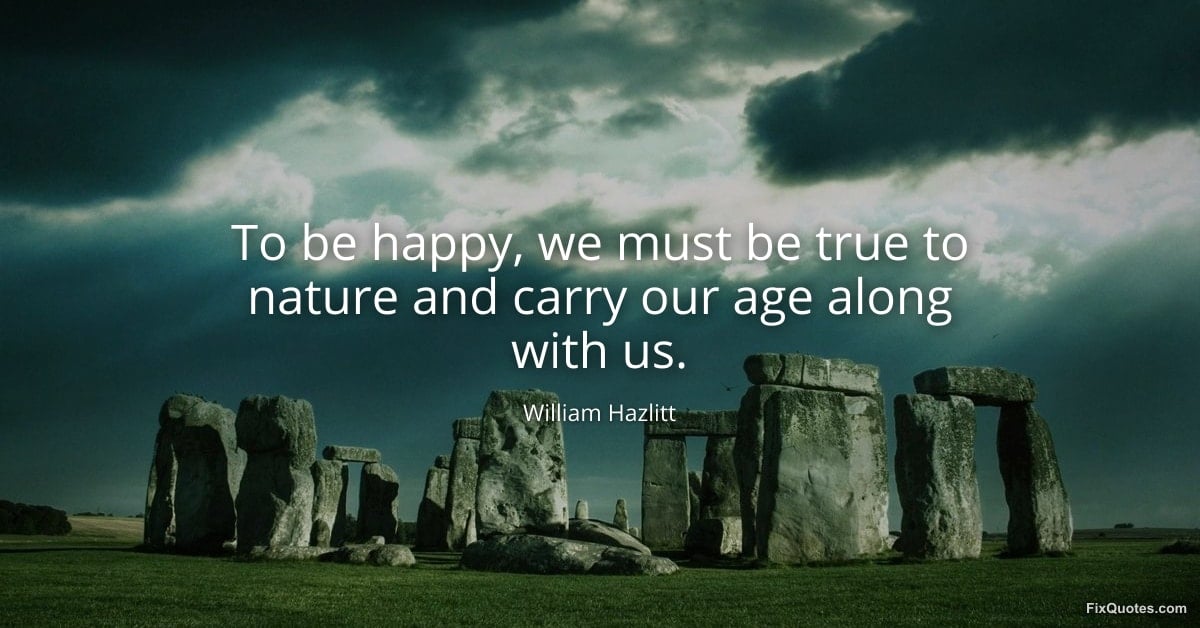
"To be happy, we must be true to nature and carry our age along with us"
About this Quote
The kicker is "carry our age along with us". Age here isn’t a number to be managed but a companion you either acknowledge or drag, resentfully, behind you. Hazlitt’s subtext is that the modern self is always tempted to live in bad faith: to treat youth as moral capital, to measure worth by freshness, to keep remaking the persona so the mirror stays flattering. He frames acceptance as forward motion, not resignation. You "carry" age the way you carry experience: integrated, visible, useful.
Context matters. Writing in the early 19th century, Hazlitt sits at the hinge between Enlightenment rationalism and Romantic self-fashioning, when sincerity was becoming a cultural fetish and public identity was increasingly performative (in salons, in print, in politics). His intent is quietly polemical: against vanity, against nostalgia, against the fantasy that happiness is a loophole in the human condition. The sentence works because it refuses the usual consolations. It offers no glow, just a clean bargain: peace comes when you stop trying to subtract yourself from time.
Quote Details
| Topic | Happiness |
|---|---|
| Source | Help us find the source |
| Cite | Cite this Quote |
Citation Formats
APA Style (7th ed.)
Hazlitt, William. (2026, January 14). To be happy, we must be true to nature and carry our age along with us. FixQuotes. https://fixquotes.com/quotes/to-be-happy-we-must-be-true-to-nature-and-carry-78924/
Chicago Style
Hazlitt, William. "To be happy, we must be true to nature and carry our age along with us." FixQuotes. January 14, 2026. https://fixquotes.com/quotes/to-be-happy-we-must-be-true-to-nature-and-carry-78924/.
MLA Style (9th ed.)
"To be happy, we must be true to nature and carry our age along with us." FixQuotes, 14 Jan. 2026, https://fixquotes.com/quotes/to-be-happy-we-must-be-true-to-nature-and-carry-78924/. Accessed 3 Feb. 2026.